Showing posts with label Ben Reilly. Show all posts

Tuesday, 3 November 2009

70 Years of Marvel - 1996


1996 was a crunch year for Marvel. While the X-Titles were doing ok, the Spider-Books were embroiled in the seemingly-everlasting Clone Saga, and the Avengers were just emerging from The Crossing, a crossover event which had seen Tony Stark go evil, the Wasp turned into a real giant-size woman-bug, and many readers jumping ship. Captain America, written at the time by Mark Waid, was well-regarded, but nothing spectacular, sales-wise. And the Fantastic Four had been lumbering along under Tom DeFalco's guidance for years. With sales crashing all over as a result of the end of the speculator boom, Marvel wanted to try something radical.

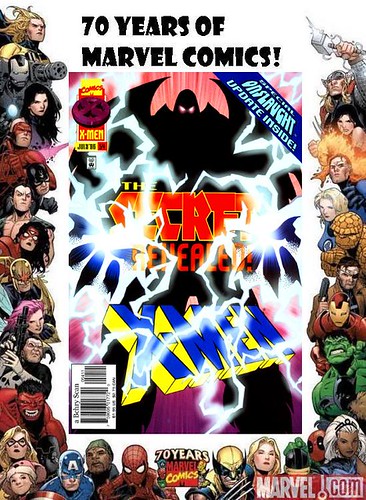
Their answer was Onslaught, an ultra-powerful mutant (with a dark secret) who tried to destroy the world. A couple of months of group-wide crossovers led to a final battle, in which the Avengers and the FF sacrificed themselves to stop Onslaught. The public, seeing their heroes killed, blamed mutantkind, and the X-Men's lives got that little bit more difficult.

But the Avengers and the Fantastic Four weren't dead. Oh no, not at all. Instead, they faced a worse fate: outsourcing! Marvel hired Jim Lee and Rob Liefeld, founders of Image Comics, to "reimagine" the two teams, in the Image style. So it was farewell to the classic Marvel style, and hello to this...
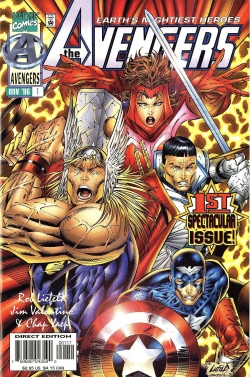
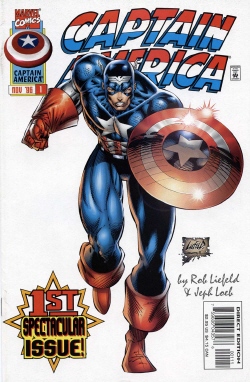
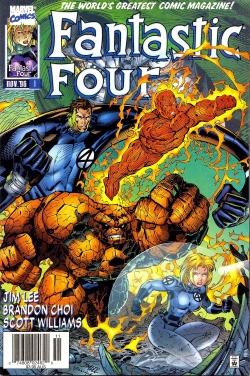
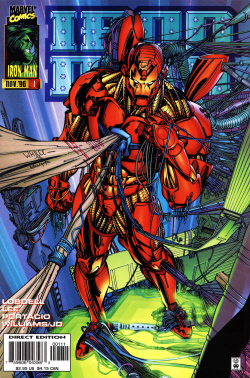
It worked, after a fashion. Sales went through the roof, and everyone was talking about Marvel again. And that the the books weren't very good didn't really matter. After a year, the books would revert to being written and drawn in-house, with yet another set of #1 issues. And because each restart was accompanied by a bump in sales, we could henceforth look forward to pretty much every Marvel title restarting every couple of years.

In other comics news, the Clone Saga did eventually finish, at the end of this year, accompanied by the return of Norman Osborn. It says something for how much people were tired of the whole clone thing, that the resurrection of Spidey's most famously dead arch-nemesis seemed like a pretty neat idea. 13 years on, and with Norman appearing in pretty much every comic pretty much every month, it doesn't seem like such a winning plan.

1996 was also the year of Amalgam Comics, in which Marvel and DC Comics collaborated on a shared universe, with characters made up of blends of both companies' heroes and villains.
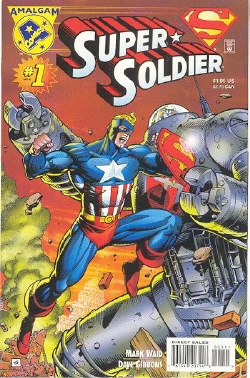
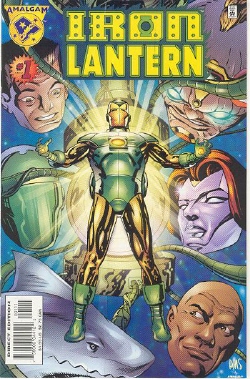
A novel idea amongst a sea of detritus, Amalgam Comics managed two runs, in '96 and '97, before vanishing without trace.

Sunday, 1 November 2009

70 Years of Marvel - 1995


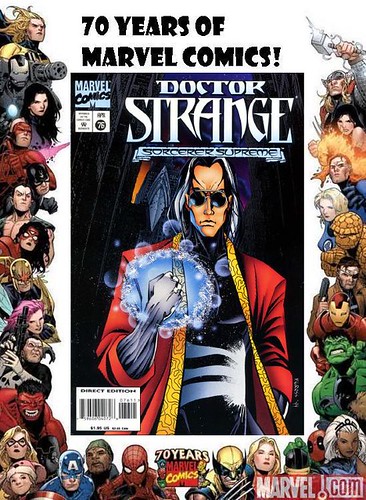
Some new looks last longer than others. In 1995, Dr Strange changed from his Jason King look (one which pre-dated Jason King by several years) to this rather stylish persona. This was the tail end of a run on Strange by David Quinn, which had seen the good doctor lose the title of Sorcerer Supreme, become split into three seperate people, and fall out with most of his friends - who would presumably have warned him off adopting such a terrible look. By the end of the year, Quinn was out, and Warren Ellis was in, briefly, to restore Strange to his classic look. This wouldn't be enough to save the book from cancellation. Strange fans are still waiting for him to get another shot at headlining his own book.

1995 also saw the Spider-books dominated by the Clone Saga, with Peter Parker "revealed" to be a clone, and Ben Reilly "revealed" to be the real Peter Parker. By year's end, the saga had outlived its usefulness, but as long as sales remained good, the clone story would drag on. Fans of the original Spider-Man could still get their fix of him, but only in flashback tales, such as the Untold Tales of Spider-Man, a lovely little book from Kurt Busiek, which filled in gaps in Spider-Man's first couple of years.

The X-Books took a four month break this year, with the Age of Apocalypse displacing the "real" universe. A neat concept, showing a world in which Professor X had died, and the consequent changes to the world. Unfortunately, as with all neat ideas, it's a well which successive writers have gone back to, again and again. The AoA was responsible for the introduction of Nate Grey, a parallel version of the character with the most confusing backstory ever, just to make things a bit more opaque.

Finally, this was also the year in which Nick Fury was really, truly, incontravertrally, killed off. Not a dream, not an imaginary story, not a clone, and absolutely, definitely, not a robot duplicate. Gone for good. Or, at least, until 1998, when editorial fiat demanded he be brought back to life. And their clever explanation for this resurrection: he was never dead, it was a robot duplicate. God bless the revolving door of death, and the boundless ability of comics readers to accept this sort of nonsense.

In the real world, the Manic Street Preachers lost their muse. The millions of pounds they would make in the next few years may have softened the blow. In Oklahoma, Timothy McVeigh blew up a federal building, killing 168 people. And OJ Simpson was definitely not guilty of murdering his ex-wife and her boyfriend.

Saturday, 31 October 2009

70 Years of Marvel - 1994


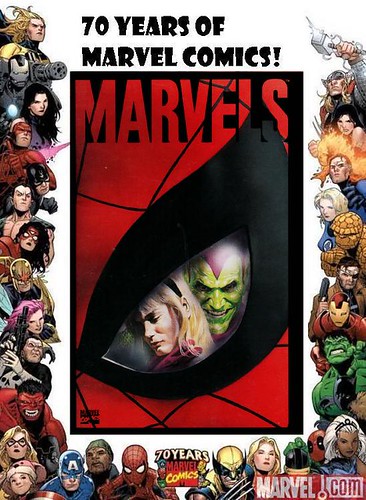
Can you believe there was a time when we weren't all just a bit tired of Alex Ross' painted artwork? Or when hardly anyone had heard of Kurt Busiek? Marvels made stars of both men, and deservedly so. A retelling of some of the most iconic moments from the 60s and 70s of Marvel Comics, through the cynical eyes of a photojournalist, Marvels managed to make events like the coming of Galactus and the death of Gwen Stacy come to life in a way that even Jack Kirby and Gil Kane could only dream. Like all classics, it's probably a bit overrated, but it holds up a damn site better than most modern classics, much like the source material that Busiek and Ross were studying.

1994 was also the year that saw Avengers West Coast shut down and replaced with the much more EXTREME Force Works. It featured some of the earliest Marvel US work by the 2000AD team of Dan Abnett and Andy Lanning, who would do much better on books to come. Mostly made up of disaffected ex-Avengers, Force Works handled cases too EXTREME for other super teams. I'd take the piss out of this more, but it doesn't really deserve it. Not compared to the awful terribleness that was Fantastic Force, an attempt to create an FF franchise. This starred mysteriously grown-up Franklin Richards leading a team of heroes so obscure that they arrived without trace, and vanished the same way a year or so later. Interestingly, the team was brought together by the Black Panther, who somehow managed to wriggle out of membership. Good choice, T'challa.

Less terribly awful, at least at first, was Generation X, an attempt at the whole "mutant kids learning to adjust to their powers in a school environment" concept, that the New Mutants had tried a decade or so back. This saw the transformation of Emma Frost from White Queen of the Hellfire Club to the sarcastic schoolmistress we've all come to know and love.

Another new book, and one which whilst somewhat better regarded, would vanish without trace after barely a handful of issues, was Clan Destine, Alan Davis' follow-up to his Excalibur work. Quirky does not usually equate with longevity, and this was no exception.

Oh, and was there something else? I'm sure there was some other event. Oh, yes, of course. Spider-Man began to share book space with a young man calling himself Ben Reilly. Disaster lay ahead...

In the real world, or close to it, Kurt Cobain broke teenage grunge hearts all over the world, Ayrton Senna crashed into a wall at 135mph, and John Smith died, giving God's Gift To Labour a chance to rule Britain in a couple of years.