Showing posts with label Steve Englehart. Show all posts

Tuesday, 6 October 2009

10 Second-Stringers

Following up on yesterday's post, I thought it'd be nice to take a closer look at these guys, a posse of criminally underexposed characters introduced in 1974, who, if not for the cult of Wolverine, might well be far more respected in comics circles. Or they might not. You judge...


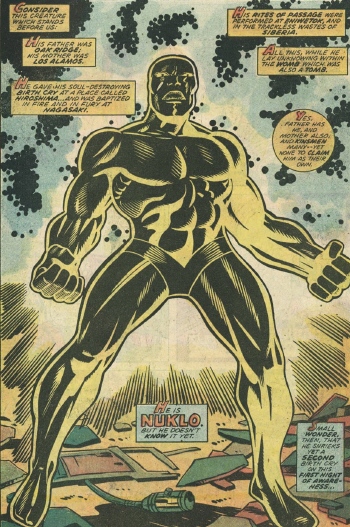
Nuklo was the son of a couple of golden age heroes, and briefly, the brother of Quicksilver and the Scarlet Witch. Created by Roy Thomas in the pages of Giant-Size Avengers, Nuklo, unfortunately, possessed the power of being highly radioactive, which probably scuppered his chances of joining any of the big-name teams. So naturally, he ended up appearing in the pages of Thunderbolts later on.
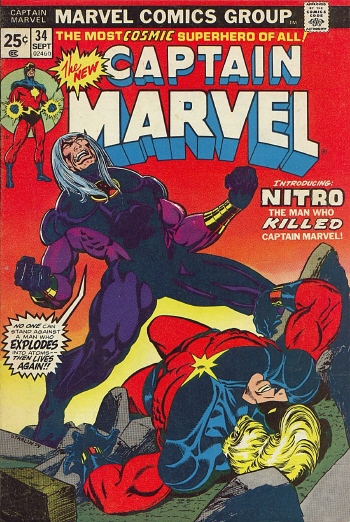

Created by Jim Starlin and Steve Englehart, Nitro's proved one of the more successful of the class of 1974. Not only was he indirectly responsible for the death of Captain Marvel, who died as a result of an illness contracted during this very issue, but, depending on your viewpoint, he was either indirectly or directly to blame for the disaster which led to Marvel's Civil War a couple of years back.
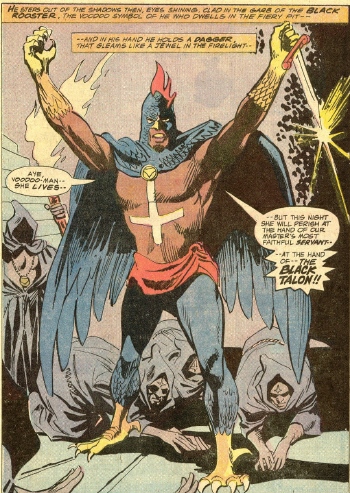
No, your eyes are not deceiving you, unfortunately. That really is a man dressed up as a giant chicken. To be fair, he is a voodoo priest, so a chicken costume is not entirely inappropriate, but I'm not sure most comics readers are discerning enough to take that look seriously. Time remains to tell whether Black Talon ( a creation of Len Wein and Gene Colan) will once again show up as a foe of Brother Voodoo, now that he's the Sorcerer Supreme.
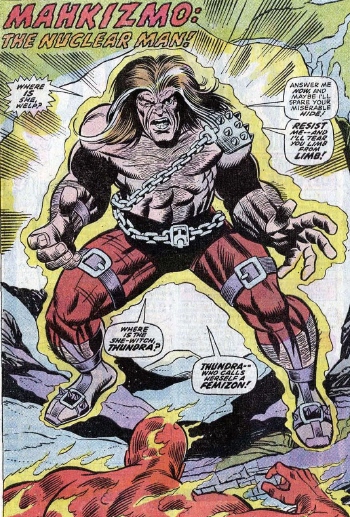

Oh, my... Mid-70s Marvel was many things, but subtle it wasn't. Mahkizmo, the Nuclear Man, came from an alternative future world where men enslaved women, a world at war with another alternative world, this one the female-dominated world of Thundra. Created by Gerry Conway and Rich Buckler, Mahkizmo disappeared after his first appearance, only resurfacing when She-Hulk author John Byrne was looking for some bottom of the barrel villain to make fun of.
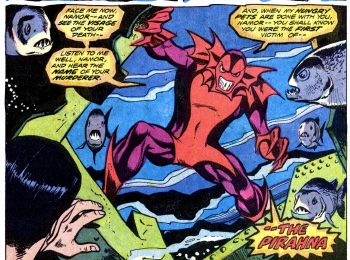

OK, so they can't all be winners. Marv Wolfman and George Tuska brought the Piranha into the pages of Sub-Mariner, as they were beginning to seriously run out of good ideas. Originally, a real piranha fish, this chap was mutated by radiation during one of Subby's many battles, and, rather than count his blessings, Piranha decided to hunt down Namor. Other than a couple of guest shots in the Defenders, alongside other fish-based foes, he's never been seen since. Good.
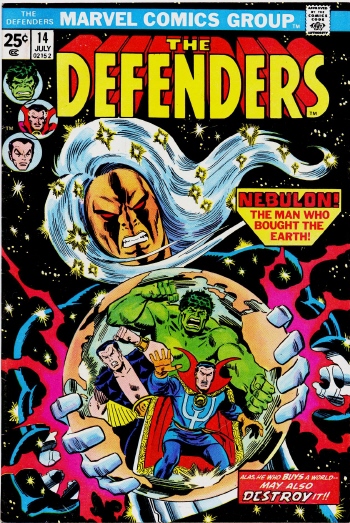

And talking of the Defenders, here's Nebulon. Introduced by Len Wein and Sal Buscema, Nebulon made a couple of half-hearted efforts to conquer the Earth, before vanishing into the mists of time.
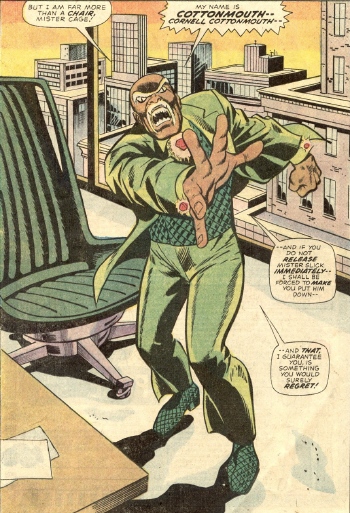
Luke Cage had some wacky bad guys in the early days of his title. Created by Len Wein (him again) and George Tuska (and him again), Cottonmouth was a drug-dealer with ambition, a taste for snake skin shoes, and, when the occasion demanded, a bazooka. Like so many other animal-themed characters, he seems to have been a one-shot character, with his name being pinched later by a member of the Serpent Society.
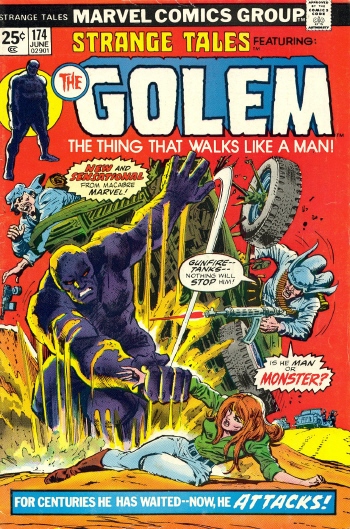

From the mailbox: "It had to happen. Marvel was first among comics publishers to feature black superheroes - and villains. Marvel was first to recognise the women's movement in comics with characters like the Black Widow. And now, in this issue of STRANGE TALES, we're proud to introduce the comics' first Jewish monster-hero. Needless to say, we're looking forward to your reactions[]. So ... grab a sheet of paper or a post card or last week's leftover bagel and WRITE!!" I think you can guess how filled-to-the-brim the Mighty Marvel Mailbag was that week. Brought to the world by Len Wein (it's that man again) and John Buscema, the Golem lasted all of three months, before vanishing for the rest of the century.
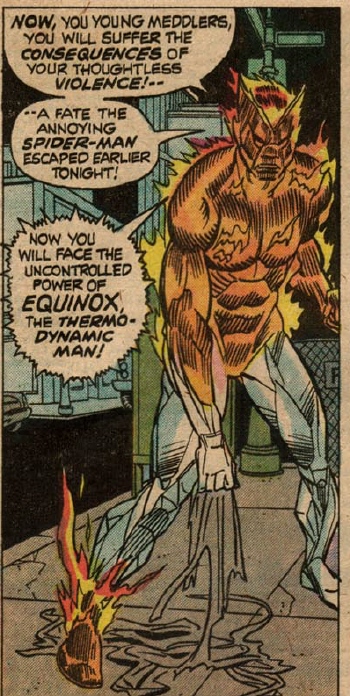

Jeez, Len Wein gets about, doesn't he? Equinox, a curious blend of the power of fire and ice, turned up a few times in the pages of Marvel Team-Up, and even showed up a couple of years ago during the Secret Invasion, but despite having one of the more interesting visual looks of the era, never really seems to have found his groove.
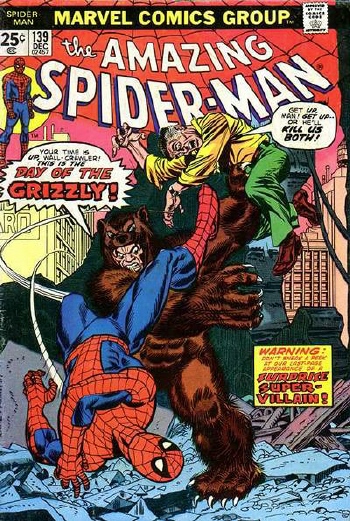

Brought to us courtesy of Gerry Conway and Ross Andru, Grizzly must be the character who must resents the ol' Canucklehead. I mean, look at the guy. With that surly attitude, coupled with the ridiculous costume, he must have reckoned he had at least as good a chance as Wolverine of making the big time. If not for a quirk of fate, Grizzly could have found himself on the cover of Giant-Sized X-Men #1, and we might now be reading three or four monthly books about the exploits of the world's favourite ex-wrestler. There's no justice.

So there you have. Ten of the, er, best creations of 1974 who didn't go on to become superstars. I like to think that in some parallel universe, these guys are world-famous, with legions of fans. Well, except for Piranha. That guy sucks.

Sunday, 4 October 2009

70 Years of Marvel - 1973


1973 saw the Black Panther, after guest-starring in pretty much every title out there, finally get a shot at his own book. This was the start of "Panther's Rage", a 13-parter which, these days, is recognised as ground-breaking in terms of being a very early example of a graphic novel. "Panther's Rage" was written by Don McGregor, in virtually his first work for Marvel, and, like a lot of Panther books, was able to push the creative envelope, safe in the knowledge that most people wouldn't be reading it anyway.

Elsewhere in 1973, the Titan priestess-turned-hero, Moondragon, was making her presence felt, although for reason best know to herself, was dubbing herself Madame MacEvil at this point. Meanwhile, her father, Drax the Destroyer, was also turning up, as another new writer, Jim Starlin, began introducing more and more cosmic elements to Marvel's books. Vampire-slayer, Blade, began hunting down Dracula, and martial-artist Mantis, Celestial Madonna-to-be, debuted in the pages of the Avengers. In the newly-revived Strange Tales, Len Wein and Gene Colan were introducing Brother Voodoo, a young man with a big future, whilst in the pages of Adventure In Fear, a book starring the monstrous Man-Thing, a duck named Howard was making his debut. The Son of Satan was making his first appearance, in the pages of Ghost Rider. Another famous son, this time, Shang-Chi, Master of Kung Fu, and son of Fu Manchu, was making his first appearance. And Marvel was bringing one of its first big crossovers, as Steve Englehart brought us the Avengers-Defenders War! Yoinks!

In the real world, 1973 saw Nixon, in the face of overwhelming evidence to the contrary, "I am not a crook." Meanwhile, his VP, Spiro Agnew, was being convicted of tax evasion. Happy days.

On the tv, Last of the Summer Wine started, bringing the hilarious exploits of three ancient Yorkshiremen to anyone too lazy to change channels. We were also treated to the almost equally hilarious exploits of the cast of Are You Being Served, while over in America, the Six-Million Dollar Man was making his debut. Meanwhile, at the pictures, The Exorcist was terrifying witless teenagers, and Yul Brynner was a psychotic android in Westworld.

Saturday, 3 October 2009

70 Years of Marvel - 1972


Spoiler: no he didn't.

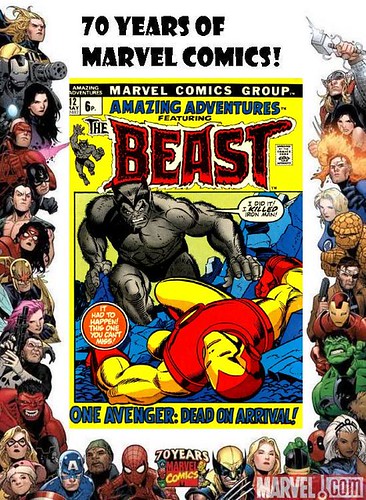
Amazing Adventures had been launched a couple of years earlier, as a vehicle for the Inhumans and the Black Widow, but by 1972, they'd been turfed from the title, in favour of the X-Men's Beast, now transformed into a furry monster. Written first by Gerry Conway, then by Steve Englehart, who would later introduce him to the Avengers, the furry Beast has fluctuated between furry and human ever since. Currently he's a big cat. Go figure.

Amazing Adventures itself would shortly become home to post-apocalypse hero, Killraven, who would be the book's star for the remainder of its run. More on him later.

1972 also saw the first appearance of Werewolf By Night, the launch of a new Ghost Rider, and the arrival of Dracula in the Marvel Universe, as the 70s Horror Onslaught began. As if that wasn't enough, that year also saw the debut of (Sweet Christmas!) Luke Cage, Hero For Hire. Marvel also introduced 3 more girl heroes: Ka-Zar-wife-to-be, Shanna the She-Devil, Night Nurse, who , after a four-issue run in her own title, would vanish into obscurity for the remainder of the 20th century, and the Cat, who would become better known in later years as Tigra.

In the real world, some important stuff probably happened, but since it was also the year that I was born, damned if I'm letting anyone else share my day.

Sunday, 20 September 2009

70 Years of Marvel - 1959


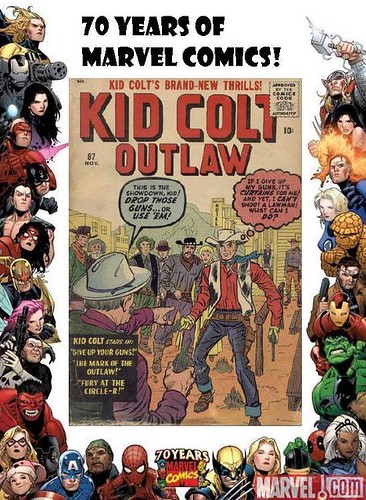
Kid Colt, wikipedia tells me, is "the longest-running cowboy star in American comic-book publishing, featured in stories for a 31-year stretch from 1948-1979". Although, as it hastens to add, it was pretty much a reprint book from 1966. Observant viewers may note that the issue above, #87, features cover art by one Jack Kirby, who was about to become something of an overnight sensation.

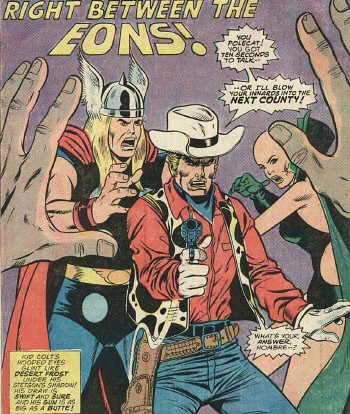
Like other early Marvel characters, Kid Colt was introduced into the Marvel Universe, once again by Steve Englehart, who seems to have made a career looting past glories of Marvel:


Kid Colt's appearances have been sporadic over the years, but he's not going to complain. Not after what happened to his pal, the Rawhide Kid.

So, other than Kid Colt celebrating 11 years in publication, what else happened in 1959? Well, Castro was taking over in Cuba. Whatever happened to that guy? Buddy Holly, Ritchie Valens and The Big Bopper were killed in a plane crash. And the international community decreed that Antarctica should become a protected region, thus saving the world forever.

In France, Asterix turned up. Meanwhile, William Burroughs was writing the Naked Lunch, and Robert Bloch was writing Psycho. Juke Box Jury was starting up on tv, as were Bonanza (in colour, no less!) and the Twilight Zone. At the movies, Chuck Heston was starring as Ben-Hur. Cary Grant and James Mason were opposing forces in North by Northwest. But more important than that, Ed Wood's soon-to-be-the-most-famous-bad-film-in-history, Plan 9 From Outer Space, was out!

Thursday, 17 September 2009

70 Years of Marvel - 1956


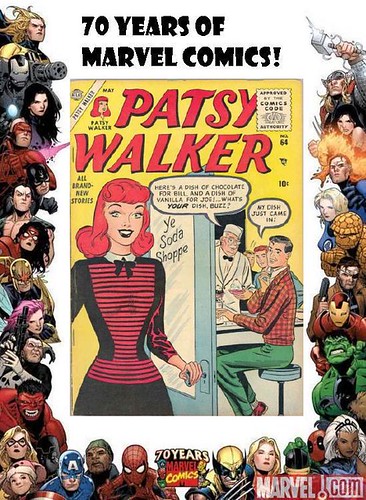
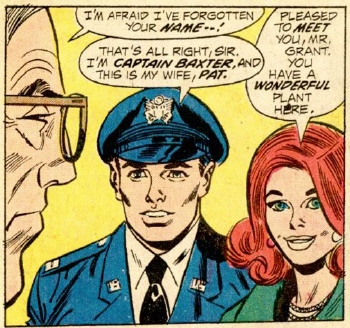
Patsy Walker has been around since 1944, and began as an attempt by Timely-Marvel to copy the success of their Millie the Model title. It worked: Patsy had her own book well into the 60s, through the whole Atlas era and into the Silver Age of superheroes. She clearly had her own fan base in the 60s Marvel bullpen, as Lee and Kirby gave her a cameo appearance at the wedding of Reed Richards and the Invisible Girl.

Even after her own book ended, she wasn't finished, as Steve Englehart brought her, and her husband, back, as guest stars in his run on Amazing Adventures in 1972.


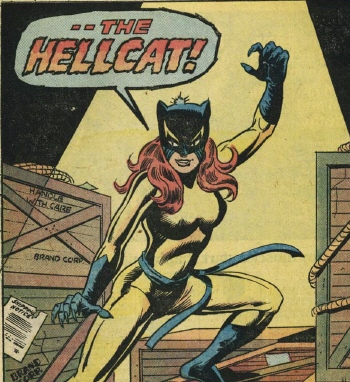
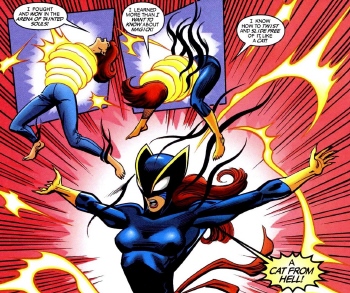
A couple of years later, Englehart reintroduced Patsy, having her help out the Avengers against her soon-to-be-ex-husband and his employers. Along the way, Patsy somehow gained a costumed identity.

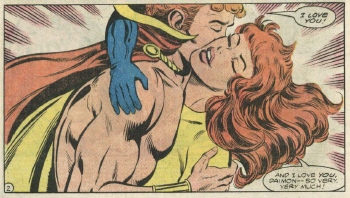
A couple of years after that, Gerry Conway, in pretty much his last act as writer of the Defenders, would bring Patsy / Hellcat to the team, where she would spend the remainder of the 70s and half of the 80s, before leaving the team to settle down with her new husband, Daimon Hellstrom, the Son of Satan.


Patsy and Daimon languished in obscurity together, until 1993, when Hellstorm got his own book (it was the 90s, pretty much everyone in the Marvel Universe had their own book. I'm surprised Irving Forbush didn't have his own book). Fans of Patsy would probably be disappointed by her first appearance in Hellstorm...


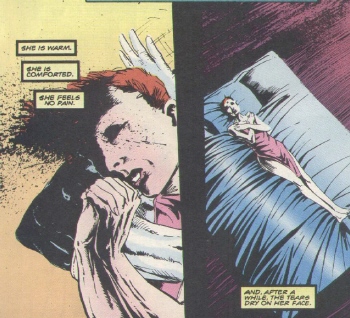
Then later, Warren Ellis got hold of the book. And killed her off.


But this being comics, even that didn't stop the Powers-What-Be from using the character. Firstly, she was rescued from hell by the Thunderbolts.


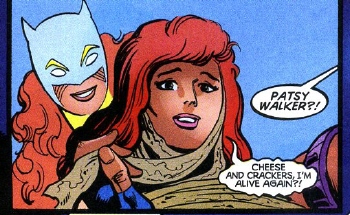
And then, courtesy of long-time fan, Steve Englehart (it's that man again!), she got her own book again, albeit briefly.

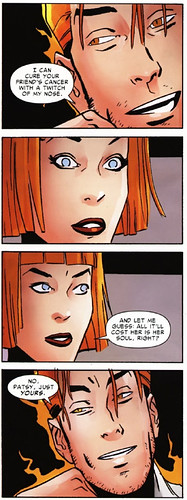
And now, in 2009, in these days of Civil Wars and Secret Invasions, when everything's grim and gritty, and just when you think Patsy has nothing to offer anymore, she's back in a thinly-veiled "homage" to Sex and the City.

Honesty, whatever next?

Anyway, elsewhere in the real world in 1956, the people of Europe were thrilling to the first Eurovision Contest. Sadly, no Terry Wogan. Two planes collided in mid-air above the Grand Canyon, Egypt nationalised the Suez Canal, and frogman "Buster" Crabb vanished in Portsmouth harbour, sparking a flurry of conspiracy theories.

In the world of entertainment, Elvis was staying at the Heartbreak Hotel, Invasion of the Body Snatchers was on at the pictures, David Niven was going Around the World in 80 Days, and musical fans could go see The King And I with Yul Brynner. But only if he wasn't busy. Boom boom.

On the small screen, Tony Hancock was making the move from radio to telly, and Hughie Green was introducing Opportunity Knocks, without which we might well be spared half the tripe on Saturday night tv. At the library, one could pick up a copy of Gerald Durrell's My Family and Other Animals, whilst theatre-goers could see a very young Alan Bates starring in Look Back in Anger. Something for everyone there, I'm sure you'll agree.