Showing posts with label Human Torch II. Show all posts

Friday, 2 October 2009

70 Years of Marvel - 1971


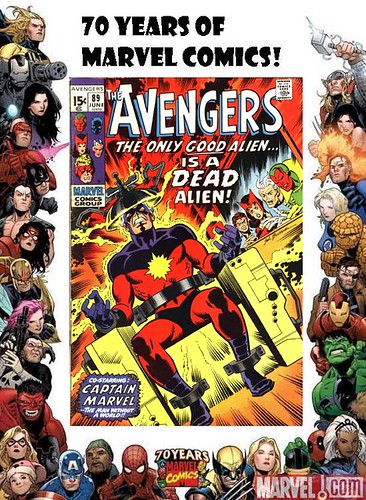
1971 saw the start of one of Marvel's most famous sagas, the cosmos-spanning Kree-Skrull War, in which the Avengers - aided by the Kree exile, Captain Marvel, learned of a centuries-long conflict between the two most prominent alien races in the Marvel Universe, and, in their efforts to avoid Earth being devastated by the war, found themselves being drawn deeply into it. On the way, Roy Thomas got to bring back (albeit briefly) a number of golden age heroes:
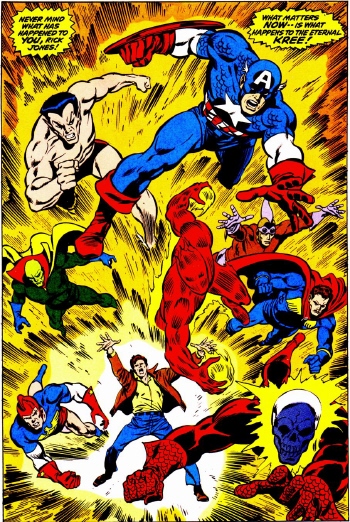

Clockwise, from Captain America, we have the Fin, the Human Torch, the Angel, the Blazing Skull, perpetual sidekick Rick Jones, the Patriot, the original Vision, and of course the Sub-Mariner, all serving as a reminder of the glorious (by this time 32 year) history of the Marvel Universe.

Elsewhere in comics, 1971 saw the introduction of super-psychiatriast, Doc Samson, who would spend the next few years hunting the Hulk. It would also see Spider-Man briefly transformed into a literal man-spider, and the debut of the not-quite-a-vampire, Morbius and the not-quite-Swamp-Thing, Man-Thing, as Marvel chanced their arm to see what the Comics Code Authority would allow. But possibly most earth-shattering of all, 1971 saw the arrival of the world's greatest non-team, the Defenders, as the Hulk teamed up with the Sub-Mariner and Dr Strange to face Yandroth's greatest challenge: the Omegatron! Ooh, scary!

In the real 1971, Britain dropped the old pounds-shilling-pence system, in favour of something which people could actually understand. The World Trade Center, then the tallest building in the world, was completed. The UK government launched Operation Demetrius, interring people suspected of being members of the IRA. And DB Cooper became a legend.

Entertainment-wise, one could pick from buying Led Zeppelin IV, reading The Day of the Jackal, watching The Two Ronnies on the telly, or, if one was quick, catch A Clockwork Orange at the pictures.

Monday, 14 September 2009

70 Years of Marvel - 1953


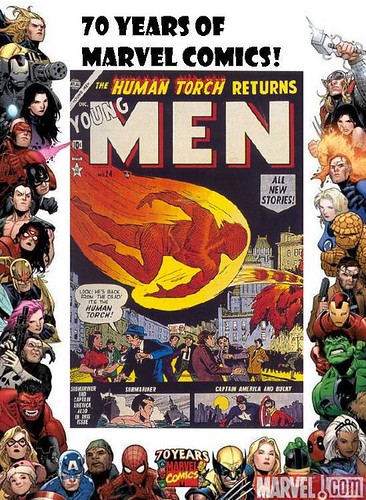
Young Men #24 saw the return of the superheroes, as Marvel-Atlas tried another throw of the dice. The return of Captain America, Sub-Mariner and the Human Torch would be short-lived, since no-one seemed much interested in superhero books. In a couple of years, DC Comics would start a big push on superhero titles, and things would turn around, but for now, super-books were very much on the periphery.

1953 saw the end of the Korean War, but the Cold War was in full swing: America had made the first hydrogen bomb, the Rosenbergs were being executed as Russian spies, and Stalin was dying, or depending on who you believe, being assassinated. Britain and the US were overthrowing the government of Iran

At the movies, Burt Lancaster was starring in From Here To Eternity, Brando was playing Julius Caesar, and more importantly, Daffy Duck was starring in Duck Dodgers in the 24½th Century. On the telly, Patrick Troughton was playing Robin Hood, The Quatermass Experiment was in progress, and topical news prog, Panorama, was beginning a run on BBC tv which continues to this day. Meanwhile, Ian Fleming was writing the first adventure of a certain well-known British secret agent. And the first issue of Playboy was out.

Monday, 31 August 2009

70 Years Of Marvel - 1939

So, apparently, Marvel Comics is 70. Which is odd, because in 1986, it was 25. Mind you, Marvel's idea of the passage of time has always been fluid, whether it be the sliding 10-15 year timescale of the Marvel Universe, or confusion over what came first, 1954 or 1961 (just ask Alan Moore). Anyway, in tribute to this alleged anniversary, and in order to fill up some space on the internet, here's the first in a hopefully daily look at Marvel through the years, beginning with...


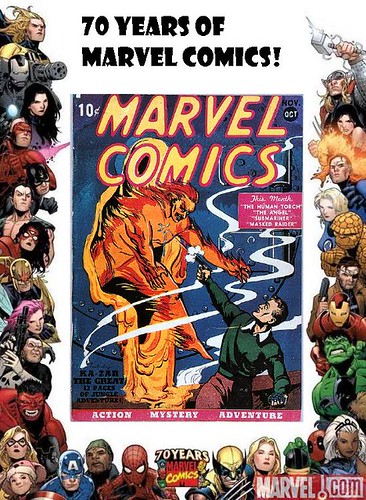
Where it all began - Marvel Comics #1 - which saw the first appearances of, among others, Namor the Sub-Mariner and the Human Torch, as well as the creative talents of such luminaries as Paul Gustavson, Carl Burgos, and of course, Bill Everett. It may not look like much now, but it blazed a trail which successive generations of writers and artists have been following ever since.