Showing posts with label FF. Show all posts

Tuesday, 3 November 2009

70 Years of Marvel - 1996


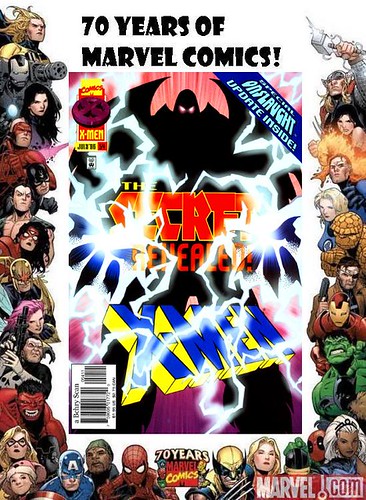
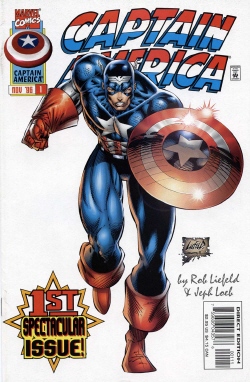
1996 was a crunch year for Marvel. While the X-Titles were doing ok, the Spider-Books were embroiled in the seemingly-everlasting Clone Saga, and the Avengers were just emerging from The Crossing, a crossover event which had seen Tony Stark go evil, the Wasp turned into a real giant-size woman-bug, and many readers jumping ship. Captain America, written at the time by Mark Waid, was well-regarded, but nothing spectacular, sales-wise. And the Fantastic Four had been lumbering along under Tom DeFalco's guidance for years. With sales crashing all over as a result of the end of the speculator boom, Marvel wanted to try something radical.

Their answer was Onslaught, an ultra-powerful mutant (with a dark secret) who tried to destroy the world. A couple of months of group-wide crossovers led to a final battle, in which the Avengers and the FF sacrificed themselves to stop Onslaught. The public, seeing their heroes killed, blamed mutantkind, and the X-Men's lives got that little bit more difficult.

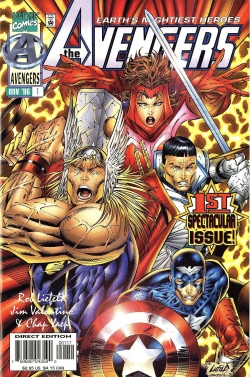
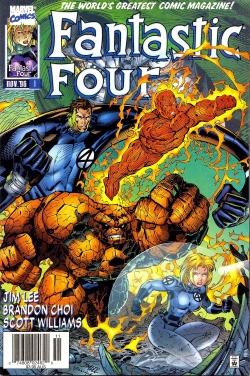
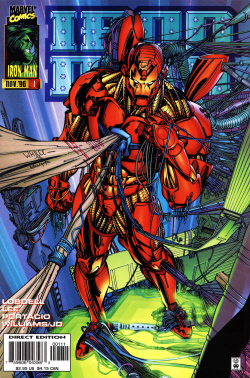
But the Avengers and the Fantastic Four weren't dead. Oh no, not at all. Instead, they faced a worse fate: outsourcing! Marvel hired Jim Lee and Rob Liefeld, founders of Image Comics, to "reimagine" the two teams, in the Image style. So it was farewell to the classic Marvel style, and hello to this...


It worked, after a fashion. Sales went through the roof, and everyone was talking about Marvel again. And that the the books weren't very good didn't really matter. After a year, the books would revert to being written and drawn in-house, with yet another set of #1 issues. And because each restart was accompanied by a bump in sales, we could henceforth look forward to pretty much every Marvel title restarting every couple of years.

In other comics news, the Clone Saga did eventually finish, at the end of this year, accompanied by the return of Norman Osborn. It says something for how much people were tired of the whole clone thing, that the resurrection of Spidey's most famously dead arch-nemesis seemed like a pretty neat idea. 13 years on, and with Norman appearing in pretty much every comic pretty much every month, it doesn't seem like such a winning plan.

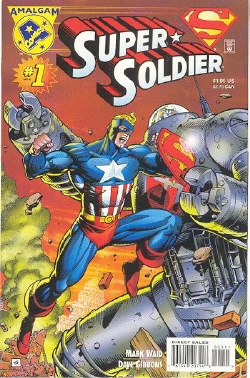
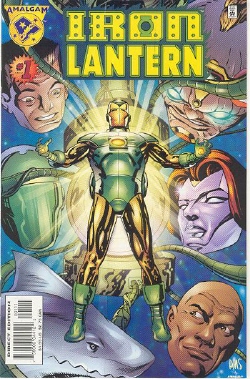
1996 was also the year of Amalgam Comics, in which Marvel and DC Comics collaborated on a shared universe, with characters made up of blends of both companies' heroes and villains.


A novel idea amongst a sea of detritus, Amalgam Comics managed two runs, in '96 and '97, before vanishing without trace.

Monday, 2 November 2009

Oooh! Shiny!

The mid-90s saw the comic speculator boom reach its crescendo, as a whole bunch of stupid people decided that, because Amazing Fantasy #15 and Detective Comics #27 were worth a fortune, then all comics would eventually be worth a fortune. These stupid people went forth and bought a shedload of comics, which they then either bagged and tagged, to sell in the future once said comics had become valuable, or, hilariously, sold them to even more stupid people, who believed that because the comics were being bought in large numbers, they must be worth lots of money NOW. Before anyone could realise these spectacular profits, the bubble burst, the speculators went on to the next big thing (pogs, probably, or trading cards), and comic sales dropped like a stone, taking most of the comic shops with them. Before you laugh, bear in mind this sort of "logic" is pretty much exactly what caused the house-buying boom of the last few years, and you saw how well that turned out.

The rise and fall of the speculator market can be symbolised by looking at the use of foil covers in comic books. Bear with me.


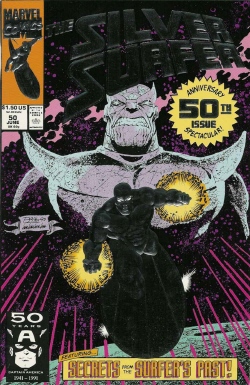
In 1991, Silver Surfer #50 came out. This book featured a battle between Surfy and the reborn dark titan, Thanos, and was a prelude to the Infinity Gauntlet, a cosmic event which touched on most of the Marvel Universe (except the X-Books, which for some reason managed to dodge such things). Some bright spark at Marvel decided to celebrate this milestone issue, by issuing the book with a silver foil cover.

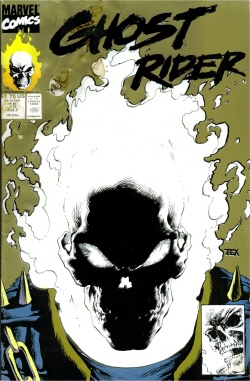
I imagine it did well, I recall friends being excited by the (really not done justice by scanners) cover. In any case, Marvel followed this up the very next month with a glow-in-the-dark cover on Ghost Rider #15.


Nice enough, I'm sure you'll agree, but, really, why the need for a gimmick cover? This issue did feature a confrontation between the 90s Ghost Rider and his 70s equivelent, but it was the concluding part of a three parter, and not even a particularly good three parter at that.

1992 saw Marvel issue a few more books promotional covers Most of them seem justifiable enough:
Amazing Spider-Man #365, Spider-Man #26 and Spectacular Spider-Man #189 all celebrated Spidey's 30th anniversary with neat little holographic panels.
Hulk #393 commemorated the Hulk's 30th anniversary and revisited his origins.
Guardians of the Galaxy #25 featured the 31st century heroes battling Galactus.
Spider-Man 2099 and Ravage 2099 introduced the world of tomorrow.
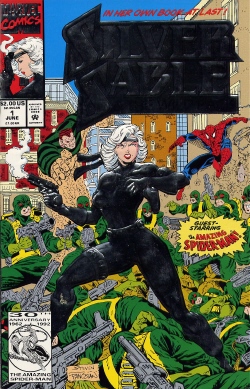
And, er, Silver Sable #1 celebrated the bounty hunting blondeshell getting her own book at last.


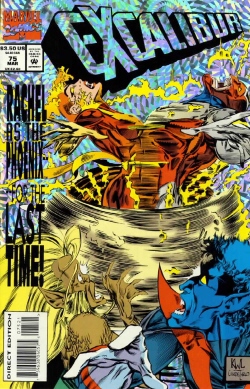
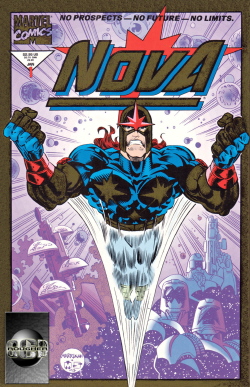
In 1993 , Marvel were churning out the gimmick covers, on, by my count, 44 comics. Some, such as the Avengers and the X-Men's 30th anniversary, were reasonable. Then there were such "essentials" as Namor #37, which celebrated Subby getting a new costume. Or Fantastic Four #371, in which the Human Torch accidentally set fire to Empire State University. Or Venom: Funeral Pyre, in which the world's most overrated supervillain takes on the Punisher (spoiler: nobody dies). By 1994, just about every comic had a gold, silver, platinum, 3D, die-cut, prismatic cover, or it felt like it. Every anniversary, no matter how trivial, every first issue, every "landmark" issue, had a pretty cover, and an inflated cover price to match. Sales were spiking all over the place, based not on how good the books were, but on the relative "buzz" generated by Excalibur #75 or Nova #1.


By 1995, the speculators were getting tired, and by 1996, most of them had vanished off in search of the nearest shop selling Magic: The Gathering cards. Other than a couple of Marvel 2099 books, the foil cover phenomenon vanished without trace virtually overnight.


It would be a good long while before Marvel would try another attempt at getting those speculator dollars, through the use of variant covers on books. A glance at the shelves of your nearest comic shop will show that Marvel doesn't really seemed to have learned any lessons from the 90s speculator boom, as just about every comic out at the moment is available with at least two covers. Disaster lies ahead...

Saturday, 31 October 2009

70 Years of Marvel - 1994


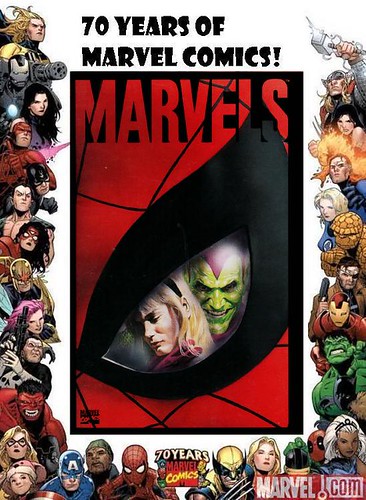
Can you believe there was a time when we weren't all just a bit tired of Alex Ross' painted artwork? Or when hardly anyone had heard of Kurt Busiek? Marvels made stars of both men, and deservedly so. A retelling of some of the most iconic moments from the 60s and 70s of Marvel Comics, through the cynical eyes of a photojournalist, Marvels managed to make events like the coming of Galactus and the death of Gwen Stacy come to life in a way that even Jack Kirby and Gil Kane could only dream. Like all classics, it's probably a bit overrated, but it holds up a damn site better than most modern classics, much like the source material that Busiek and Ross were studying.

1994 was also the year that saw Avengers West Coast shut down and replaced with the much more EXTREME Force Works. It featured some of the earliest Marvel US work by the 2000AD team of Dan Abnett and Andy Lanning, who would do much better on books to come. Mostly made up of disaffected ex-Avengers, Force Works handled cases too EXTREME for other super teams. I'd take the piss out of this more, but it doesn't really deserve it. Not compared to the awful terribleness that was Fantastic Force, an attempt to create an FF franchise. This starred mysteriously grown-up Franklin Richards leading a team of heroes so obscure that they arrived without trace, and vanished the same way a year or so later. Interestingly, the team was brought together by the Black Panther, who somehow managed to wriggle out of membership. Good choice, T'challa.

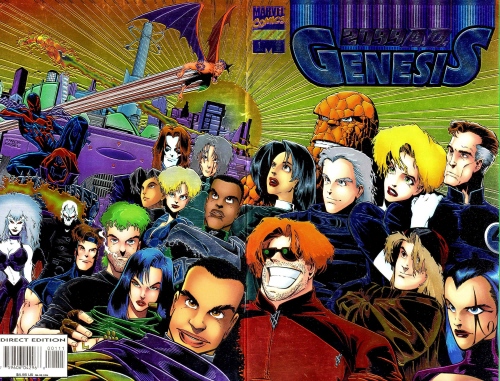
Less terribly awful, at least at first, was Generation X, an attempt at the whole "mutant kids learning to adjust to their powers in a school environment" concept, that the New Mutants had tried a decade or so back. This saw the transformation of Emma Frost from White Queen of the Hellfire Club to the sarcastic schoolmistress we've all come to know and love.

Another new book, and one which whilst somewhat better regarded, would vanish without trace after barely a handful of issues, was Clan Destine, Alan Davis' follow-up to his Excalibur work. Quirky does not usually equate with longevity, and this was no exception.

Oh, and was there something else? I'm sure there was some other event. Oh, yes, of course. Spider-Man began to share book space with a young man calling himself Ben Reilly. Disaster lay ahead...

In the real world, or close to it, Kurt Cobain broke teenage grunge hearts all over the world, Ayrton Senna crashed into a wall at 135mph, and John Smith died, giving God's Gift To Labour a chance to rule Britain in a couple of years.

Tuesday, 27 October 2009

11 of the Best: Cosmic Sagas

Since we're talking about cosmic comics, here's what I regard as the most unmissably unmissable space tales. Long-term readers of comics may find little to surprise them here...


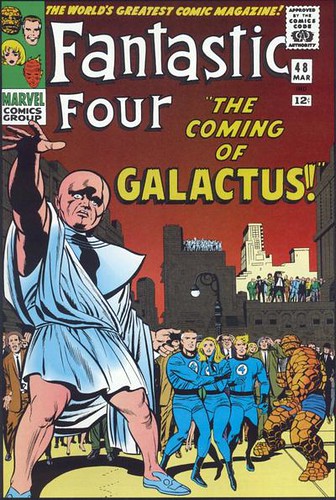
The Coming Of Galactus, Fantastic Four, 1966 (Lee & Kirby)
Jack and Stan had already introduced us to the world beyond, with the introduction of the Skrull Empire in the early issues of FF, but this was the biggie. A god-like being turns up, heralded by a cosmic-powered sentinel, the Silver Surfer, and the Fantastic Four know this is bad news, because the sworn-never-to-interfere Watcher shows up to warn them. Marvel's first truly epic storyline.


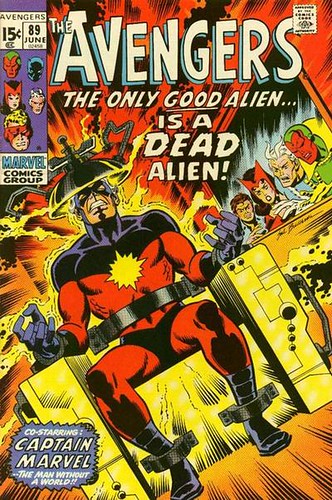
The Kree-Skrull War, Avengers, 1971-72 (Roy Thomas, Sal Buscema, and Neil Adams)
Also introduced in the pages of the FF, the Kree were the great space power of the galaxy, with the Earth considered too remote to interest them. That changed when the Kree's centuries-old conflict with the Skrull Empire spread to the Earth's solar system. The Avengers were drawn, via their ally, Captain Mar-Vell, into the war, and fought to prevent the Earth itself being an innocent bystander of the battle.


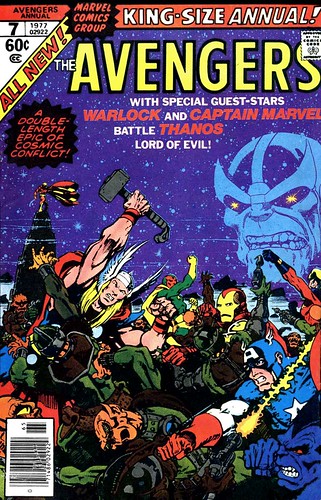
The Thanos War, Strange Tales, Avengers and Marvel Two-In-One, 1977 (Jim Starlin)
The mad god, Thanos, had been lurking on the fringes of the Marvel Universe for a few years, and had even gotten hold of a Cosmic Cube once, but this was his big play for universal domination. Obsessed with death, Thanos had obtained the Infinity Gems, which he intended to use to destroy the universe. The Avengers, Captain Marvel, and Adam Warlock would stand against him, and one of them would not be walking away from this battle.


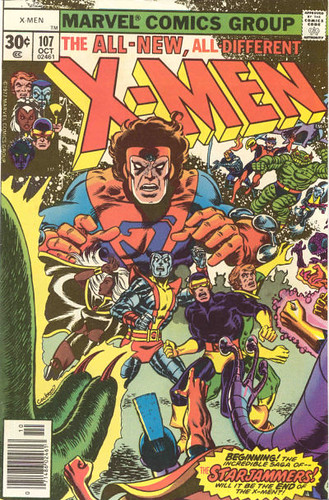
The Phoenix Saga, X-Men, 1977 (Chris Claremont, Dave Cockrum, and John Byrne)
This was the X-Men's first big space adventure, in which Professor X's latest floozy, Princess Lilandra, was kidnapped by her insane brother, the Shi'ar Emperor, D'ken, and the team went to rescue her. Notable for the first appearance of the Starjammers, and the first time Jean Grey was allowed to unleash the power of the Phoenix, this also saw the introduction of the Shi'ar as the other great star empire, one powerful enough to give even the Kree pause in their expansionism.


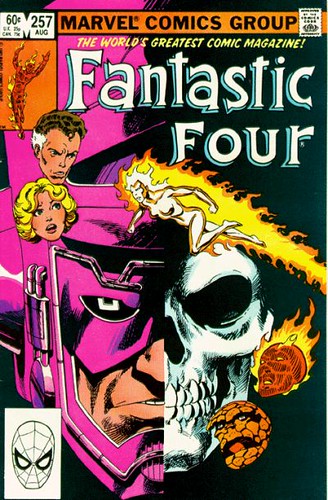
The Trial Of Galactus, Fantastic Four, 1983-84 (John Byrne)
After being saved from certain death by Mr Fantastic, Galactus finds the Skrull homeworld, and eats it. As well as incurring Reed Richards the displeasure of pretty much every sentient being in the universe, this throws out the balance of power in the galaxy, crippling the Skrull Empire, and setting the stage for...


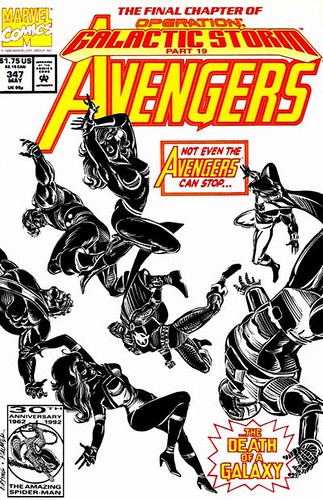
Operation: Galactic Storm, various Avengers books, 1992 (Bob Harras, Steve Epting, Roy and Dann Thomas, Dave Ross, Mark Gruenwald, Rik Levins, Greg Capullo, Gerard Jones and Jeff Johnson)
In which the Kree and Shi'ar Empires go to war, with the Avengers stuck in the middle. Condemned at the time as a cheap attempt to cash in on Operation: Desert Storm (why, and how, anyone would "cash in" on a war is a bit of a puzzler, I have to say), O:GS is notable for the uncompromising attitude of some of the Avengers, an attitude for which the editorial staff have to be commended: no bottling the tough issues here. Of course, this uncompromising attitude is probably where the current "dickish" Iron Man comes from, so it's not all good...


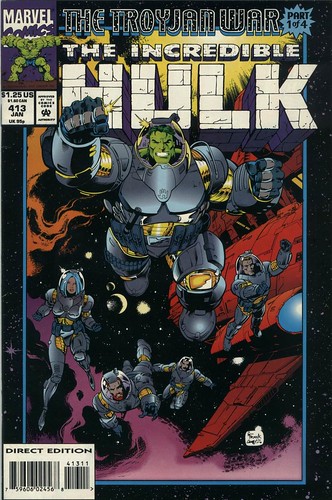
The Troyjan War, Incredible Hulk, 1994 (Peter David and Gary Frank)
Maybe Peter David was hoping to create the next big alien race, or maybe he was just looking for a villain who could give the Hulk a run for his money. Either way, this wasn't the most successful launch, since the Troyjans haven't (to the best of my knowledge) showed up anywhere since the Hulk led his then-allies, the Pantheon, against the Troyjans and their warlord, Arm’chedon (Armageddon, get it?). However, there's a lot going on in this serial, with appearances by both the Silver Surfer and the Starjammers, not to mention a battle royal between the Hulk and the Troyjan's champion, Trauma. Great stuff.


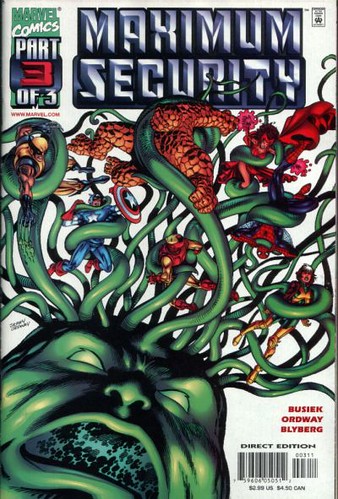
Maximum Security, various titles, 2001 (Kurt Busiek and Jerry Ordway)
One of the wackier storylines of recent years, Maximum Security saw various alien governments, led by the Shi'ar, turn Earth into an impromtuo penal colony and exile their worst criminals there. The prisoners, regretably, include Ego, the Living Planet, who proceeds to try to take over the world. Bizarre, but great fun, which is all you can ask for in a comic, particularly a 21st century comic...


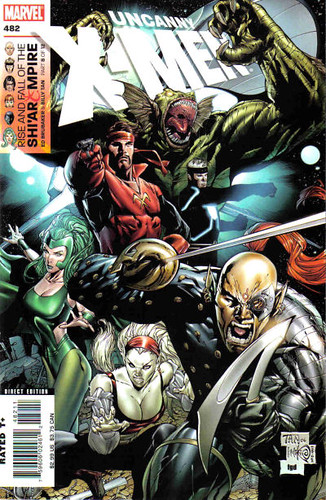
Fall And Rise Of The Shi'ar Empire, Uncanny X-Men, 2006-07 (Ed Brubaker, Billy Tan, and Clayton Henry)
In which Havok pursues his long-lost brother, Vulcan, into deep space, to try to stop him from taking his revenge on the Shi'ar for killing their mother. Another run which disrupts the balance of power in the galaxy, with Vulcan declaring himself Shi'ar emperor and threatening to cause chaos. Mind you, perhaps the Shi'ar can count themselves lucky; after all, they at least managed to avoid...


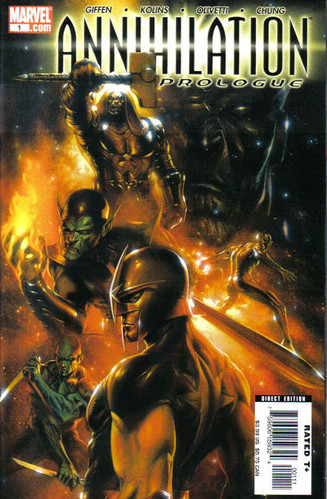
Annihilation, 2006-07 (Keith Giffen and Andrea Divito)
A dark power strikes in the galaxy, sparking an interstellar war, which sees the Skrull Empire crushed, the Kree severely weakened, and the Silver Surfer once again swearing loyalty to Galactus. Just about every one of Marvel's cosmic powers showed up in this maxi-series, a title which has done more to open up the expanded Marvel Universe than pretty much anything else in the past forty years.


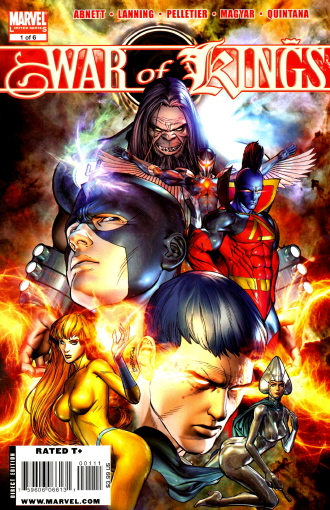
War of Kings, 2009 (Dan Abnett, Andy Lanning, and Paul Pelletier)
Abnett and Lanning have been building on Annihilation for some time now. They used that title as an opportunity to bring Nova back in his own title. They wrote the sequel, Conquest, in which the Phalanx, a long-forgotten X-Men foe, conquer the Kree, and they used that story to launch their own version of the Guardians of the Galaxy, a book which has made a star of a talking raccoon. Finally, they had the Kree, now led by Black Bolt and the Inhumans, go to war with the Vulcan-led Shi'ar, bringing together pretty much all the cosmic events of the past few years. Since Marvel seem to have worked out that there's money to be made out of these cosmic events, expect Abnett and Lanning, and others, to continue mining this seam for some time to come.

(This post mostly recycled from an earlier post on my other blog.)

Sunday, 25 October 2009

70 Years of Marvel - 1989


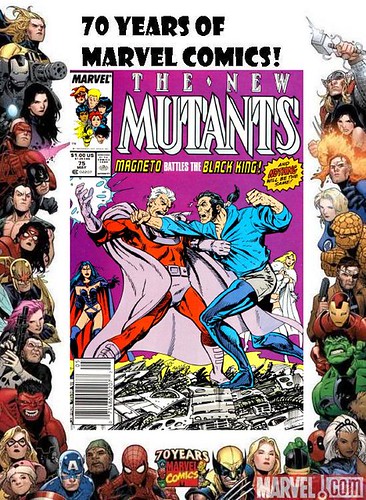
The X-Universe was getting busy by 1989, with 5 full-time books: Uncanny X-Men (under the control of Chris Claremont and Marc Silvestri); Excalibur (Claremont and Alan Davis); Wolverine (Claremont, again, and John Buscema); X-Factor (written by Louise Simonson, and drawn mostly by husband Walt); and New Mutants (Simonson, again, and mostly Bret Blevins, although the issue above was drawn by John Byrne). Of course, had we known what was ahead of us, in terms of the apparent exponential expansion of the X-universe, we'd have counted ourselves lucky to just have five books.

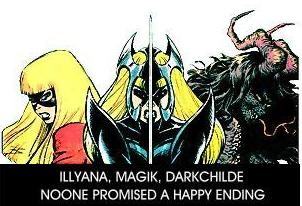
The New Mutants themselves were pretty busy too. They started 1989 by being embroiled in the Inferno saga, with Magik going crazy and turning into a demon. They lost the school and their headmaster, Magneto, turned back into a villain, and they finished the year stranded in Asgard, trying to save the 9 Realms from Hela. By this point, the book had abandoned any of the notion of being a story about school kids who just happened to be mutants, in favour of standard superhero stuff. We weren't quite at the annual "event" stage yet, but we were getting there.

Speaking of events, 1989 saw the "Acts of Vengeance" storyline, where some of Marvel's biggest bad guys decided the best way to beat their foes was to trade opponents. This led to such fights as Doctor Doom versus the Punisher, Daredevil versus Ultron, and the Fantastic Four versus Plantman. That storyline also saw the introduction of the New Warriors, another team of teenage superheroes, whilst, back over at the X-Books, future X-Woman, Jubilee, made her first appearance. Thor had a new secret identity, in the person of Eric Masterson, who'd later become the pseudo-Thunder God, Thunderstrike.

The real 1989 saw author Salman Rushdie get into a spot of bother, the introduction of the somewhat unpopular Poll Tax in the UK, and the decline and fall of the Berlin Wall. Yay!

Thursday, 22 October 2009

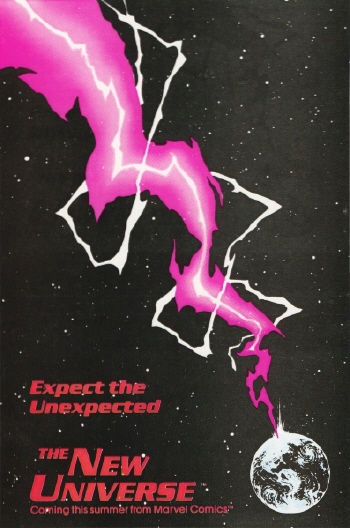
"Expect The Unexpected!"


So, as we've previously seen, 1986 saw the introduction of Jim Shooter's New Universe line, which was, I think, the first attempt by any comics company to launch, from scratch, a whole new universe, with heroes and villains gaining their powers as a result of a mysterious "White Event". We'd later see this sort of thing, again from Jim Shooter at Valiant Comics, from the launch of Image Comics, and indeed from Marvel with the 2099 and Ultimate lines. But this was, in 1986, a relatively revolutionary idea.


One of the controversies of the New Universe was that, according to legend, Marvel wiped out a swathe of its existing titles to make way for the new books. In actual fact the only books which I can see as being canned in the months before the launch were Power Man And Iron Fist, a title which had (and I speak as a big fan of Iron Fist) seen better times; Star Wars, which had lasted several years after the release of Return of the Jedi; Doctor Who, something of a niche product (in those days); and The Thing, despatched, at least in part, so that Jim Shooter could bring Ben Grimm back into the Fantastic Four fold. Other than that, and a couple of mini-series finishing up, there wasn't much in the way of dead wood being cleared in the months up to the launch of the first New Universe books.


Famously, Shooter fell foul of Marvel's new managment team, and so his plan to hire top talent to launch his new line was thwarted: oddly, no-one who was anyone wanted to write or draw a brand new, untried-out book, especially as there was no money to pay anyone. What we ended up with was a host of books written by Marvel's editorial team, and drawn by those who really needed the work.


Star Brand
Shooter himself wrote, whilst John Romita Jr, one of the few willing volunteers for the project, drew this, a tale of an ordinary man who suddenly gains superpowers. One of the more criticized books, described as a wish fulfilment book for Shooter himself, Star Brand was nonetheless one of the more lasting concepts, being picked up in the Marvel Universe proper long after the New Universe was long gone.

Spitfire And The Troubleshooters
Gerry Conway and Herb Trimpe came up with this one, based around the adventures of a group of MIT students and their battle suit


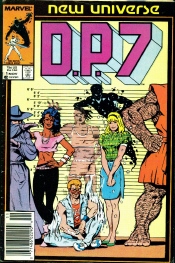
D.P.7
Mark Gruenwald and Paul Ryan wrote the entire 32 issue run of this one, concerning a group of suddenly-superpowered folk who, rather than be cut up like lab rats, go on the run. If you're a fan of the X-Men and The Fugitive, this might be your kind of thing.

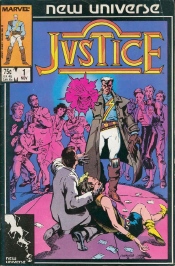
Justice
Brought to us by Archie Goodwin and Geoff Isherwood, Justice concerned the exploits of an alien who came to Earth to hunt down the evil. At least it did, until Peter David was hired to retcon Justice into a delusional government agent instead. Amazingly, this book lasted 32 issues.


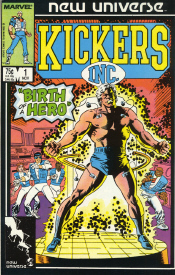
Kickers, Inc.
At the same time that Tom DeFalco and Ron Frenz were building a rep for themselves as the creative team on Amazing Spider-Man, they were also working together on this book, about a team good samaritans, led by a superstrong ex-footballer. As good as it sounds, this book managed 12 issues, before being put to death, by which time DeFalco and Frenz had left the book to take on the adventures of a golden-haired Asgardian.

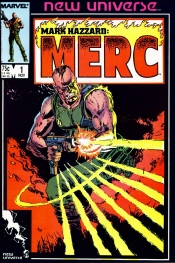
Mark Hazzard: Merc
Written, at first, by Peter David, and drawn, at first, by Gray Morrow, this dealt with, as you may guess, the adventures of an appropriately named mercenary. Certainly different to normal superhero fare, it was barely related to any of the other New Universe books, which may explain why it lasted only the dozen issues.


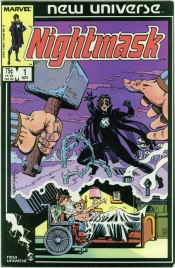
Nightmask
Another book by Archie Goodwin, with a rotating cast of artists that included future workhorses, Ron Lim and Mark Bagley, among many others. Lasting just the twelve issues, this one began with Keith Remsen, comatose since an explosion, being awoken by the White Event, and gaining the power to enter people's dreams, like the Sandman, only wearing a domino mask, for some reason.

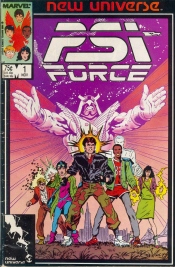
Psi-Force
A group of telepaths on the run from American and Russian secret service agents, Psi Force was the creation of Archie Goodwin (again) and Walt Simonson, though neither of them showed up to produce an issue. Notably, this did see some very early comics work from top 90s talent, Fabien Nicieza, who wrote half of its 32 issues.


After various attempts at tinkering, including the departure of Jim Shooter, the slimming down of the books, and a couple of "event" books, the New Universe line was somewhat unceremoniously killed off in the summer of '89, its titles replaced with a swathe of new books: Quasar; a second volume of What If?; and new titles for She-Hulk, Nick Fury and Moon Knight. The age of experiment was over, and it was back to stripmining Marvel's history, for the next few years, at least.

Tuesday, 20 October 2009

"Slay Your Enemies, And All You Desire Shall Be Yours!"

As mentioned yesterday, in 1985 (and indeed 1984) comic fans were getting all excited over Secret Wars. It was, while by no means the first mini-series published by Marvel, certainly the first one to have line-wide consequences. These days Marvel would call it an "event", publish a line of related titles, and you'd be sick of the thing before it was halfway finished. In the mid-80s though, Marvel just had many of their top heroes whisked away via a mysterious portal to another world, where they were forced to battle villains, with the promise of the ultimate prize for the winners. Jim Shooter took a year to tell the story of what had happened, but whilst these days, we'd face 12 months of comics featuring stand-in heroes in the missing characters' books, in those days, they simply showed the heroes returning the next month, and the radical changes which the as yet untold Secret Wars had wrought.

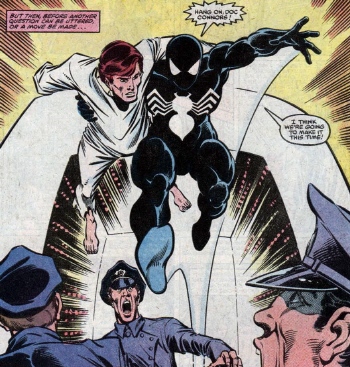
Spider-Man appeared with a new, black and white costume, which changed between civilian and super-duds depending on what was needed, and which never ran out of webbing. Later he'd discover that the costume was actually an alien symbiote, trying to take him over. Later still, the symbiote would be reborn as the villainous Venom, and later still, we'd all be sick of the sight of the black costume. But at the time, for all that it was just a change of look, we were quite excited by it.


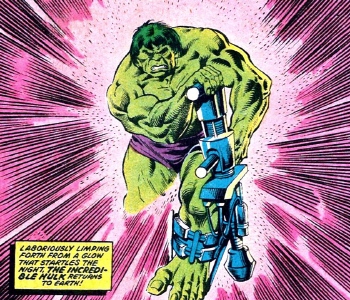
The Incredible Hulk came back from Battleworld with a broken leg and a bad attitude. The broken leg was courtesy of a fight against Ultron, whilst the bad attitude came, at least in part, from the manipulations of old Dr Strange foe, Nightmare, out to get at the Sorcerer Supreme via one of his fellow former Defenders. Of course, a week of fighting the Absorbing Man and having mountains dropped on him probably didn't help the Hulk's disposition either.


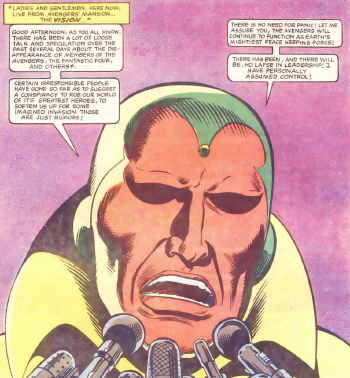
The Vision, newly recovered from a near-death experience, took advantage of the disappearance of most of the Avengers to launch a bloodless coup. Naming himself chairman, he cosied up to the government and got them to approve setting up a new West Coast branch of the team. Had anyone realised that he was suffering from the android equivalent of brain damage after his time spent in a coma, he'd probably have encountered slightly more resistance.


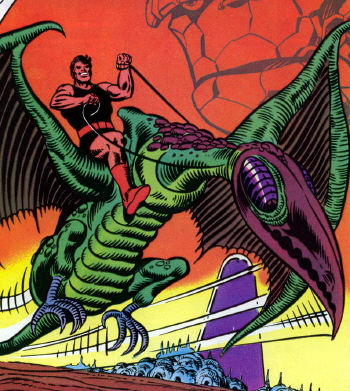
Ben Grimm, in contrast to most of the heroes, quite enjoyed his time away from Earth. He discovered that he was able to turn back into his human form at will, and decided that, on the whole, he'd sooner spend his future riding around on pteradons than go home and be a monster again. So he chose to stay on Battleworld, leaving the Fantastic Four a man short.


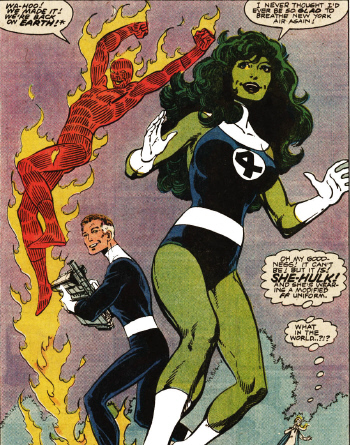
The FF didn't waste time replacing the Thing, offering his place in the team to the first superstrong person they saw. In this case, the She-Hulk, who, although a member of the Avengers, was happy to cross the street to the Baxter Building. Later, the Human Torch would take advantage of the Thing's absence to shag his girlfriend. Classy. Secret Wars would also tease the readers of the FF with the mystery of how Doctor Doom, killed the previous year, could be alive on Battleworld. A somewhat convoluted explanation would eventually be given, accompanied by a somewhat gratuitous appearance by the Beyonder.


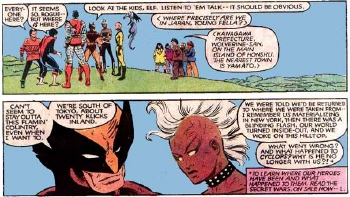
And the X-Men? Well, they stood around a hill in Japan talking a lot. Well, it was the 80s, and it was Chris Claremont, so perhaps we shouldn't have expected anything too revolutionary. In Claremont's defence, he did use Secret Wars to promote his agenda of Magneto as an extreme activist, rather than as an out-and-out supervillain, to break up Kitty Pryde and Colossus as a couple, and to justify Professor X deciding to take a more active role in leading the X-Men, but what we really remember is the constant talking...

Monday, 19 October 2009

70 Years of Marvel - 1985


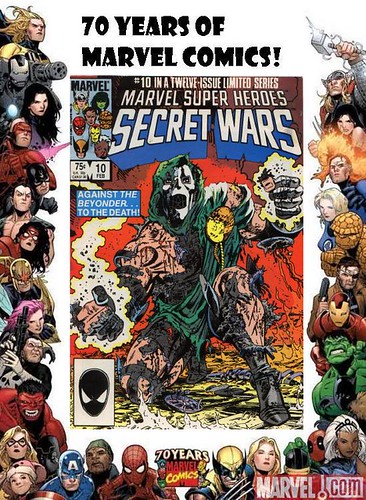
1985 saw the conclusion of the original Secret Wars series, a particularly well-received mini-series, in which the Beyonder, an all-powerful alien, kidnapped Spider-Man, the Avengers, the Fantastic Four, and the X-Men, and sent them to a planet to fight a variety of supervillains, including Galactus, Kang, Doctor Octopus, and of course, Doctor Doom (pictured, above, getting a kicking from the Beyonder). The series, written by then editor-in-chief, Jim Shooter, was followed up by Secret Wars 2, in which the Beyonder came to Earth to study humanity, meeting pretty much every hero along the way. Secret Wars 2 was pretty much universally reviled, which shows that even in the 80s, Marvel didn't know how to quit while they were ahead.

Secret Wars 2 did have one long-term effect, that of the introduction of Tabitha Smith, who, under the alias, Boom Boom, would become one of the New Mutants. Also, Longshot, hollow-boned alien mutant X-Man, made his first appearance in this year, whilst Firestar, who'd been one of Spider-Man's Amazing Friends on tv a few years previously, made it into the Marvel Universe proper.

In the real world, 1985 was the year of Live Aid, in which the great and the good of pop music sang their little hearts out for famine relief. Mikhail Gorbachev came to power in the USSR. Coca Cola released New Coke; it didn't last.

On the telly, Eastenders, an ordinary tale of simple London folk, had its debut, as did the Australian soap, Neighbours. Action hero, MacGuyver, made his first appearance, Bruce Willis was becoming a star in Moonlighting, and Elmo joined the cast of Sesame Street. In the cinema, Out of Africa was scooping up Oscars like candy, but Back to the Future was the film people actually wanted to see.

Saturday, 17 October 2009

My First Comics

I may never know which Borders comics fan's mum decided to turf out his November and December-dated Marvel comics, but it was my good fortune that, rather than binning them, she instead donated them to one of the stalls at the Liberal Party's pre-Christmas Bazaar. At the event, where I was dragged by my mum and dad, not only did I get to meet the impressively-statured Cyril Smith, I was confronted with a selection of comics of which, until then, I was sadly unaware.


Alpha Flight #4 & #5 (both by John Byrne)
Alpha Flight #4 featured the tail end of a multi-parter in which the so-called Master of the World attempted to conquer the world, using Marrina the Fish-Girl. It also featured the Invisible Girl and Sub-Mariner, and introduced the idea of Aurora's multiple personality disorder. Issue #5 featured the dwarf, Puck, investigating a drug-smuggling ring based out of a hospital. For a comic featuring only one character I'd even heard of, Alpha Flight had me hooked from the start.


Fantastic Four #260 & #261 (both also by John Byrne)
FF #260 introduced me to the FF's nemesis, Doctor Doom (I may have been aware of him from things like the Spider-Man cartoons, but it would be a very vague awareness), and, before the end of the issue, had killed him off, in a battle between the Silver Surfer and Tyros. This was also the end of a multi-parter, but was also reasonably straightforward to fathom. Alpha Flight #4 was set immediately between #260 and #261, introducing me to the idea of crossovers between titles. #261 had the FF off in space, bumping into the Watcher, and had the team trying to justify not having let Galactus die in an earlier issue. This was a bit of a mystery, but by the end of the book, I pretty much understood what it was all about. The issue also featured a recap of the FF's origin, which was handy for newbies like me.


Amazing Spider-Man #246 & #247 (by Roger Stern and John Romita Jr)
ASM #246 was, essentially, an imaginary story, in which J. Jonah Jameson, Mary Jane Watson, the Black Cat, and Spidey himself daydreamed about their perfect day. Oddly, whilst Jameson and the Cat's dreams ended well, neither Mary Jane or Peter Parker were able to sustain their delusion, suggesting that both have some psychological issues to deal with. #247 featured Spidey teaming up with the fabulous Frog Man, a hunt for the Hobgoblin, and a mystery villain, Thunderball (of the Wrecking Crew). It would be years before I would find out who Thunderball is, and I have no idea to this day about Frog Man. The Hobgoblin was another story, of course.


Spectacular Spider-Man #84 (by Bill Manto and Dave Simons) and #85 (by Mantlo and Al Milgrom)
PPTSSM #84 featured Spidey hunting down a gang of child abductors, and was a purely self-contained story. #85, on the other hand, had the Hobgoblin show up to take on Spidey and the Black Cat. It also, handily, showed the story so far of the Hobgoblin, and featured Peter Parker having a get together with his old college friends, including Harry Osborn, which in turn introduced me to the history of the Green Goblin, which made Spider-Man's obsession with the Hobgoblin a lot more explicable.


Avengers #237 & #238 (both by Roger Stern and Al Milgrom)
Avengers #237 featured Spider-Man trying out for the team, an event alluded to in Spidey's own book, and had the Avengers fighting a whole load of supervillains in Project Pegasus. Looking back, I'm not sure why I accepted supervillains being imprisoned with their costumes on, but it's not something that gave me cause for concern at the time. Issue #238 had the Vision, in a coma due to an earlier battle, recover unexpectedly, showed the She-Hulk househunting, and featured a last-page appearance by Tigra and the ghost of Spider-Woman, the last of which confused the heck out of me.


Captain America #288 (by JM DeMatteis and Mike Zeck)
Set in the future world of 1993, this featured Cap teaming up with the cyborg, Deathlok, to take on the ruler of a destroyed New York. This was pretty much double-dutch to me at the time, and since I didn't have the next issue, it would be a long time before I'd find out how Cap stopped the imminent destruction of the world.

Daredevil #202 (by Dennis O'Neil and William Johnson)
This book had Matt Murdock's firm hired by an African tribe do do PR for their boss, Micah Synn. Micah turns out to be a nutjob, prone to dangling policemen out of windows. As a one-shot, it does a fine job of introducing DD and his significant others, and as an introduction to Micah Synn, it made me want to read more about him, which handily was what Denny O'Neil intended.


Defenders #125 (by JM DeMatteis and Don Perlin)
My first issue of Defenders featured the departure of the original team, the wedding of Patsy Walker and Daimon Hellstrom, and a new team being formed. it also featured an Elf. Much of this made little sense, but thankfully, there was a handy letters page which clarified some of what was going on.

The Thing #5 (by John Byrne and Ron Wilson)
This book had Ben Grimm getting beaten up, for no readily apparent reason, by Wonder Man, She-Hulk, and Spider-Man, before being possessed by his old foe, the Puppet Master. I didn't know at the time who the Puppet Master was, nor why he was out to get the Thing, so this was a less successful introduction to the book, but since the book was essentially an FF spin-off, it wasn't too much of a problem.


Incredible Hulk #289 (by Bill Mantlo and Sal Buscema)
The Hulk was intelligent at this point in his history, which seemed odd at the time, less so now. It had MODOK setting the Abomination to attack Bruce Banner, who was working for the government on gamma ray research - which with hindsight seems less logical than the Hulk's intelligence. Mostly the issue involved Hulk beating up the Abomination, which for a Hulk book is pretty much what you'd expect.

Marvel Team-Up #135 (by Bill Mantlo, again, and Ron Frenz)
This issue featured Kitty Pryde (note the lack of codename) rescuing some kidnapped children from the Morlock tunnels, with the help of Spider-Man. I didn't know who the Morlocks were at the time, and I'm not sure why they were kidnapping people, but it was a decent enough tale, at the time.


The Mighty Thor #337 (by Walt Simonson)
This was a flummoxer. Thor lost his powers, whilst an alien invader gets them. Nick Fury turns up, with little explanation of who he is and why he has a flying car and a helicarrier. And out in space, someone is forging something big. Now, having read the succeeding two years worth of issues, I know this is a classic, but at the time, it was not a good first issue. Not at all.
Uncanny X-Men #175 (by Chris Claremont, Paul Smith and John Romita Jr)
Speaking of confusing first issues, this issue features the wedding of Cyclops and Madelyne Pryor, the return of Dark Phoenix, and Mastermind looking for revenge against the team for what Phoenix had done to him. Confusing stuff, but with enough exposition (this was a Claremont book) to make it explicable.

So there you have it. My first 18 Marvel books. Some classics, and some, less than classic, but enough to get an 11 year-old me hooked on the things, if not for life, then at least for the forseeable future. To my bank manager's horror.