Showing posts with label Phoenix. Show all posts

Tuesday, 27 October 2009

11 of the Best: Cosmic Sagas

Since we're talking about cosmic comics, here's what I regard as the most unmissably unmissable space tales. Long-term readers of comics may find little to surprise them here...


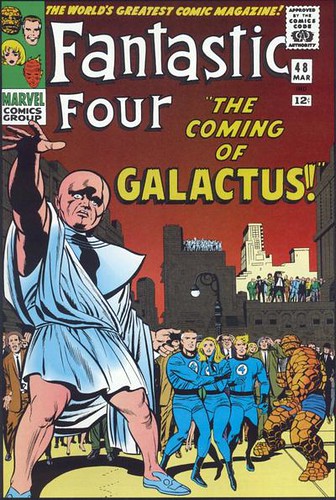
The Coming Of Galactus, Fantastic Four, 1966 (Lee & Kirby)
Jack and Stan had already introduced us to the world beyond, with the introduction of the Skrull Empire in the early issues of FF, but this was the biggie. A god-like being turns up, heralded by a cosmic-powered sentinel, the Silver Surfer, and the Fantastic Four know this is bad news, because the sworn-never-to-interfere Watcher shows up to warn them. Marvel's first truly epic storyline.
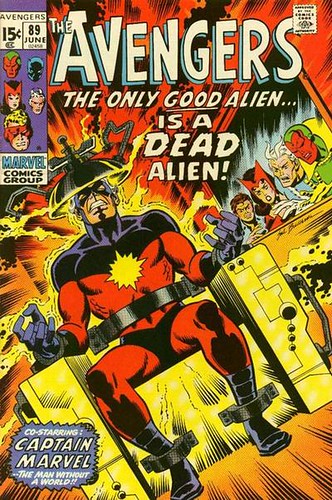

The Kree-Skrull War, Avengers, 1971-72 (Roy Thomas, Sal Buscema, and Neil Adams)
Also introduced in the pages of the FF, the Kree were the great space power of the galaxy, with the Earth considered too remote to interest them. That changed when the Kree's centuries-old conflict with the Skrull Empire spread to the Earth's solar system. The Avengers were drawn, via their ally, Captain Mar-Vell, into the war, and fought to prevent the Earth itself being an innocent bystander of the battle.
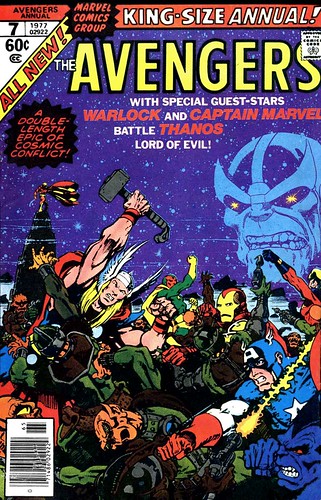

The Thanos War, Strange Tales, Avengers and Marvel Two-In-One, 1977 (Jim Starlin)
The mad god, Thanos, had been lurking on the fringes of the Marvel Universe for a few years, and had even gotten hold of a Cosmic Cube once, but this was his big play for universal domination. Obsessed with death, Thanos had obtained the Infinity Gems, which he intended to use to destroy the universe. The Avengers, Captain Marvel, and Adam Warlock would stand against him, and one of them would not be walking away from this battle.
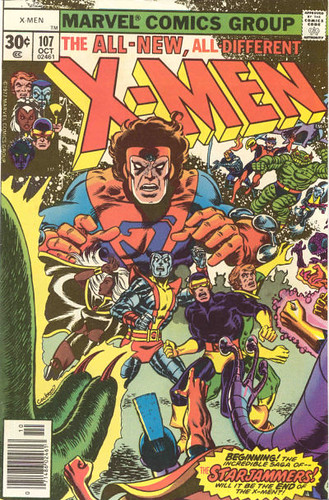

The Phoenix Saga, X-Men, 1977 (Chris Claremont, Dave Cockrum, and John Byrne)
This was the X-Men's first big space adventure, in which Professor X's latest floozy, Princess Lilandra, was kidnapped by her insane brother, the Shi'ar Emperor, D'ken, and the team went to rescue her. Notable for the first appearance of the Starjammers, and the first time Jean Grey was allowed to unleash the power of the Phoenix, this also saw the introduction of the Shi'ar as the other great star empire, one powerful enough to give even the Kree pause in their expansionism.
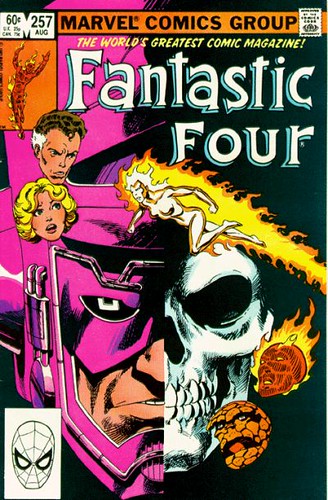

The Trial Of Galactus, Fantastic Four, 1983-84 (John Byrne)
After being saved from certain death by Mr Fantastic, Galactus finds the Skrull homeworld, and eats it. As well as incurring Reed Richards the displeasure of pretty much every sentient being in the universe, this throws out the balance of power in the galaxy, crippling the Skrull Empire, and setting the stage for...
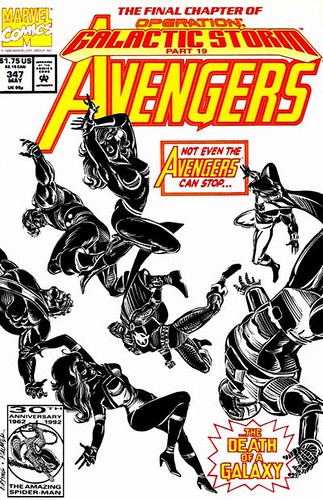

Operation: Galactic Storm, various Avengers books, 1992 (Bob Harras, Steve Epting, Roy and Dann Thomas, Dave Ross, Mark Gruenwald, Rik Levins, Greg Capullo, Gerard Jones and Jeff Johnson)
In which the Kree and Shi'ar Empires go to war, with the Avengers stuck in the middle. Condemned at the time as a cheap attempt to cash in on Operation: Desert Storm (why, and how, anyone would "cash in" on a war is a bit of a puzzler, I have to say), O:GS is notable for the uncompromising attitude of some of the Avengers, an attitude for which the editorial staff have to be commended: no bottling the tough issues here. Of course, this uncompromising attitude is probably where the current "dickish" Iron Man comes from, so it's not all good...
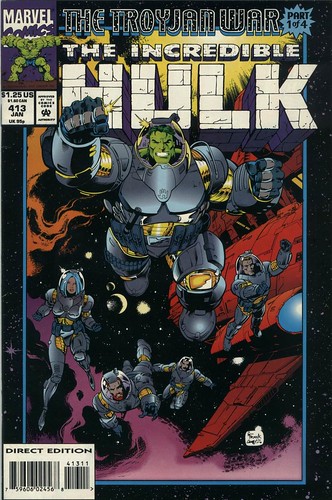

The Troyjan War, Incredible Hulk, 1994 (Peter David and Gary Frank)
Maybe Peter David was hoping to create the next big alien race, or maybe he was just looking for a villain who could give the Hulk a run for his money. Either way, this wasn't the most successful launch, since the Troyjans haven't (to the best of my knowledge) showed up anywhere since the Hulk led his then-allies, the Pantheon, against the Troyjans and their warlord, Arm’chedon (Armageddon, get it?). However, there's a lot going on in this serial, with appearances by both the Silver Surfer and the Starjammers, not to mention a battle royal between the Hulk and the Troyjan's champion, Trauma. Great stuff.
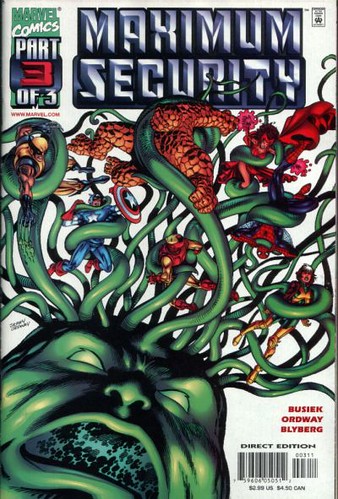

Maximum Security, various titles, 2001 (Kurt Busiek and Jerry Ordway)
One of the wackier storylines of recent years, Maximum Security saw various alien governments, led by the Shi'ar, turn Earth into an impromtuo penal colony and exile their worst criminals there. The prisoners, regretably, include Ego, the Living Planet, who proceeds to try to take over the world. Bizarre, but great fun, which is all you can ask for in a comic, particularly a 21st century comic...
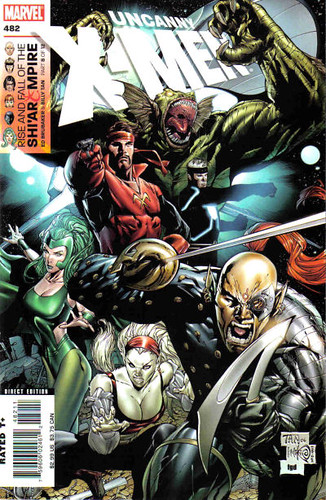

Fall And Rise Of The Shi'ar Empire, Uncanny X-Men, 2006-07 (Ed Brubaker, Billy Tan, and Clayton Henry)
In which Havok pursues his long-lost brother, Vulcan, into deep space, to try to stop him from taking his revenge on the Shi'ar for killing their mother. Another run which disrupts the balance of power in the galaxy, with Vulcan declaring himself Shi'ar emperor and threatening to cause chaos. Mind you, perhaps the Shi'ar can count themselves lucky; after all, they at least managed to avoid...
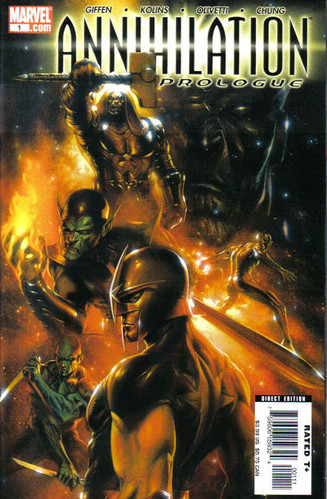

Annihilation, 2006-07 (Keith Giffen and Andrea Divito)
A dark power strikes in the galaxy, sparking an interstellar war, which sees the Skrull Empire crushed, the Kree severely weakened, and the Silver Surfer once again swearing loyalty to Galactus. Just about every one of Marvel's cosmic powers showed up in this maxi-series, a title which has done more to open up the expanded Marvel Universe than pretty much anything else in the past forty years.
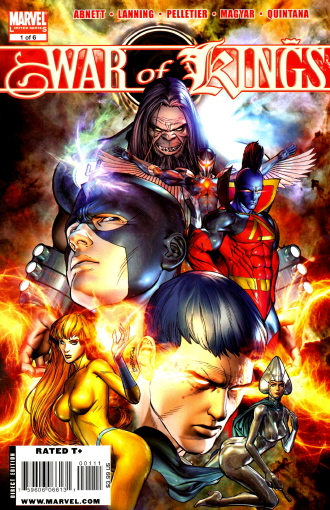

War of Kings, 2009 (Dan Abnett, Andy Lanning, and Paul Pelletier)
Abnett and Lanning have been building on Annihilation for some time now. They used that title as an opportunity to bring Nova back in his own title. They wrote the sequel, Conquest, in which the Phalanx, a long-forgotten X-Men foe, conquer the Kree, and they used that story to launch their own version of the Guardians of the Galaxy, a book which has made a star of a talking raccoon. Finally, they had the Kree, now led by Black Bolt and the Inhumans, go to war with the Vulcan-led Shi'ar, bringing together pretty much all the cosmic events of the past few years. Since Marvel seem to have worked out that there's money to be made out of these cosmic events, expect Abnett and Lanning, and others, to continue mining this seam for some time to come.

(This post mostly recycled from an earlier post on my other blog.)

Saturday, 17 October 2009

My First Comics

I may never know which Borders comics fan's mum decided to turf out his November and December-dated Marvel comics, but it was my good fortune that, rather than binning them, she instead donated them to one of the stalls at the Liberal Party's pre-Christmas Bazaar. At the event, where I was dragged by my mum and dad, not only did I get to meet the impressively-statured Cyril Smith, I was confronted with a selection of comics of which, until then, I was sadly unaware.


Alpha Flight #4 & #5 (both by John Byrne)
Alpha Flight #4 featured the tail end of a multi-parter in which the so-called Master of the World attempted to conquer the world, using Marrina the Fish-Girl. It also featured the Invisible Girl and Sub-Mariner, and introduced the idea of Aurora's multiple personality disorder. Issue #5 featured the dwarf, Puck, investigating a drug-smuggling ring based out of a hospital. For a comic featuring only one character I'd even heard of, Alpha Flight had me hooked from the start.


Fantastic Four #260 & #261 (both also by John Byrne)
FF #260 introduced me to the FF's nemesis, Doctor Doom (I may have been aware of him from things like the Spider-Man cartoons, but it would be a very vague awareness), and, before the end of the issue, had killed him off, in a battle between the Silver Surfer and Tyros. This was also the end of a multi-parter, but was also reasonably straightforward to fathom. Alpha Flight #4 was set immediately between #260 and #261, introducing me to the idea of crossovers between titles. #261 had the FF off in space, bumping into the Watcher, and had the team trying to justify not having let Galactus die in an earlier issue. This was a bit of a mystery, but by the end of the book, I pretty much understood what it was all about. The issue also featured a recap of the FF's origin, which was handy for newbies like me.


Amazing Spider-Man #246 & #247 (by Roger Stern and John Romita Jr)
ASM #246 was, essentially, an imaginary story, in which J. Jonah Jameson, Mary Jane Watson, the Black Cat, and Spidey himself daydreamed about their perfect day. Oddly, whilst Jameson and the Cat's dreams ended well, neither Mary Jane or Peter Parker were able to sustain their delusion, suggesting that both have some psychological issues to deal with. #247 featured Spidey teaming up with the fabulous Frog Man, a hunt for the Hobgoblin, and a mystery villain, Thunderball (of the Wrecking Crew). It would be years before I would find out who Thunderball is, and I have no idea to this day about Frog Man. The Hobgoblin was another story, of course.


Spectacular Spider-Man #84 (by Bill Manto and Dave Simons) and #85 (by Mantlo and Al Milgrom)
PPTSSM #84 featured Spidey hunting down a gang of child abductors, and was a purely self-contained story. #85, on the other hand, had the Hobgoblin show up to take on Spidey and the Black Cat. It also, handily, showed the story so far of the Hobgoblin, and featured Peter Parker having a get together with his old college friends, including Harry Osborn, which in turn introduced me to the history of the Green Goblin, which made Spider-Man's obsession with the Hobgoblin a lot more explicable.


Avengers #237 & #238 (both by Roger Stern and Al Milgrom)
Avengers #237 featured Spider-Man trying out for the team, an event alluded to in Spidey's own book, and had the Avengers fighting a whole load of supervillains in Project Pegasus. Looking back, I'm not sure why I accepted supervillains being imprisoned with their costumes on, but it's not something that gave me cause for concern at the time. Issue #238 had the Vision, in a coma due to an earlier battle, recover unexpectedly, showed the She-Hulk househunting, and featured a last-page appearance by Tigra and the ghost of Spider-Woman, the last of which confused the heck out of me.


Captain America #288 (by JM DeMatteis and Mike Zeck)
Set in the future world of 1993, this featured Cap teaming up with the cyborg, Deathlok, to take on the ruler of a destroyed New York. This was pretty much double-dutch to me at the time, and since I didn't have the next issue, it would be a long time before I'd find out how Cap stopped the imminent destruction of the world.

Daredevil #202 (by Dennis O'Neil and William Johnson)
This book had Matt Murdock's firm hired by an African tribe do do PR for their boss, Micah Synn. Micah turns out to be a nutjob, prone to dangling policemen out of windows. As a one-shot, it does a fine job of introducing DD and his significant others, and as an introduction to Micah Synn, it made me want to read more about him, which handily was what Denny O'Neil intended.


Defenders #125 (by JM DeMatteis and Don Perlin)
My first issue of Defenders featured the departure of the original team, the wedding of Patsy Walker and Daimon Hellstrom, and a new team being formed. it also featured an Elf. Much of this made little sense, but thankfully, there was a handy letters page which clarified some of what was going on.

The Thing #5 (by John Byrne and Ron Wilson)
This book had Ben Grimm getting beaten up, for no readily apparent reason, by Wonder Man, She-Hulk, and Spider-Man, before being possessed by his old foe, the Puppet Master. I didn't know at the time who the Puppet Master was, nor why he was out to get the Thing, so this was a less successful introduction to the book, but since the book was essentially an FF spin-off, it wasn't too much of a problem.


Incredible Hulk #289 (by Bill Mantlo and Sal Buscema)
The Hulk was intelligent at this point in his history, which seemed odd at the time, less so now. It had MODOK setting the Abomination to attack Bruce Banner, who was working for the government on gamma ray research - which with hindsight seems less logical than the Hulk's intelligence. Mostly the issue involved Hulk beating up the Abomination, which for a Hulk book is pretty much what you'd expect.

Marvel Team-Up #135 (by Bill Mantlo, again, and Ron Frenz)
This issue featured Kitty Pryde (note the lack of codename) rescuing some kidnapped children from the Morlock tunnels, with the help of Spider-Man. I didn't know who the Morlocks were at the time, and I'm not sure why they were kidnapping people, but it was a decent enough tale, at the time.


The Mighty Thor #337 (by Walt Simonson)
This was a flummoxer. Thor lost his powers, whilst an alien invader gets them. Nick Fury turns up, with little explanation of who he is and why he has a flying car and a helicarrier. And out in space, someone is forging something big. Now, having read the succeeding two years worth of issues, I know this is a classic, but at the time, it was not a good first issue. Not at all.

Uncanny X-Men #175 (by Chris Claremont, Paul Smith and John Romita Jr)
Speaking of confusing first issues, this issue features the wedding of Cyclops and Madelyne Pryor, the return of Dark Phoenix, and Mastermind looking for revenge against the team for what Phoenix had done to him. Confusing stuff, but with enough exposition (this was a Claremont book) to make it explicable.

So there you have it. My first 18 Marvel books. Some classics, and some, less than classic, but enough to get an 11 year-old me hooked on the things, if not for life, then at least for the forseeable future. To my bank manager's horror.

Thursday, 8 October 2009

70 Years of Marvel - 1976


In 1976, the Defenders were the antidote to superhero comics. Steve Gerber had taken over the book a year or so back, and what had been just another team book rapidly became something else, with bodyswaps, self-help gurus, possessed deer, and the Hulk dressed as a clown. And all that , just in the issue above! These weren't your dad's comic books.

In the same year, Captain Britain was making his debut, in the pages of his own Marvel UK title. Richard Ryder was gaining the power of Nova. The Shroud was turning up for the first time, in the pages of Super-Villain Team-Up. In the X-Men, Jean Grey was transforming into the Phoenix. Third-string super hero, Jack of Hearts, was appearing in the pages of Deadly Hands of Kung Fu. And, with Kirby back at Marvel, he was taking over the reigns at Captain America, adapting the 2001: A Space Odyssey movie, as well as launching a new team of god-like beings, the Eternals.

In the real world, 1976 saw Jim Callaghan become British PM, Jimmy Carter become American President, and Chairman Mao dead.

On television, children were watching Rentaghost and Multi-Coloured Swap Shop, whilst the grown-ups were watching Reginald Perrin and I, Claudius. Sylvester Stallone was making a name for himself as Rocky Balboa. And vampire literature got a boost, with the publication of Interview With The Vampire, introducing the "vampire rock star" subgenre of horror fiction.