Showing posts with label Captain America. Show all posts

Wednesday, 18 November 2009

70 Years of Marvel - 2007


One of the highlights of 2007 was this little gem, MODOK's 11, in which the Big Giant Head recruits a couple of fistfuls of followers, including second-stringers like Mentallo, the Armadillo, and the Chameleon, to commit the ultimate robbery. With the rest of the Marvel Universe getting increasingly grim and gritty, this was a nice lighthearted little romp, and got Fred Van Lente his first start in the Marvel Universe proper.

Other than this, most books in 2007 revolved around either the fallout from Civil War, the consequences of the Annihilation Event, or the Hulk's invasion of New York. The Spider-Books were being culled left, right, and centre, whilst Spidey himself was making a deal with the devil to save his Aunt May. Elsewhere, JMS was being recruited to revamp Thor, Captain America was getting shot, and Iron Man was being appointed Director of SHIELD. The world was getting weirder, that was for sure.

Monday, 16 November 2009

70 Years of Marvel - 2006


By 2006, "event comics were rampant at Marvel. We had, in no particular order:

X-Men: Deadly Genesis - in which Ed Brubaker finally answered the question of who Cyclops and Havok's mystery brother was, about a decade after anyone had last expressed an interest in finding this out. The third brother, Vulcan, believed dead, and erased from the memories of everyone who met him (by that good guy, Professor X), came back from the dead, kidnapped the X-Men, killed Banshee, then went off into space to conquer the Shi'ar Empire.

Civil War - in which Mark Millar spins a yarn in which the New Warriors accidentally blow up a school, and the superhero community is torn in half, with factions arguing for and against superhero registration led by Iron Man and Captain America respectively, Spider-Man reveals his secret identity to the world, and Hank Pym builds a clone of Thor.

Planet Hulk - in which Mr Fantastic, Iron Man, Black Bolt and Dr Strange decide to exile the Hulk into space, accidentally sending him to a planet of enslaving insects, whom he proceeds to conquer. Planet Hulk's writer, Greg Pak, would subsequently return the Hulk to Earth to kick some arse, but this was a far superior tale.

Annihilation - in which Annihilus and his Negative Zone pals try to conquer the "Positive" Universe. Used by Keith Giffen and others as a means to jumpstart Marvel's "cosmic" characters, who had been somewhat underused in recent years.

Additionally, 2006 saw the Black Panther marry the X-Men's Storm, Warren Ellis launch Nextwave, comedy misadventures of some b-list heroes, and Neil Gaiman relaunch the Eternals. In all, a busy year for Marvel's marketing department.

Tuesday, 3 November 2009

70 Years of Marvel - 1996


1996 was a crunch year for Marvel. While the X-Titles were doing ok, the Spider-Books were embroiled in the seemingly-everlasting Clone Saga, and the Avengers were just emerging from The Crossing, a crossover event which had seen Tony Stark go evil, the Wasp turned into a real giant-size woman-bug, and many readers jumping ship. Captain America, written at the time by Mark Waid, was well-regarded, but nothing spectacular, sales-wise. And the Fantastic Four had been lumbering along under Tom DeFalco's guidance for years. With sales crashing all over as a result of the end of the speculator boom, Marvel wanted to try something radical.

Their answer was Onslaught, an ultra-powerful mutant (with a dark secret) who tried to destroy the world. A couple of months of group-wide crossovers led to a final battle, in which the Avengers and the FF sacrificed themselves to stop Onslaught. The public, seeing their heroes killed, blamed mutantkind, and the X-Men's lives got that little bit more difficult.

But the Avengers and the Fantastic Four weren't dead. Oh no, not at all. Instead, they faced a worse fate: outsourcing! Marvel hired Jim Lee and Rob Liefeld, founders of Image Comics, to "reimagine" the two teams, in the Image style. So it was farewell to the classic Marvel style, and hello to this...


It worked, after a fashion. Sales went through the roof, and everyone was talking about Marvel again. And that the the books weren't very good didn't really matter. After a year, the books would revert to being written and drawn in-house, with yet another set of #1 issues. And because each restart was accompanied by a bump in sales, we could henceforth look forward to pretty much every Marvel title restarting every couple of years.

In other comics news, the Clone Saga did eventually finish, at the end of this year, accompanied by the return of Norman Osborn. It says something for how much people were tired of the whole clone thing, that the resurrection of Spidey's most famously dead arch-nemesis seemed like a pretty neat idea. 13 years on, and with Norman appearing in pretty much every comic pretty much every month, it doesn't seem like such a winning plan.

1996 was also the year of Amalgam Comics, in which Marvel and DC Comics collaborated on a shared universe, with characters made up of blends of both companies' heroes and villains.


A novel idea amongst a sea of detritus, Amalgam Comics managed two runs, in '96 and '97, before vanishing without trace.

Friday, 23 October 2009

70 Years of Comics - 1987


1987 saw Walt Simonson bring to a close his four-year run on Thor, a run which he'd used to reestablish Thor's godly credentials. Simonson had used ever Norse legend out there, up to and including Ragnarok. In the process, Thor had been mostly pulled out of his usual interactions with the rest of the Marvel Universe, although he would still be involved in major events like the Siege of Avengers Mansion and the Morlock Massacre. For most of the run, Simonson was both writing and drawing the book, though for the later issues the art was handled by workhorse Sal Buscema, who showed he was just as capable at handling the epic stuff as he had been the day-to-day activities of Peter Parker and Bruce Banner. Like Frank Miller's run on Daredevil, Simonson's run on Thor has never been matched; unlike Miller's run, no-one's even come close to matching Simonson.

1987 was the year that Steve Rogers was replaced in the Captain America suit by John Walker, who would later be better known as the U.S. Agent. It also saw Peter Parker and Mary Jane Watson marry move in together, setting a fine example to the youth of America.

1987 also saw Terry Waite kidnapped in Beirut, where he'd spend the next 4 years in captivity. Ronald Reagan and Oliver North were embroiled in the Iran-Contra Affair. And despite Michael Fish's assurances to the contrary, there was a hurricane coming to the south of England.

Wednesday, 21 October 2009

70 Years of Marvel - 1986


In 1986, rising comics superstar Frank Miller was just finishing up his second run on Daredevil. The "Born Again" saga, by Miller and David Muzzicchelli, began with the Kingpin discovering the secret identity of his blind foe, and ended with Daredevil teaming up with Captain America to battle a deranged supersoldier. along the way, Miller took us into the hearts of Matt Murdock and Wilson Fisk, as well as their numerous friends and associates, and set a standard that successive writers, try as they might, have never quite been able to match.

Elsewhere in 1986, Magneto was taking charge of the New Mutants. Jean Grey was back from the dead, prompting the original X-Men to reunite as the mutant-hunting X-Factor Investigations. Private investigator, Dakota North, was introduced to the Marvel Universe, as was Sharon Ventura, the new Ms. Marvel. The Scourge of the Underworld was wiping out hordes of second and third-tier villains, whilst the Marauders were wiping out hordes of Morlocks. And Baron Zemo and his Masters of Evil were doing a decent job of destroying the Avengers. But all this would pale into insignificance in the face of the coming of the New Universe titles. More on that later.

Outside of comics, 1986 was the year of the Challenger Disaster, and I don't really have anything else to say about that year.

Saturday, 17 October 2009

My First Comics

I may never know which Borders comics fan's mum decided to turf out his November and December-dated Marvel comics, but it was my good fortune that, rather than binning them, she instead donated them to one of the stalls at the Liberal Party's pre-Christmas Bazaar. At the event, where I was dragged by my mum and dad, not only did I get to meet the impressively-statured Cyril Smith, I was confronted with a selection of comics of which, until then, I was sadly unaware.


Alpha Flight #4 & #5 (both by John Byrne)
Alpha Flight #4 featured the tail end of a multi-parter in which the so-called Master of the World attempted to conquer the world, using Marrina the Fish-Girl. It also featured the Invisible Girl and Sub-Mariner, and introduced the idea of Aurora's multiple personality disorder. Issue #5 featured the dwarf, Puck, investigating a drug-smuggling ring based out of a hospital. For a comic featuring only one character I'd even heard of, Alpha Flight had me hooked from the start.


Fantastic Four #260 & #261 (both also by John Byrne)
FF #260 introduced me to the FF's nemesis, Doctor Doom (I may have been aware of him from things like the Spider-Man cartoons, but it would be a very vague awareness), and, before the end of the issue, had killed him off, in a battle between the Silver Surfer and Tyros. This was also the end of a multi-parter, but was also reasonably straightforward to fathom. Alpha Flight #4 was set immediately between #260 and #261, introducing me to the idea of crossovers between titles. #261 had the FF off in space, bumping into the Watcher, and had the team trying to justify not having let Galactus die in an earlier issue. This was a bit of a mystery, but by the end of the book, I pretty much understood what it was all about. The issue also featured a recap of the FF's origin, which was handy for newbies like me.


Amazing Spider-Man #246 & #247 (by Roger Stern and John Romita Jr)
ASM #246 was, essentially, an imaginary story, in which J. Jonah Jameson, Mary Jane Watson, the Black Cat, and Spidey himself daydreamed about their perfect day. Oddly, whilst Jameson and the Cat's dreams ended well, neither Mary Jane or Peter Parker were able to sustain their delusion, suggesting that both have some psychological issues to deal with. #247 featured Spidey teaming up with the fabulous Frog Man, a hunt for the Hobgoblin, and a mystery villain, Thunderball (of the Wrecking Crew). It would be years before I would find out who Thunderball is, and I have no idea to this day about Frog Man. The Hobgoblin was another story, of course.


Spectacular Spider-Man #84 (by Bill Manto and Dave Simons) and #85 (by Mantlo and Al Milgrom)
PPTSSM #84 featured Spidey hunting down a gang of child abductors, and was a purely self-contained story. #85, on the other hand, had the Hobgoblin show up to take on Spidey and the Black Cat. It also, handily, showed the story so far of the Hobgoblin, and featured Peter Parker having a get together with his old college friends, including Harry Osborn, which in turn introduced me to the history of the Green Goblin, which made Spider-Man's obsession with the Hobgoblin a lot more explicable.


Avengers #237 & #238 (both by Roger Stern and Al Milgrom)
Avengers #237 featured Spider-Man trying out for the team, an event alluded to in Spidey's own book, and had the Avengers fighting a whole load of supervillains in Project Pegasus. Looking back, I'm not sure why I accepted supervillains being imprisoned with their costumes on, but it's not something that gave me cause for concern at the time. Issue #238 had the Vision, in a coma due to an earlier battle, recover unexpectedly, showed the She-Hulk househunting, and featured a last-page appearance by Tigra and the ghost of Spider-Woman, the last of which confused the heck out of me.


Captain America #288 (by JM DeMatteis and Mike Zeck)
Set in the future world of 1993, this featured Cap teaming up with the cyborg, Deathlok, to take on the ruler of a destroyed New York. This was pretty much double-dutch to me at the time, and since I didn't have the next issue, it would be a long time before I'd find out how Cap stopped the imminent destruction of the world.

Daredevil #202 (by Dennis O'Neil and William Johnson)
This book had Matt Murdock's firm hired by an African tribe do do PR for their boss, Micah Synn. Micah turns out to be a nutjob, prone to dangling policemen out of windows. As a one-shot, it does a fine job of introducing DD and his significant others, and as an introduction to Micah Synn, it made me want to read more about him, which handily was what Denny O'Neil intended.


Defenders #125 (by JM DeMatteis and Don Perlin)
My first issue of Defenders featured the departure of the original team, the wedding of Patsy Walker and Daimon Hellstrom, and a new team being formed. it also featured an Elf. Much of this made little sense, but thankfully, there was a handy letters page which clarified some of what was going on.

The Thing #5 (by John Byrne and Ron Wilson)
This book had Ben Grimm getting beaten up, for no readily apparent reason, by Wonder Man, She-Hulk, and Spider-Man, before being possessed by his old foe, the Puppet Master. I didn't know at the time who the Puppet Master was, nor why he was out to get the Thing, so this was a less successful introduction to the book, but since the book was essentially an FF spin-off, it wasn't too much of a problem.


Incredible Hulk #289 (by Bill Mantlo and Sal Buscema)
The Hulk was intelligent at this point in his history, which seemed odd at the time, less so now. It had MODOK setting the Abomination to attack Bruce Banner, who was working for the government on gamma ray research - which with hindsight seems less logical than the Hulk's intelligence. Mostly the issue involved Hulk beating up the Abomination, which for a Hulk book is pretty much what you'd expect.

Marvel Team-Up #135 (by Bill Mantlo, again, and Ron Frenz)
This issue featured Kitty Pryde (note the lack of codename) rescuing some kidnapped children from the Morlock tunnels, with the help of Spider-Man. I didn't know who the Morlocks were at the time, and I'm not sure why they were kidnapping people, but it was a decent enough tale, at the time.


The Mighty Thor #337 (by Walt Simonson)
This was a flummoxer. Thor lost his powers, whilst an alien invader gets them. Nick Fury turns up, with little explanation of who he is and why he has a flying car and a helicarrier. And out in space, someone is forging something big. Now, having read the succeeding two years worth of issues, I know this is a classic, but at the time, it was not a good first issue. Not at all.

Uncanny X-Men #175 (by Chris Claremont, Paul Smith and John Romita Jr)
Speaking of confusing first issues, this issue features the wedding of Cyclops and Madelyne Pryor, the return of Dark Phoenix, and Mastermind looking for revenge against the team for what Phoenix had done to him. Confusing stuff, but with enough exposition (this was a Claremont book) to make it explicable.

So there you have it. My first 18 Marvel books. Some classics, and some, less than classic, but enough to get an 11 year-old me hooked on the things, if not for life, then at least for the forseeable future. To my bank manager's horror.

Friday, 16 October 2009

70 Years of Marvel - 1983


1983 was a big year for Iron Man. Tony Stark, the original party animal, had always liked a drink, but this was the year that a business rival, Obadiah Stane, took advantage of Stark's weakness for the sauce, creating a set of circumstances to push him deep into a bottle. Consequently, Stark became bankrupt, losing his company, and his pilot / sidekick, Jim Rhodes, was forced to take over using the armour. Stark spent most of 1983 in various states of drunkenness, and it would a couple of years before he'd be back in the Iron Man suit. Rhodes, meantime, would get his own suit of armour, dubbed War Machine, and spend the next 25 years participating in the storylines deemed too racy, adult, or violent for Iron Man.

Meantime, 1983 also saw Starfox, half-brother of Thanos, make his debut as superhero, and saw Jack Monroe, retconned sidekick to the retconned Captain America of the 1950s, back in action as the new Nomad. Over in the UK, Captain Britain's sister, Betsy Braddock, was starting out on a path that would end up with her becoming the X-Men's Psylocke. Beta-Ray Bill was being given the power of Thor. Colossus' little sister, Illyana, was becoming ruler of Limbo, in the Magik mini-series. And Rogue, member of the Brotherhood of Evil Mutants, ditched her old gang and went off to join the X-Men.
In the real world, NATO decided to pretend to start World War 3, an exercise known as Able Archer 83, and as a result, the Soviets nearly launched a real one. Whoops.

Friday, 9 October 2009

70 Years of Marvel - 1977


Alas, the Champions. They never get the love. Everyone's all "X-Men this" or "Avengers that". People get all nostalgic for the Defenders. But the Champions? Even the members of this particular team don't seem to talk about those days. They were a bit of an odd mix, to be fair: ex-X-Men Iceman and Angel, ex-Avenger and current spy, Black Widow, the demigod Hercules, and the flaming-skulled Ghost Rider, all brought together by an invasion by Hercules' godly brethren. The Champions hung out in LA, fighting all the bad guys who preferred a sunnier climate than New York. Eventually they added Darkstar, a former bad guy, to their line-up, but that wouldn't be enough to save their book from cancellation. There was talk recently of a new Champions book, before someone pointed out to Marvel that they don't actually own the rights to that title anymore. Doh.

Elsewhere in 1977, Jack Kirby continued his revival, with the introduction of Machine Man, a new series of Black Panther, and the introduction of such foes as Arnim Zola in the pages of Captain America. Meanwhile, the Star Wars comic was wowing audiences. Dr Druid, a character from the pre-FF Marvel Universe, showed up to fight the Hulk. Film-star Godzilla was being featured in his own comic, while longtime Avengers foe, Ultron, was making himself a bride, Jocasta, who would, like all robots turn on her creator. The X-Men's universe was being expanded with the introduction of the Starjammers. Jessica Drew was making her first appearance as Spider-Woman, whilst long-time supporting character, Carol Danvers, finally got her turn in the spotlight, as Ms. Marvel. And the worlds of infinite possibility were explored for the first time, with the launch of What If?
In the real world, Elvis Presley, the King of Rock and Roll, died on the toilet. We also lost Groucho Marx. On television, the Hulk was starring in his own tv show. And at the pictures, George Lucas was releasing his adaptation of the Star Wars comic (shurely shum mishtake? - ed).

Thursday, 8 October 2009

70 Years of Marvel - 1976


In 1976, the Defenders were the antidote to superhero comics. Steve Gerber had taken over the book a year or so back, and what had been just another team book rapidly became something else, with bodyswaps, self-help gurus, possessed deer, and the Hulk dressed as a clown. And all that , just in the issue above! These weren't your dad's comic books.

In the same year, Captain Britain was making his debut, in the pages of his own Marvel UK title. Richard Ryder was gaining the power of Nova. The Shroud was turning up for the first time, in the pages of Super-Villain Team-Up. In the X-Men, Jean Grey was transforming into the Phoenix. Third-string super hero, Jack of Hearts, was appearing in the pages of Deadly Hands of Kung Fu. And, with Kirby back at Marvel, he was taking over the reigns at Captain America, adapting the 2001: A Space Odyssey movie, as well as launching a new team of god-like beings, the Eternals.

In the real world, 1976 saw Jim Callaghan become British PM, Jimmy Carter become American President, and Chairman Mao dead.

On television, children were watching Rentaghost and Multi-Coloured Swap Shop, whilst the grown-ups were watching Reginald Perrin and I, Claudius. Sylvester Stallone was making a name for himself as Rocky Balboa. And vampire literature got a boost, with the publication of Interview With The Vampire, introducing the "vampire rock star" subgenre of horror fiction.

Friday, 2 October 2009

70 Years of Marvel - 1971


1971 saw the start of one of Marvel's most famous sagas, the cosmos-spanning Kree-Skrull War, in which the Avengers - aided by the Kree exile, Captain Marvel, learned of a centuries-long conflict between the two most prominent alien races in the Marvel Universe, and, in their efforts to avoid Earth being devastated by the war, found themselves being drawn deeply into it. On the way, Roy Thomas got to bring back (albeit briefly) a number of golden age heroes:


Clockwise, from Captain America, we have the Fin, the Human Torch, the Angel, the Blazing Skull, perpetual sidekick Rick Jones, the Patriot, the original Vision, and of course the Sub-Mariner, all serving as a reminder of the glorious (by this time 32 year) history of the Marvel Universe.

Elsewhere in comics, 1971 saw the introduction of super-psychiatriast, Doc Samson, who would spend the next few years hunting the Hulk. It would also see Spider-Man briefly transformed into a literal man-spider, and the debut of the not-quite-a-vampire, Morbius and the not-quite-Swamp-Thing, Man-Thing, as Marvel chanced their arm to see what the Comics Code Authority would allow. But possibly most earth-shattering of all, 1971 saw the arrival of the world's greatest non-team, the Defenders, as the Hulk teamed up with the Sub-Mariner and Dr Strange to face Yandroth's greatest challenge: the Omegatron! Ooh, scary!

In the real 1971, Britain dropped the old pounds-shilling-pence system, in favour of something which people could actually understand. The World Trade Center, then the tallest building in the world, was completed. The UK government launched Operation Demetrius, interring people suspected of being members of the IRA. And DB Cooper became a legend.

Entertainment-wise, one could pick from buying Led Zeppelin IV, reading The Day of the Jackal, watching The Two Ronnies on the telly, or, if one was quick, catch A Clockwork Orange at the pictures.

Wednesday, 30 September 2009

70 Years of Marvel - 1969


As you can see from the picture above, 1969 saw the first appearance of Havok, who was the long-lost brother of the X-Men's Cyclops. Well, one of them anyway.

1969 also saw the arrival of the 31st century Guardians of the Galaxy, as opposed to the 21st century whom I've come to love in recent years. In the pages of Captain America, a new hero was appearing, the Falcon, which gave the Marvel universe the grand total of 2 black heroes. (DC fans needn't gloat, since it'd be the mid-70s before they managed even one black hero.)

Meanwhile, in 1969, Tricky Dickie was being sworn in as President. The Beatles were splitting up. And man was landing on the moon. On the television, kid's icon, Scooby Doo made his debut, as did Monty Python's Flying Circus, as well as the endlessly-popular Benny Hill. At the pictures, Peter Fonda and Dennis Hopper were Easy Riders, whilst Michael Cane was embarking on The Italian Job. Meanwhile, on the novel front, The Godfather was doing good business, and Billy Pilgrim was spastic in time.

Monday, 28 September 2009

70 Years of Marvel - 1967

Marvel's other two-hander book of the 60s was Tales of Suspense, in which arch-conservative hero, Iron Man, shared the headline with democratic poster-boy, Captain America, forging a friendship which would last the next 40 years...


Elsewhere in comics, 1967 saw the first appearance of the future X-Man, Banshee, begorah bejesus, as well as the Kree supersoldier, Captain Marvel, and fellow cosmic hero, Adam Warlock, or, as he was known in them thar days, Him. Yes, even by then, all the good names were taken.

In the real world, 1967 saw both America and Russia suffer space-related tragedy, with the destruction of Apollo 1 and Soyuz 1. Most of the Middle East was getting briefly embroiled in the Six Day War, and Concorde was unleashed.

On the telly, Patrick McGoogan was stranded in a Welsh village with a load of posh spies and a giant balloon, in The Prisoner, whilst wheelchair-bound Ironside was cracking San Francisco murders aplenty. At the movies, Mowgli was learning the bear necessities in The Jungle Book, Lee Marvin was leading the Dirty Dozen, and Dustin Hoffman was fending off Ann Bancroft in The Graduate. And on the radio, BBCs 1 through 4 were launched.

Friday, 25 September 2009

70 Years of Marvel - 1964


Yes, Thunderbolts fans, that is the self-same Baron Zemo who would go on to become Captain America's WW2 nemesis, who would subsequently go on to found the Masters Of Evil, and whose son would in turn found his own team of Masters, start up the Thunderbolts as the biggest con in history, and eventually become an almost-good-guy. In his first appearance, though, Doctor Zemo was merely one of many Nazi stooges who took on Sgt Fury and his Howling Commandos, and lost.

Famously, Sgt Fury was the result of a bet at the Marvel offices, in which Stan Lee wagered that he could make a war comic in the Marvel manner and make it a success. It worked, for at least the next couple of decades, thriving throughout any number of successes and failures at the House of Ideas.

Making a return to regular appearances in 1964 was Captain America, albeit only as a member of the Avengers. The Scarlet Witch and Quicksilver made their first appearance in this year, as did Daredevil, the Black Widow, Wonder Man, and Hawkeye.

1964 also saw the US Government suggest (god forbid) that smoking cigarettes might be harmful to ones health. The Beatles were conquering America. And IBM were unleashing the S360 mainframe! Meanwhile, the war was hotting up in Vietnam.

At the movies, Clint Eastwood was scowling his way through A Fistful of Dollars, while Santa Claus was Conquering the Martians. Meanwhile, on the telly, Top of the Pops was not yet tragically unhip. The Munsters and the Addams Family were both tearing up the airwaves, as was the Man From UNCLE. And a generation of kids were thrilling to the adventures of Charlie and the Chocolate Factory.

Friday, 18 September 2009

70 Years of Marvel - 1957


Created by ex-EC staffer, Al Feldstein, the Yellow Claw was a fairly unsubtle personification of the American fear of Communist China. Based on Fu Manchu, Yellow Claw had his own Nayland Smith equivelent, in the person of Jimmy Woo, an FBI agent whom he battled in the four issues of Yellow Claw in the mid-50s.

Yellow Claw made a return to the Marvel Universe in 1973, when Steve Englehart and Sal Buscema brought him to the pages of Captain America, in which he and his army of giant spiders attempted to destroy New York. Yikes!


Later, the Claw, accompanied by an army of ex-Nazis, would battle Nova and Nick Fury.


And later still (1993) he siezed control of super-terrorist crew, HYDRA, and had another go at taking on Nick Fury and SHIELD.


And then he vanished into obscurity, until 2006, when God's gift to Marvel Comics, Jeff Parker, introduced a new team of ex-Atlas heroes, fittingly titled Agents Of Atlas, with the Yellow Claw acting as the antagonist against whom the was brought team together.


If you're not reading Agents Of Atlas, then you really, really should be.

At the movies in 1957, Alec Guinness was helping build the Bridge on the River Kwai, and Henry Fonda was on a jury along with another 11 Angry Men. Meanwhile, b-movie fans could thrill to the adventures of the Incredible Shrinking Man. On television, a nearly-young Patrick Moore was presenting the first edition of the Sky at Night, whilst an also-nearly-young Jim Garner was set to play Maverick.

In books, Jack Kerouac had written On the Road, whilst for younger readers, Dr Suess was producing not one, but two, classics: Cat In The Hat and How the Grinch Stole Christmas. Score!

Oh, and in Liverpool, John Lennon and Paul McCartney met. Wonder would ensue.

Friday, 11 September 2009

70 Years of Marvel - 1950


I can't help but observe that that appears to be the woman from yesterday's entry, about to be eaten by the Shaggy Man. Anyway, by 1950, superhero comics had had their day (although Timely's Distinguished Competition were still producing a few superhero books), and Captain America had suffered the indignity of being turfed out of his own book. Which, as readers of Captain America since 2007 be able to testify, would not be the last time that would happen to him. Horror comics, exemplified by EC Comics, were the next big thing, and Timely wanted some of those comics dollars. After all, nothing could be more wholesome than horror comics, right?

In the real world, 1950 saw the start of the Korean War, as well as the Chinese invasion of Tibet. It also saw the first publication of the Eagle, the introduction of the Peanuts newspaper strip, and the publication of The Lion, The Witch and the Wardrobe, all of which are more fondly remembered these days.

Saturday, 5 September 2009

70 Years Of Marvel - 1944


Miss America was one of the more successful Timely heroines, though given how few of them there were in the '40s, this perhaps isn't saying very much. Created by Otto Binder, who who would go on to do a power of work for DC, Miss America gained her powers through a not-yet-a-trope lightning strike. She would go on to be a member of the All-Winners Squad, before disappearing at the tail end of the decade.

Years later, Marvel Editor-in-Chief, Roy Thomas, would make use of Miss America in one of his continuity-establishing exercises. According to Rascally Roy, Miss America had married fellow hero, the Whizzer, and the two of them had gone on to have children, two of which were now famous superheroes: Quicksilver and the Scarlet Witch. Later, of course, the Maximoff twins' parentage would be revised somewhat, and the Miss America connection would be severed.

Since then, Miss America's been pretty much gone, other than a brief reappearance, in the pages of X-Statix, a couple of years back. God bless Pete Milligan, for remembering a little bit of Marvel history.

Meanwhile, in the real world, the war was going badly for the Axis Powers, the Normandy invasion and the Battle of Guam among several setbacks. Terrible things continued to happen in various concentration camps, and Anne Frank was on her way to one of them.

July 6th saw the Hartford Circus fire, which killed several hundred members of the audience, when the big top they were, which was waterproofed by means of parrafin and gasoline, caught ablaze, Nasty stuff.

Film fans may note that 1944 saw the release of Double Indemnity, a nice bit of film noir, in which she-vixen Barbara Stanwyck persuaded Fred MacMurray to participate in a spot of mariticide. More related to our topic, Captain America was starring in a Republic serial, which by all accounts was terrible.

Wednesday, 2 September 2009

70 Years of Marvel - 1941


Years before Quentin Tarantino played fast and loose with the history of the Second World War, American comics were presenting youthful readers with the imaginstive sight of Captain America punching out Der Fuhrer. Take that, Fritz!

Captain America, almost the longest-standing Marvel hero, and almost the most successful, was the creation of Joe Simon and Jack Kirby, a couple of youngsters with a promising career in front of them. Both Simon and Kirby would soon fall out with Timely publisher, Martin Goodman, quit the company, which in turn would give another promising youngster his big break. Yes, true believers, 1941 was the year that Stanley "The Manley" Lieber broke into comics. The rest, as they say, is history, with a smidgeon of hype.

Meanwhile, in the real world, America wasn't quite ready to enter the war. That would change, in November, when Japanese forces attacked a US naval base in Hawaii. Pearl Harbour would finally provoke America into taking sides, which would make things a lot harder for the Axis powers.

Meantime, in showbiz news, Citizen Kane and Dumbo were out at the pictures, as was The Maltese Falcon. And Woody Woodpecker was making his first appearance.

Saturday, 31 January 2009

The Old Order Changeth!


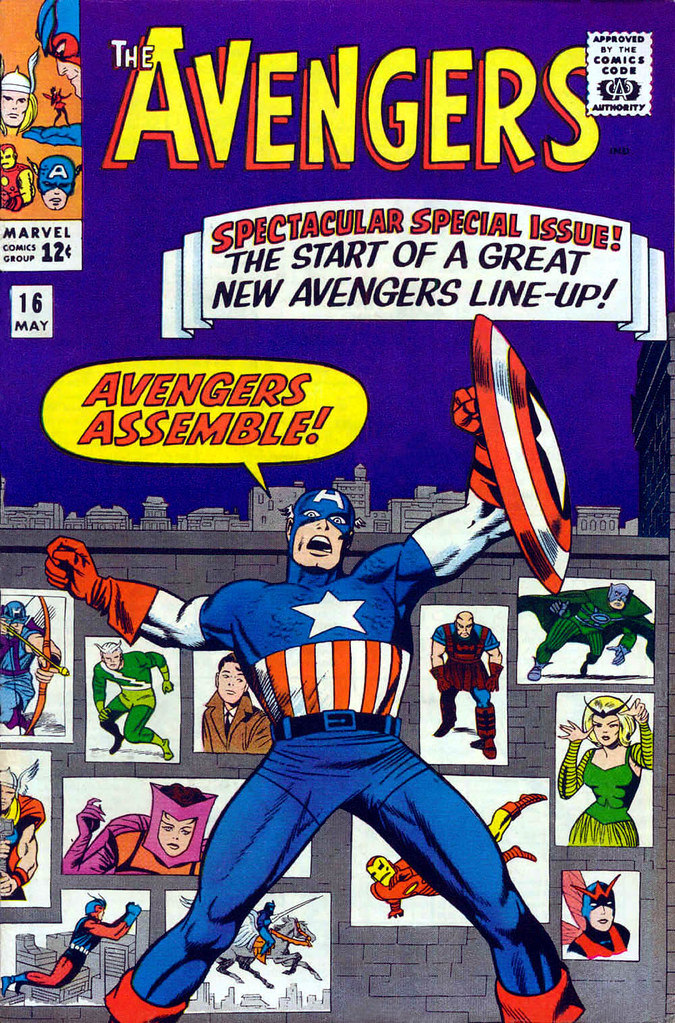
Avengers #16, May 1965.
(By Lee, Kirby & Ayers)

Well, here we are then, the first in what will become a very regular event in the Avengers, the "changing of the guard" issue. Common as muck now, back in the day this must have been a bit of a puzzler for the readership, who'd got used to the adventures of Marvel's Mightiest Heroes, and the Wasp. Off we go.

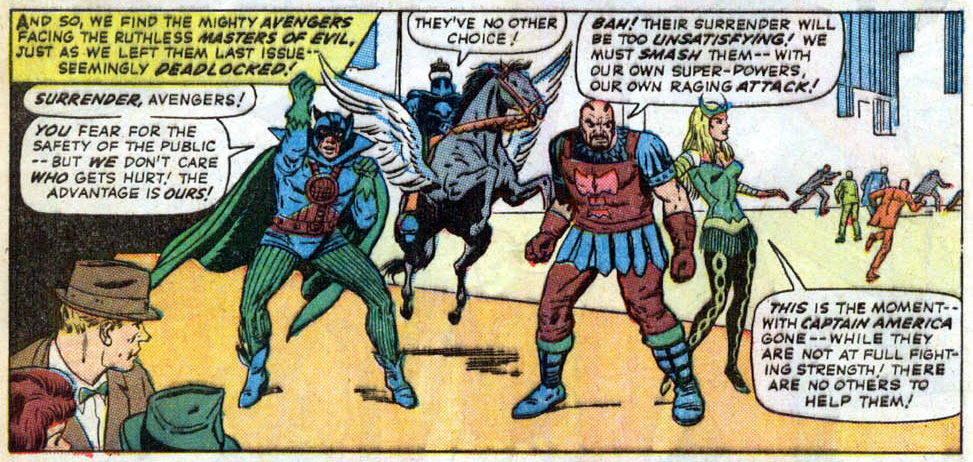
Our story picks up where the last one left off, with the Avengers polishing off the battered remains of the Masters Of Evil. Here they are.


That there, folks, is the Melter (with the stripy tights), the Black Knight (with the horse), the Executioner (with the skirt), and the Enchantress (with the Executioner). They are unaware that the reason Captain America is missing, is because he's in South America, dropping a large number of rocks on the bad guys' leader, Baron Zemo.

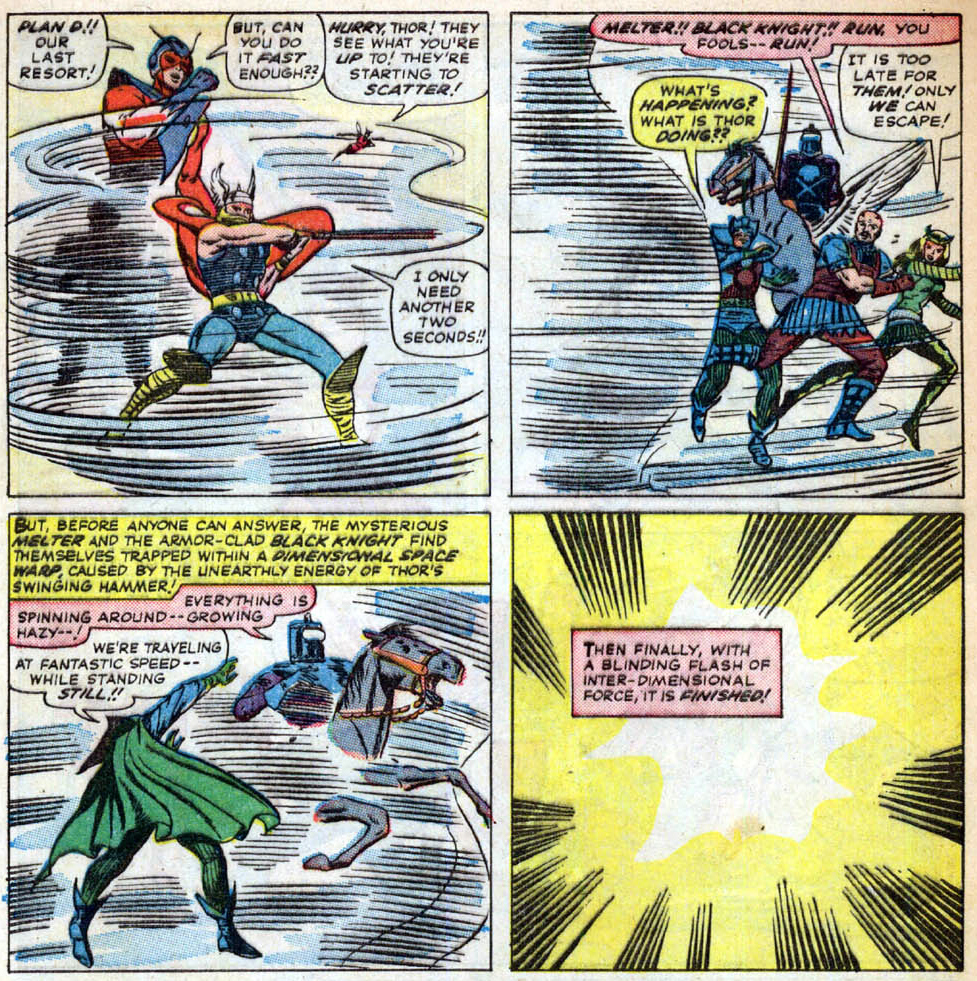
So confident are the Masters of their ability to win the day, that they stand around while Thor twirls his magic hammer; never a good idea.


With the Masters of Evil beaten, and with Cap stranded in South America, the remaining Avengers (Thor having shot off to take care of some private business) meet to decide what to do next. Go rescue Cap, you say? Guess again.


What, just like that? Where's your gumption? Your fighting spirit? Or has Tony Stark had a meeting with his accountants, and found out just how much it's costing to keep his Superfriends on the payroll?

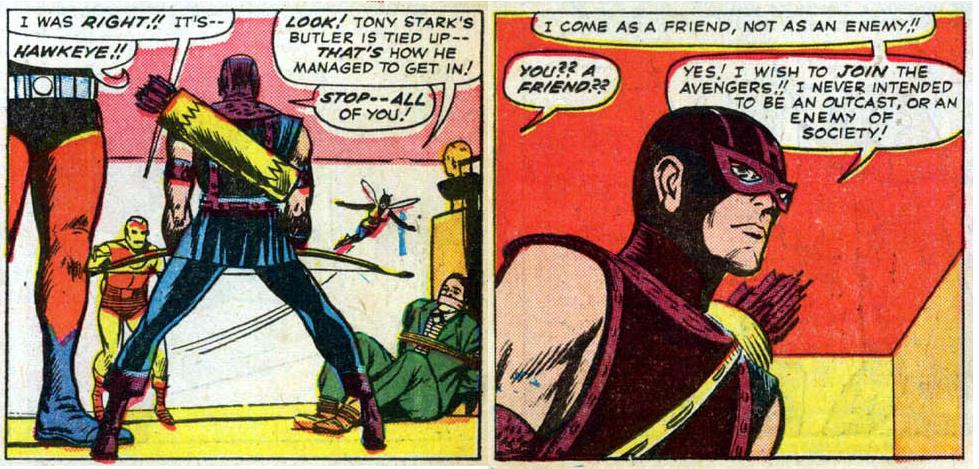
Before the Avengers can make good on their plan to abandon Captain America in the Amazon and retire, they receive a mystery visitor. A visitor who leaves only one clue: an arrow. Wonder if Iron Man can work out who it is...


Hawkeye then spins a sob story about how he's just been misunderstood this whole time, a pawn of the Black Widow and her commie masters. Then he does a trick shot with his arrow. And then the Avengers hire him on the spot. Somehow, I'd have expected the interview process to be more formal. At my work, it takes three months of credit checks, police checks, and god knows what other checks, to even get in the door, and these guys are giving Hawkeye the keys to Avengers Mansion with barely a twenty-second chinwag? Some might say they're being indecently hasty in their rush to retire.

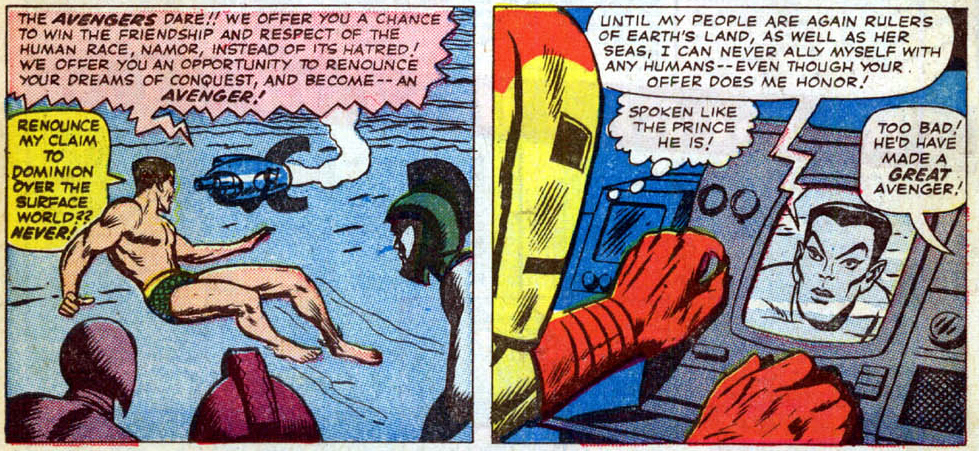
Having hired a two-bit hood to replace them, they next move onto a would-be world conquerer.


I mean, what?!? At this point, the Avengers have only fought Namor a couple of times, but he's gone toe-to-toe with everyone from Daredevil to Spider-Man, and recently led an invasion of New York! Sixties superheroes presumably didn't worry so much about public relations. Ah well, perhaps after he's conquered the surface world, he'll be ready to join up.

Who's next?


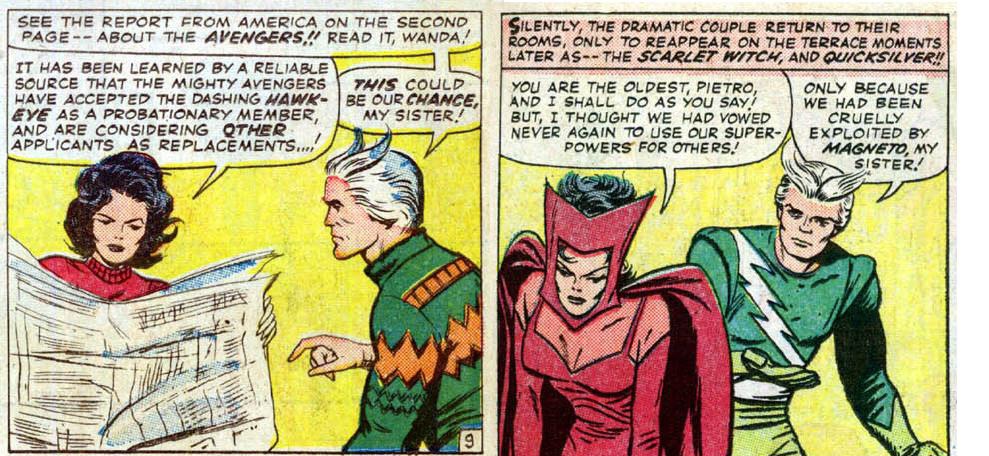
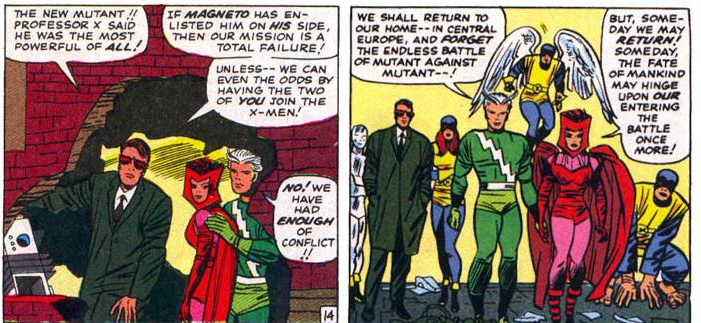
Yes, it's everyones' favourite members of the Brotherhood of Evil Mutants, taking a relaxing time after the dissolution of their gang of villains (in this month's X-Men #11) I don't know what I like more, Quicksilver's sensible yet stripy jumper, or that they feel the need to get changed into their super-togs before deciding to try for membership in the Avengers.

Odd though, wouldn't you really expect them, if they've finally gotten the oppoortunity to join the forces of good, to hang out with their old pals, the X-Men. Or is that speciesist, to think that way. In fact, it's odd to see them contemplating signing up at all, given this exchange, less than a month ago, in that self-same X-Men #11:


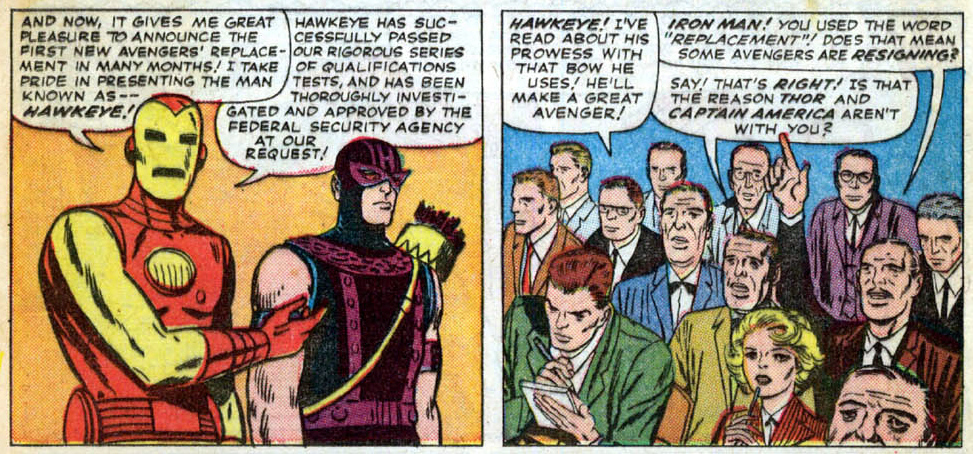
Anyway, let's move back to New York, where the Avengers are announcing their latest recruit:


On the one hand, it's comforting that the team actually have some sort of official screening process. On the other hand, it's a bit disconcerting that the Feds didn't pick up on Hawkeye having spent the last few months working with a commie spy. Not to mention that the assembled ladies and gentlemen of the press don't have anything
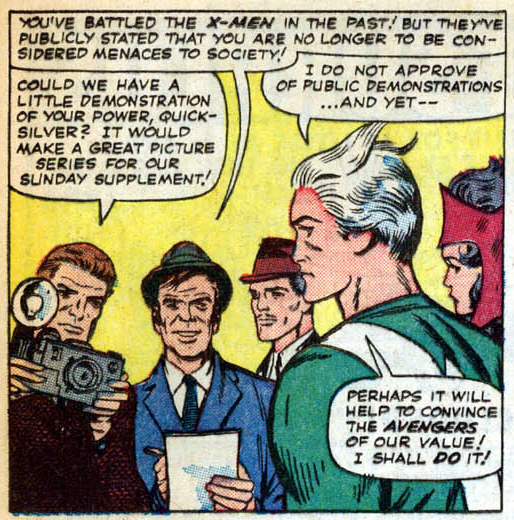
to say about it. Perhaps part of the American Dream is the crimes of supervillains and mutant terrorists are just never mentioned again, once they've apologised. Like so:


Quicksilver, the fastest man alive, proceeds to race Tony Stark's chauffeur through the streets of New York, and perhaps unsurprisingly, he wins. Which is enough for both him and his sister to get a seat at the big table.

No sooner have the new members settled in, then Captain America finally gets back from South America. Without so much as a "where the hell was my lift home?", Cap welcomes the chaps who'll be joining the team.


Ever get the feeling you've been shafted, Cap? Rick's worked it out, he's smart enough to realise that Paste-Pot Pete and the Vulture would have got a job, if they could pass the qualifying test: showing up.

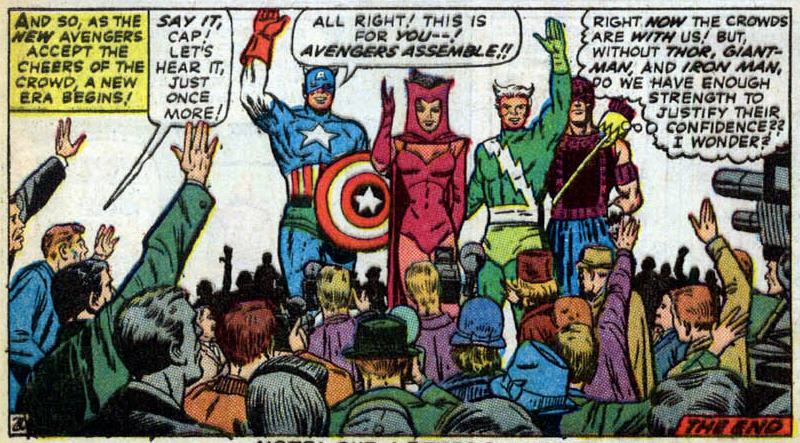
Anyway, with the new team assembled, it's time to meet the people...


Good question, Hawkeye, although I can't but notice that you don't even mention the Wasp. It was tough being a woman in the sixties, huh?

So there we have them: Cap's Kooky Quartet. As anti-establishment as their predecessors were Republican, things are going to be a mite different round Avengers Mansion from now on...