Showing posts with label Dr Strange. Show all posts

Monday, 16 November 2009

70 Years of Marvel - 2006


By 2006, "event comics were rampant at Marvel. We had, in no particular order:

X-Men: Deadly Genesis - in which Ed Brubaker finally answered the question of who Cyclops and Havok's mystery brother was, about a decade after anyone had last expressed an interest in finding this out. The third brother, Vulcan, believed dead, and erased from the memories of everyone who met him (by that good guy, Professor X), came back from the dead, kidnapped the X-Men, killed Banshee, then went off into space to conquer the Shi'ar Empire.

Civil War - in which Mark Millar spins a yarn in which the New Warriors accidentally blow up a school, and the superhero community is torn in half, with factions arguing for and against superhero registration led by Iron Man and Captain America respectively, Spider-Man reveals his secret identity to the world, and Hank Pym builds a clone of Thor.

Planet Hulk - in which Mr Fantastic, Iron Man, Black Bolt and Dr Strange decide to exile the Hulk into space, accidentally sending him to a planet of enslaving insects, whom he proceeds to conquer. Planet Hulk's writer, Greg Pak, would subsequently return the Hulk to Earth to kick some arse, but this was a far superior tale.

Annihilation - in which Annihilus and his Negative Zone pals try to conquer the "Positive" Universe. Used by Keith Giffen and others as a means to jumpstart Marvel's "cosmic" characters, who had been somewhat underused in recent years.

Additionally, 2006 saw the Black Panther marry the X-Men's Storm, Warren Ellis launch Nextwave, comedy misadventures of some b-list heroes, and Neil Gaiman relaunch the Eternals. In all, a busy year for Marvel's marketing department.

Saturday, 14 November 2009

Everything Old Is New Again

Of course, 2004 wasn't just about Brian Bendis. It was also the year of optimistic relaunches:


3rd time out for Alpha Flight, and a return to Marvel for 90s X-writer, Scott Lobdell. A humorous spin on the Canadian superteam, this lasted all of a dozen issues, and most of the team were subsequently exterminated, in order to establish the badass credentials of the latest Avengers foe. As for Cable and Deadpool, this was was a buddy book, written by Lobdell's former partner in X-crime, Fabian Nicieza, and, for the first few issues, even featured covers by Rob Liefeld, who'd brought Cable and Deadpool to comics in the first place.


Keith Giffen, J.M DeMatteis, and Kevin Maguire had made comedy names for themselves with a relaunch of the Justice League at DC Comics, in 1987. 17 years on, they decided to have a crack at the Defenders, applying similar comedic principles to the title. Meanwhile, J. Michael Straczynski decided to have a crack at making Dr Strange popular again, mostly by retelling his origin. Neither limited series did much for the ongoing popularity of their cast, but neither did a great deal of harm either.


On the other hand, these two books did no good at all for anyone. Chris Claremont launched a new Excalibur book, not related to the previous team book, but instead starring Professor X and Magneto, mostly so that Claremont could retcon the evil Magneto who had been showing up in Grant Morrison's New X-Men. There followed a great deal of to-ing and fro-ing between Morrison fans and critics, none of which made Excalibur a good book. Still, compared to James Mullaney's brief revival of Iron Fist, a book so bad that, despite being the biggest fan in the world of Danny Rand, I have been unable to reread, Excalibur was a classic.


Dan Slott made his first venture into the Marvel Universe with a new She-Hulk book, in which Shulkie joins a law firm and engages in all sorts of superhero litigation. Imagine Boston Legal with super-types. In one form or another, this book was still going until quite recently. Meanwhile, having killed off the original Thunderbolts concept, and replaced it with a supervillain wrestling book, Marvel persuaded series originator Kurt Busiek to come back one more time. The relaunch lasted until Warren Ellis came along and kicked out the existing team, in the midst of 2006's Civil War, to my somewhat dissatisfaction.

Yeah, on the whole, actual ideas were pretty much on the way out over at the House of Ideas that year.

Sunday, 1 November 2009

70 Years of Marvel - 1995


Some new looks last longer than others. In 1995, Dr Strange changed from his Jason King look (one which pre-dated Jason King by several years) to this rather stylish persona. This was the tail end of a run on Strange by David Quinn, which had seen the good doctor lose the title of Sorcerer Supreme, become split into three seperate people, and fall out with most of his friends - who would presumably have warned him off adopting such a terrible look. By the end of the year, Quinn was out, and Warren Ellis was in, briefly, to restore Strange to his classic look. This wouldn't be enough to save the book from cancellation. Strange fans are still waiting for him to get another shot at headlining his own book.

1995 also saw the Spider-books dominated by the Clone Saga, with Peter Parker "revealed" to be a clone, and Ben Reilly "revealed" to be the real Peter Parker. By year's end, the saga had outlived its usefulness, but as long as sales remained good, the clone story would drag on. Fans of the original Spider-Man could still get their fix of him, but only in flashback tales, such as the Untold Tales of Spider-Man, a lovely little book from Kurt Busiek, which filled in gaps in Spider-Man's first couple of years.

The X-Books took a four month break this year, with the Age of Apocalypse displacing the "real" universe. A neat concept, showing a world in which Professor X had died, and the consequent changes to the world. Unfortunately, as with all neat ideas, it's a well which successive writers have gone back to, again and again. The AoA was responsible for the introduction of Nate Grey, a parallel version of the character with the most confusing backstory ever, just to make things a bit more opaque.

Finally, this was also the year in which Nick Fury was really, truly, incontravertrally, killed off. Not a dream, not an imaginary story, not a clone, and absolutely, definitely, not a robot duplicate. Gone for good. Or, at least, until 1998, when editorial fiat demanded he be brought back to life. And their clever explanation for this resurrection: he was never dead, it was a robot duplicate. God bless the revolving door of death, and the boundless ability of comics readers to accept this sort of nonsense.

In the real world, the Manic Street Preachers lost their muse. The millions of pounds they would make in the next few years may have softened the blow. In Oklahoma, Timothy McVeigh blew up a federal building, killing 168 people. And OJ Simpson was definitely not guilty of murdering his ex-wife and her boyfriend.

Thursday, 29 October 2009

70 Years of Marvel - 1992


1992 started out as a good year for Marvel. They had a bunch of superstar artists working on their biggest X-Books: Whilce Portacio on Uncanny X-Men, Jim Lee on the Adjectiveless X-Men, and of course, Rob Liefeld on X-Force. Over in the Spider-Books, Erik Larsen had just taken over the writing and drawing on Peter Parker: Spider-Man, replacing Todd McFarlane, who'd gone off in a bit of a strop. They even had a successful relaunch of Guardians of the Galaxy, produced by Jim Valentino. Good times, eh?

It wouldn't last. Turns out that strop that Todd was having was a bit more serious than expected. Rather than going over to DC, or coming back, cap in hand, McFarlane persuaded Portacio, Lee, Leifeld, Larsen and Valentino to go start up their own company with him. Thus was Image Comics born. And while the Image boy's departures did allow new talent like Andy Kubert to get a regular artistic gig, there wouldn't be the superstar mentality of the early 1990s for a good long time.

1992 also saw the Rise of the Midnight Sons, in which Marvel decided to make a group out of all of its darker books. Since, at that point, it only actually had one "darker" book - Ghost Rider - that meant launching a whole line of new books:
Darkhold: Pages From The Book Of Sins - in which dark forces take an ancient grimoire, cut it up, and give pages out of it to unsuspecting bystanders, unleashing all manner of evil.
Spirits of Vengeance - a team-up book between the 1970s Ghost Rider and his 1990s replacement.
Morbius The Living Vampire - the not-quite-a-vampire occasional Spider-Man foe.
Nightstalkers - former Tomb Of Dracula stalwarts, Hannibal King, Frank Drake, and Blade, who teamed up to fight evil. Imagine Angel Investigations, but with less hair product.
Eventually, Dr Strange would be brought into the Midnight Sons fold, but by that time, (1994), the line was dying on its arse, and Marvel would be moving onto its next good idea. More on that later.

As if that wasn't enough, 1992 was also the year in which Tony Stark constructed what would non-ironically be called the War Machine armour. Golly.

Tuesday, 20 October 2009

"Slay Your Enemies, And All You Desire Shall Be Yours!"

As mentioned yesterday, in 1985 (and indeed 1984) comic fans were getting all excited over Secret Wars. It was, while by no means the first mini-series published by Marvel, certainly the first one to have line-wide consequences. These days Marvel would call it an "event", publish a line of related titles, and you'd be sick of the thing before it was halfway finished. In the mid-80s though, Marvel just had many of their top heroes whisked away via a mysterious portal to another world, where they were forced to battle villains, with the promise of the ultimate prize for the winners. Jim Shooter took a year to tell the story of what had happened, but whilst these days, we'd face 12 months of comics featuring stand-in heroes in the missing characters' books, in those days, they simply showed the heroes returning the next month, and the radical changes which the as yet untold Secret Wars had wrought.

Spider-Man appeared with a new, black and white costume, which changed between civilian and super-duds depending on what was needed, and which never ran out of webbing. Later he'd discover that the costume was actually an alien symbiote, trying to take him over. Later still, the symbiote would be reborn as the villainous Venom, and later still, we'd all be sick of the sight of the black costume. But at the time, for all that it was just a change of look, we were quite excited by it.


The Incredible Hulk came back from Battleworld with a broken leg and a bad attitude. The broken leg was courtesy of a fight against Ultron, whilst the bad attitude came, at least in part, from the manipulations of old Dr Strange foe, Nightmare, out to get at the Sorcerer Supreme via one of his fellow former Defenders. Of course, a week of fighting the Absorbing Man and having mountains dropped on him probably didn't help the Hulk's disposition either.


The Vision, newly recovered from a near-death experience, took advantage of the disappearance of most of the Avengers to launch a bloodless coup. Naming himself chairman, he cosied up to the government and got them to approve setting up a new West Coast branch of the team. Had anyone realised that he was suffering from the android equivalent of brain damage after his time spent in a coma, he'd probably have encountered slightly more resistance.


Ben Grimm, in contrast to most of the heroes, quite enjoyed his time away from Earth. He discovered that he was able to turn back into his human form at will, and decided that, on the whole, he'd sooner spend his future riding around on pteradons than go home and be a monster again. So he chose to stay on Battleworld, leaving the Fantastic Four a man short.


The FF didn't waste time replacing the Thing, offering his place in the team to the first superstrong person they saw. In this case, the She-Hulk, who, although a member of the Avengers, was happy to cross the street to the Baxter Building. Later, the Human Torch would take advantage of the Thing's absence to shag his girlfriend. Classy. Secret Wars would also tease the readers of the FF with the mystery of how Doctor Doom, killed the previous year, could be alive on Battleworld. A somewhat convoluted explanation would eventually be given, accompanied by a somewhat gratuitous appearance by the Beyonder.


And the X-Men? Well, they stood around a hill in Japan talking a lot. Well, it was the 80s, and it was Chris Claremont, so perhaps we shouldn't have expected anything too revolutionary. In Claremont's defence, he did use Secret Wars to promote his agenda of Magneto as an extreme activist, rather than as an out-and-out supervillain, to break up Kitty Pryde and Colossus as a couple, and to justify Professor X deciding to take a more active role in leading the X-Men, but what we really remember is the constant talking...

Wednesday, 7 October 2009

70 Years of Marvel - 1975


By 1975, Marvel had a raft of horror magazines out on the racks: Haunt of Horror; Dracula Lives; Tales of the Zombie; Monsters Unleashed; and Vampire Tales. These were black and white books aimed at an older market. But, since there was money to be made, Marvel also had a few horror books set in the mainstream Marvel Universe, of which Tomb of Dracula was both the most famous and, at 70 issues, the longest-running.

In the course of ToD, the lord of the vampires would encounter many Marvel heroes, including Dr Strange, who, after the book was cancelled, would wipe out Dracula and his brethren. It wouldn't take, of course, and Dracula still shows up every so often, most often in the pages of Captain Britain's latest title.

1975 also saw the creation of Madrox the Multiple Man, a mutant who, after appearing with the Fantastic Four, skulked around the corners of the Marvel Universe for over a decade, before turning up as a regular character in the Peter David version of X-Factor. Batman-a-like, Moon Knight began haunting the pages of Werewolf By Night. In the pages of the Avengers, the Scarlet Witch married her android fiancé, the Vision. The Fantastic Four became the Fantastic Five, with the birth of Franklin Richards. Spider-Man had his first encounter with his clone (yes, that one). Meantime, sometime allies, Doctor Doom and the Sub-Mariner were back together, in the pages of Super-Villain Team-Up. And, with Hank Pym chopping and changeing between his Ant-Man and Yellowjacket costumes, the Goliath identity was being taken on by Pym's former partner, Bill Foster. A new team of Champions was born. Most notably, however, 1975 saw the revival of the X-Men, or rather the New X-Men, as Len Wein and Dave Cockrum introduced a new team of international heroes. Marvel Comics would never be the same again.

On tv, Saturday Night Live and Fawlty Towers were making their debut. At the pictures, Jack Nicolson was faking it in One Flew Over The Cuckoo's Nest. At the theatre, audience were witnessing the first performance of the Rocky Horror Show. And in the real world, a young man called Bill Gates was going into business.

Friday, 2 October 2009

70 Years of Marvel - 1971


1971 saw the start of one of Marvel's most famous sagas, the cosmos-spanning Kree-Skrull War, in which the Avengers - aided by the Kree exile, Captain Marvel, learned of a centuries-long conflict between the two most prominent alien races in the Marvel Universe, and, in their efforts to avoid Earth being devastated by the war, found themselves being drawn deeply into it. On the way, Roy Thomas got to bring back (albeit briefly) a number of golden age heroes:


Clockwise, from Captain America, we have the Fin, the Human Torch, the Angel, the Blazing Skull, perpetual sidekick Rick Jones, the Patriot, the original Vision, and of course the Sub-Mariner, all serving as a reminder of the glorious (by this time 32 year) history of the Marvel Universe.

Elsewhere in comics, 1971 saw the introduction of super-psychiatriast, Doc Samson, who would spend the next few years hunting the Hulk. It would also see Spider-Man briefly transformed into a literal man-spider, and the debut of the not-quite-a-vampire, Morbius and the not-quite-Swamp-Thing, Man-Thing, as Marvel chanced their arm to see what the Comics Code Authority would allow. But possibly most earth-shattering of all, 1971 saw the arrival of the world's greatest non-team, the Defenders, as the Hulk teamed up with the Sub-Mariner and Dr Strange to face Yandroth's greatest challenge: the Omegatron! Ooh, scary!

In the real 1971, Britain dropped the old pounds-shilling-pence system, in favour of something which people could actually understand. The World Trade Center, then the tallest building in the world, was completed. The UK government launched Operation Demetrius, interring people suspected of being members of the IRA. And DB Cooper became a legend.

Entertainment-wise, one could pick from buying Led Zeppelin IV, reading The Day of the Jackal, watching The Two Ronnies on the telly, or, if one was quick, catch A Clockwork Orange at the pictures.

Tuesday, 29 September 2009

70 Years of Marvel - 1968


The third of Marvel's late-60s twin-books was Strange Tales, in which Nick Fury shared the spotlight with Dr Strange. The issue above, the Fury portion of which was created by Jim Steranko, featured all sorts of super-spy hijinks, with Fury taking on the Yellow Claw, or a reasonable fascimile, whilst Dr Strange was entering the domain of Yandroth, under the watchful eyes of Denny O'Neil (in one of his few jobs at Marvel) and Dan Adkins.

1968 also saw the arrival of Dane Whitman, the Black Knight, as well as the Vision, two heroes who would henceforth appear as second-stringers within the pages of the Avengers. Over in the X-Men, Polaris was being unveiled as the daughter of Magneto. That wouldn't last.

Elsewhere in 1968, Bobby Kennedy was, briefly, standing for President of the USA. Czechoslovakia was invaded by its next-door neighbour. And Enoch Powell became the most notorious politician in England.

At the pictures, Oliver! was winning the Best Picture Oscar, while Planet of the Apes and 2001 were becoming sci-fi cult classics. On TV, Dad's Army was gearing up for its 9 year run, whilst Philip K. Dick was writing sci-fi cult-classic-to-be Do Androids Dream Of Electric Sheep?.

Friday, 29 August 2008

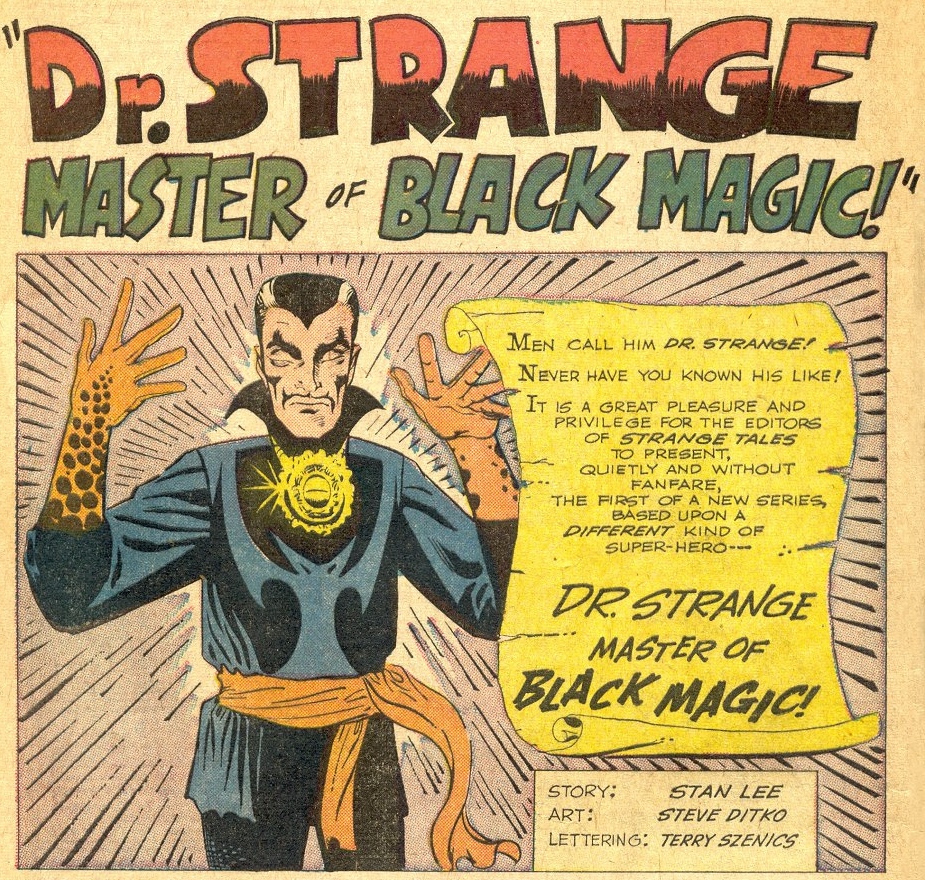
Master Of Black Magic!


Strange Tales #110, July 1963
(By Lee and Ditko, or Ditko and Lee, if you prefer.)


Today we look at the first appearance of Dr Stephen Strange, from when he was merely the star of a backup strip in Strange Tales, the Human Torch's feature-title.

As you see from the picture above, this is an unusual origin, in that it's not being drawn by Jack Kirby. Instead, the quiet man of Marvel Comics, Steve Ditko, who would conjure up some of his (and Marvel's as whole) weirdest stuff for this title, once Dr Strange gained co-star status. But for now, this is a simple five page strip, in which the good Doctor helps a man get over some bad dreams.

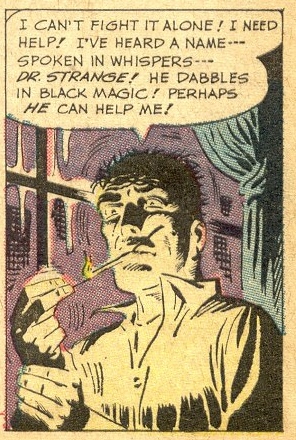
There's some lovely noir art going on here:


Yes, kids, that man there is smoking. Were this the eighties, that would indicate this man is a wrong'un. Were it being published today, the cigarette would have been clumsily whited out, cos Joe Quesada hates smoking. But, this being the sixties, there is no hidden message, no subtext, nothing.

Anyway, Dr Strange decides to pop into his client's dream and check out what's what. To achieve this, though, the Doctor must first pay a visit to his master, the (currently unnamed) Ancient One. It's astral time!


Bit of foreshadowing then from the old boy, you see? Also, a subtle hint for how this adventure will wrap up.

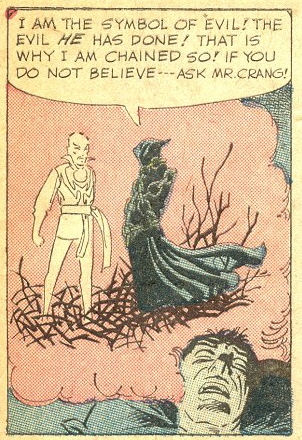
Dropping into a trance, Dr Strange enters the mind of his client, where he meets a sinister chained man...


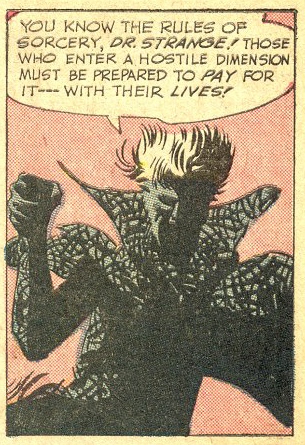
But wait, that's not all! Not only does this tale see the first appearance of the master of the mystic arts, but it also features the premiere appearance of the master of evil dreams, Nightmare! Here he is, folks!


Believe it or not, Nightmare will never again be so scary as he is now. And over the years, he'll put in a lot of appearances, most of them lame.

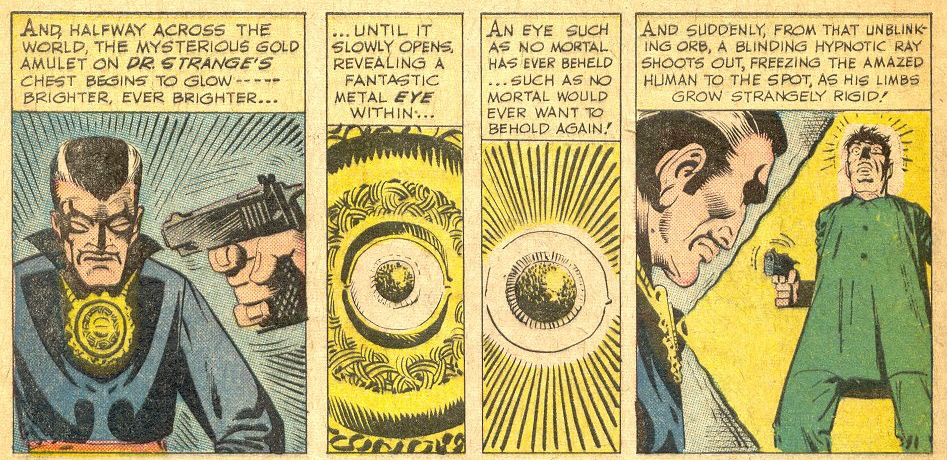
So, whilst Dr Strange is astrally arguing with Nightmare, his client wakes up, realises that the Doc has learned his dark secret, and decides to kill him. God bless America and its easily obtained handguns..!

Facing certain death, and unable to dodge past the oh-so-scary Nightmare, Dr Strange cries like a girl to his master, who decides to intervene.


Returning to his body (leaving Nightmare cursing him in true Scooby-Doo fashion), the Doctor has a quiet word with his somewhat ungrateful client.


And there you have it. No origin story yet, that wouldn't come along until 1968, when Roy Thomas would deliver Strange's origin, but in five pages, Stan and Steve pretty much tell us everything we need to know about our hero.