Showing posts with label Spider-Man. Show all posts

Wednesday, 18 November 2009

70 Years of Marvel - 2007


One of the highlights of 2007 was this little gem, MODOK's 11, in which the Big Giant Head recruits a couple of fistfuls of followers, including second-stringers like Mentallo, the Armadillo, and the Chameleon, to commit the ultimate robbery. With the rest of the Marvel Universe getting increasingly grim and gritty, this was a nice lighthearted little romp, and got Fred Van Lente his first start in the Marvel Universe proper.

Other than this, most books in 2007 revolved around either the fallout from Civil War, the consequences of the Annihilation Event, or the Hulk's invasion of New York. The Spider-Books were being culled left, right, and centre, whilst Spidey himself was making a deal with the devil to save his Aunt May. Elsewhere, JMS was being recruited to revamp Thor, Captain America was getting shot, and Iron Man was being appointed Director of SHIELD. The world was getting weirder, that was for sure.

Monday, 16 November 2009

70 Years of Marvel - 2006


By 2006, "event comics were rampant at Marvel. We had, in no particular order:

X-Men: Deadly Genesis - in which Ed Brubaker finally answered the question of who Cyclops and Havok's mystery brother was, about a decade after anyone had last expressed an interest in finding this out. The third brother, Vulcan, believed dead, and erased from the memories of everyone who met him (by that good guy, Professor X), came back from the dead, kidnapped the X-Men, killed Banshee, then went off into space to conquer the Shi'ar Empire.

Civil War - in which Mark Millar spins a yarn in which the New Warriors accidentally blow up a school, and the superhero community is torn in half, with factions arguing for and against superhero registration led by Iron Man and Captain America respectively, Spider-Man reveals his secret identity to the world, and Hank Pym builds a clone of Thor.

Planet Hulk - in which Mr Fantastic, Iron Man, Black Bolt and Dr Strange decide to exile the Hulk into space, accidentally sending him to a planet of enslaving insects, whom he proceeds to conquer. Planet Hulk's writer, Greg Pak, would subsequently return the Hulk to Earth to kick some arse, but this was a far superior tale.

Annihilation - in which Annihilus and his Negative Zone pals try to conquer the "Positive" Universe. Used by Keith Giffen and others as a means to jumpstart Marvel's "cosmic" characters, who had been somewhat underused in recent years.

Additionally, 2006 saw the Black Panther marry the X-Men's Storm, Warren Ellis launch Nextwave, comedy misadventures of some b-list heroes, and Neil Gaiman relaunch the Eternals. In all, a busy year for Marvel's marketing department.

Thursday, 12 November 2009

70 Years of Marvel - 2003


Another year, another new brand. 2003 was the year of Tsunami Comics, a line of books aimed at appealing to the Manga market, a source of prime dollars of which Marvel was thus far not getting a slice. The idea of the line was to produce books which would be reprinted in the digest format of Manga books, rather than the full-size trade paperbacks normally used.

We got some good books out of it. Sentinel (above) was the Iron Man / Iron Giant with a mutant-hunting robot instead of a a big friendly robot, whilst Runaways was the story of a group of teenagers who discover their parents are eeeviiiillll! Other than those sparks of originality, though, mostly it was just the same old, same old: a relaunch of New Mutants; an attempt at a solo book for bad / good mutant, Mystique; the teenage adventures of Emma Frost; and new books for Venom, Sub-Mariner, and the Human Torch. The line wasn't a great surprise: most people can presumably tell the difference between real Manga and Marvel's pseudo-Manga, and those that couldn't just weren't gripped by what they saw.

2003 also saw the legendary Neil Gaiman doing his first work for Marvel, with 1602, which had the Marvel Universe transposed to Elizabethan times. A fine tale in its own right, I'm sure the numerous non-Gaiman sequels, prequels and sidequels, haven't detracted from its impact at all.

Finally, 2003 also saw the definitive origin of Spider-Man, in the Mark Millar-penned Trouble. Or maybe it didn't. After all the hype about this book, no-one really seems sure what the point of it all was.

In the real world, 2003 saw the Columbia shuttle disaster, the downfall of Saddam Hussein, and the return of Dirty Den, all of which kept the internet chattering.

Friday, 6 November 2009

70 Years of Marvel - 1998


By 1998, Peter David had been writing the adventures of the Incredible Hulk for over a decade. In that time, the character had gradually evolved, from a character which no-one was really interested in, to one of the company's most complex books, with a main character whose motivations we could never really be sure of, and whose next move we'd rarely be able to guess. The book being a big success, Marvel editorial naturally wanted to tamper. Unfortunately, by 1998, Peter David was nearly as big a success as the Hulk, so when he was asked to alter his plans for the character, restoring the Dumb Savage Hulk who'd been so preeminent before his takeover, he walked off the book. It wouldn't be the last falling out PAD would have with Marvel Editorial, but it would be the biggest, with the Hulk wandering undirected for the next few years.

1998 also saw Marvel experiment again with outsourcing their work, this time to Event Comics, a little company run by an up-and-coming writer / artist called Joe Quesada. Rather than handing over their prime properties to Quesada and co, Marvel instead gave them free reign with some of their second-tier titles: Black Panther, Daredevil, the Inhumans, and the Punisher. The Marvel Knights books, as they were branded, were aimed at an older readership, 15 up, and, other than redefining the Punisher as a fallen angel, didn't miss a beat. In particular, Daredevil's fortunes took an upswing, transforming a character that no-one had known what to do with in years, into a grim and gritty street vigilante, under the authorship of first Kevin Smith, then Brian Michael Bendis. As with every successful idea in comics, the first idea of editorial is that more of what is successful, will automatically be more successful. Which is why pretty much every book this decade has been aimed at older readers. Comics aren't for kids, folks, not anymore.

Or maybe they are. After all, 1998 was also the year in which Spider-Girl gained her own title. Created as a one-off for an issue of What If?, May "Mayday" Parker is the daughter of Spidey and wife former bidey-in, Mary Jane (a daughter never born in the "real" Marvel Universe), and her adventures, provided by Tom DeFalco, have been ongoing ever since, despite numerous well-documented attempts to kill the title off. Let's hear it for the little book that could.

Elsewhere in 1998, Bill Clinton was denying having had relations with "that woman", whilst George Michael was admitting trying to have relations with "the man".

Thursday, 5 November 2009

In The Interest Of Balance

In case anyone feels I was unfair in claiming that my favourite book of the past 12 years was also the most important debut of 1997, here's a quick rundown of the other continuing books which had their debut in that year...


Steve Seagle was tapped to bring back Alpha Flight, a book that had limped along for a decade before being put to sleep in 1994. Mostly a conspiracy book, with Alpha working for the sinister forces of Department H, the book lasted 20 issues before dying off again.


A bit player in the X-Books since the early 90s, Maverick was given his own book, so that those who wanted to read the adventures of a mutant spy with a terminal disease, could do so. Since it lasted all of a dozen issues, I'm guessing Marvel overestimated the popularity of the character.


If T-Bolts was my favourite book of 1997, Heroes For Hire came a close second at times. Obstensibly a reunion for Power Man and Iron Fist, this book, devised by Roger Stern and delivered by John Ostrander, felt at times more like a reboot of the Defenders. The heroes didn't do a lot of work for hire, and there was that rotating team that Defenders fans were so familiar with. Unfortunately, although it was a good concept, it didn't catch on, and was canned after 19 issues.


Never one to let an old idea die, Marvel have resurrected MTU a few times now, but this was the first attempt, itself spinning out of a quarterly Spider-Man Team-Up book. Written by Tom Peyer, who's mostly worked for DC over the years, this was another one which barely made a dozen issues.


Another book from Peyer, Quicksilver featured the mutant speedster in one of his more heroic moments, working for the High Evolutionary and fighting against such foes as Maximus the Mad and Exodus, and was axed after 13 issues, after a team-up with the equally doomed Heroes For Hire.


Having been turfed off Captain America in the Heroes Reborn event, Mark Waid could have had his pick of characters to write. Bizarrely, he chose Ka-Zar, a second-stringer since 1965, and who, despite Waid's best efforts, would remain a second-stringer well after the 20 issues of this title.


Yeah, ok, you got me. They can't all be losers, and by any definition, Deadpool's been a big success, to the extent that, as of 2009, he stars in two ongoing titles, and he's probably the second most overexposed mutant out there. But in 1997, no-one really expected Joe Kelly's stab at an ongoing book for the Merc-With-A-Mouth to make it big. And, to be honest, I'm still astonished at the longevity of what is basically a one-dimensional character. Go figure.

So there you go. Seven books launched in the same year as Thunderbolts, of which one can be classed as a success. T-Bolts doesn't seem so lame now, does it?

Tuesday, 3 November 2009

70 Years of Marvel - 1996


1996 was a crunch year for Marvel. While the X-Titles were doing ok, the Spider-Books were embroiled in the seemingly-everlasting Clone Saga, and the Avengers were just emerging from The Crossing, a crossover event which had seen Tony Stark go evil, the Wasp turned into a real giant-size woman-bug, and many readers jumping ship. Captain America, written at the time by Mark Waid, was well-regarded, but nothing spectacular, sales-wise. And the Fantastic Four had been lumbering along under Tom DeFalco's guidance for years. With sales crashing all over as a result of the end of the speculator boom, Marvel wanted to try something radical.

Their answer was Onslaught, an ultra-powerful mutant (with a dark secret) who tried to destroy the world. A couple of months of group-wide crossovers led to a final battle, in which the Avengers and the FF sacrificed themselves to stop Onslaught. The public, seeing their heroes killed, blamed mutantkind, and the X-Men's lives got that little bit more difficult.

But the Avengers and the Fantastic Four weren't dead. Oh no, not at all. Instead, they faced a worse fate: outsourcing! Marvel hired Jim Lee and Rob Liefeld, founders of Image Comics, to "reimagine" the two teams, in the Image style. So it was farewell to the classic Marvel style, and hello to this...


It worked, after a fashion. Sales went through the roof, and everyone was talking about Marvel again. And that the the books weren't very good didn't really matter. After a year, the books would revert to being written and drawn in-house, with yet another set of #1 issues. And because each restart was accompanied by a bump in sales, we could henceforth look forward to pretty much every Marvel title restarting every couple of years.

In other comics news, the Clone Saga did eventually finish, at the end of this year, accompanied by the return of Norman Osborn. It says something for how much people were tired of the whole clone thing, that the resurrection of Spidey's most famously dead arch-nemesis seemed like a pretty neat idea. 13 years on, and with Norman appearing in pretty much every comic pretty much every month, it doesn't seem like such a winning plan.

1996 was also the year of Amalgam Comics, in which Marvel and DC Comics collaborated on a shared universe, with characters made up of blends of both companies' heroes and villains.


A novel idea amongst a sea of detritus, Amalgam Comics managed two runs, in '96 and '97, before vanishing without trace.

Sunday, 1 November 2009

70 Years of Marvel - 1995


Some new looks last longer than others. In 1995, Dr Strange changed from his Jason King look (one which pre-dated Jason King by several years) to this rather stylish persona. This was the tail end of a run on Strange by David Quinn, which had seen the good doctor lose the title of Sorcerer Supreme, become split into three seperate people, and fall out with most of his friends - who would presumably have warned him off adopting such a terrible look. By the end of the year, Quinn was out, and Warren Ellis was in, briefly, to restore Strange to his classic look. This wouldn't be enough to save the book from cancellation. Strange fans are still waiting for him to get another shot at headlining his own book.

1995 also saw the Spider-books dominated by the Clone Saga, with Peter Parker "revealed" to be a clone, and Ben Reilly "revealed" to be the real Peter Parker. By year's end, the saga had outlived its usefulness, but as long as sales remained good, the clone story would drag on. Fans of the original Spider-Man could still get their fix of him, but only in flashback tales, such as the Untold Tales of Spider-Man, a lovely little book from Kurt Busiek, which filled in gaps in Spider-Man's first couple of years.

The X-Books took a four month break this year, with the Age of Apocalypse displacing the "real" universe. A neat concept, showing a world in which Professor X had died, and the consequent changes to the world. Unfortunately, as with all neat ideas, it's a well which successive writers have gone back to, again and again. The AoA was responsible for the introduction of Nate Grey, a parallel version of the character with the most confusing backstory ever, just to make things a bit more opaque.

Finally, this was also the year in which Nick Fury was really, truly, incontravertrally, killed off. Not a dream, not an imaginary story, not a clone, and absolutely, definitely, not a robot duplicate. Gone for good. Or, at least, until 1998, when editorial fiat demanded he be brought back to life. And their clever explanation for this resurrection: he was never dead, it was a robot duplicate. God bless the revolving door of death, and the boundless ability of comics readers to accept this sort of nonsense.

In the real world, the Manic Street Preachers lost their muse. The millions of pounds they would make in the next few years may have softened the blow. In Oklahoma, Timothy McVeigh blew up a federal building, killing 168 people. And OJ Simpson was definitely not guilty of murdering his ex-wife and her boyfriend.

Saturday, 31 October 2009

70 Years of Marvel - 1994


Can you believe there was a time when we weren't all just a bit tired of Alex Ross' painted artwork? Or when hardly anyone had heard of Kurt Busiek? Marvels made stars of both men, and deservedly so. A retelling of some of the most iconic moments from the 60s and 70s of Marvel Comics, through the cynical eyes of a photojournalist, Marvels managed to make events like the coming of Galactus and the death of Gwen Stacy come to life in a way that even Jack Kirby and Gil Kane could only dream. Like all classics, it's probably a bit overrated, but it holds up a damn site better than most modern classics, much like the source material that Busiek and Ross were studying.

1994 was also the year that saw Avengers West Coast shut down and replaced with the much more EXTREME Force Works. It featured some of the earliest Marvel US work by the 2000AD team of Dan Abnett and Andy Lanning, who would do much better on books to come. Mostly made up of disaffected ex-Avengers, Force Works handled cases too EXTREME for other super teams. I'd take the piss out of this more, but it doesn't really deserve it. Not compared to the awful terribleness that was Fantastic Force, an attempt to create an FF franchise. This starred mysteriously grown-up Franklin Richards leading a team of heroes so obscure that they arrived without trace, and vanished the same way a year or so later. Interestingly, the team was brought together by the Black Panther, who somehow managed to wriggle out of membership. Good choice, T'challa.

Less terribly awful, at least at first, was Generation X, an attempt at the whole "mutant kids learning to adjust to their powers in a school environment" concept, that the New Mutants had tried a decade or so back. This saw the transformation of Emma Frost from White Queen of the Hellfire Club to the sarcastic schoolmistress we've all come to know and love.

Another new book, and one which whilst somewhat better regarded, would vanish without trace after barely a handful of issues, was Clan Destine, Alan Davis' follow-up to his Excalibur work. Quirky does not usually equate with longevity, and this was no exception.

Oh, and was there something else? I'm sure there was some other event. Oh, yes, of course. Spider-Man began to share book space with a young man calling himself Ben Reilly. Disaster lay ahead...

In the real world, or close to it, Kurt Cobain broke teenage grunge hearts all over the world, Ayrton Senna crashed into a wall at 135mph, and John Smith died, giving God's Gift To Labour a chance to rule Britain in a couple of years.

Monday, 26 October 2009

70 Years of Marvel - 1990


In 1990, Jim Starlin was back with a vengeance. Starlin had been out of the superhero game for most of the 80s, concentrating on his science-fiction work, but his killing off of Robin over in the BatBooks had brought him back to the attention of Marvel Editorial, who hired him to take over the Silver Surfer book. Within a couple of issues, Starlin had brought his most famous creation, Thanos, back from the dead, along with Thanos' nemesis, Drax the Destroyer. For the next couple of years, Starlin would take Marvel Comics in a more cosmic direction, with the Infinity Trilogy, the return of Adam Warlock, and the formation of the Infinity Watch. The cosmic revival didn't last long after Starlin lefr Marvel for other shores, and it would be a long time before we'd see Marvel do "cosmic" again.

In other comics, 1990 saw the introduction of Gambit, terrible accented cajun thief, and Cable, the mutant with the most complicated secret origin ever. I'd explain what was so confusing, but Quarter Bin, a much-missed comics website from ages past, did so much more consisely.


In the Avengers, Spider-Man nearly joined the team, whilst Sersi the Eternal and Rage the street vigilante did so. Danny Ketch became a new Ghost Rider, and Sub-Mariner, Nomad, and the Guardians of the Galaxy all got a new series.

Meanwhile in 1990, Nelson Mandela was out of jail, the USSR was coming apart at the seams, and Mrs Thatcher was being turfed out of her seat. On tv, we were being baffled by Twin Peaks, and Paul Merton and Ian Hislop began taking shots at those making the news, while at the pictures, Macaulay Culkin was becoming a child star.

Friday, 23 October 2009

70 Years of Comics - 1987


1987 saw Walt Simonson bring to a close his four-year run on Thor, a run which he'd used to reestablish Thor's godly credentials. Simonson had used ever Norse legend out there, up to and including Ragnarok. In the process, Thor had been mostly pulled out of his usual interactions with the rest of the Marvel Universe, although he would still be involved in major events like the Siege of Avengers Mansion and the Morlock Massacre. For most of the run, Simonson was both writing and drawing the book, though for the later issues the art was handled by workhorse Sal Buscema, who showed he was just as capable at handling the epic stuff as he had been the day-to-day activities of Peter Parker and Bruce Banner. Like Frank Miller's run on Daredevil, Simonson's run on Thor has never been matched; unlike Miller's run, no-one's even come close to matching Simonson.

1987 was the year that Steve Rogers was replaced in the Captain America suit by John Walker, who would later be better known as the U.S. Agent. It also saw Peter Parker and Mary Jane Watson marry move in together, setting a fine example to the youth of America.

1987 also saw Terry Waite kidnapped in Beirut, where he'd spend the next 4 years in captivity. Ronald Reagan and Oliver North were embroiled in the Iran-Contra Affair. And despite Michael Fish's assurances to the contrary, there was a hurricane coming to the south of England.

Tuesday, 20 October 2009

"Slay Your Enemies, And All You Desire Shall Be Yours!"

As mentioned yesterday, in 1985 (and indeed 1984) comic fans were getting all excited over Secret Wars. It was, while by no means the first mini-series published by Marvel, certainly the first one to have line-wide consequences. These days Marvel would call it an "event", publish a line of related titles, and you'd be sick of the thing before it was halfway finished. In the mid-80s though, Marvel just had many of their top heroes whisked away via a mysterious portal to another world, where they were forced to battle villains, with the promise of the ultimate prize for the winners. Jim Shooter took a year to tell the story of what had happened, but whilst these days, we'd face 12 months of comics featuring stand-in heroes in the missing characters' books, in those days, they simply showed the heroes returning the next month, and the radical changes which the as yet untold Secret Wars had wrought.

Spider-Man appeared with a new, black and white costume, which changed between civilian and super-duds depending on what was needed, and which never ran out of webbing. Later he'd discover that the costume was actually an alien symbiote, trying to take him over. Later still, the symbiote would be reborn as the villainous Venom, and later still, we'd all be sick of the sight of the black costume. But at the time, for all that it was just a change of look, we were quite excited by it.


The Incredible Hulk came back from Battleworld with a broken leg and a bad attitude. The broken leg was courtesy of a fight against Ultron, whilst the bad attitude came, at least in part, from the manipulations of old Dr Strange foe, Nightmare, out to get at the Sorcerer Supreme via one of his fellow former Defenders. Of course, a week of fighting the Absorbing Man and having mountains dropped on him probably didn't help the Hulk's disposition either.


The Vision, newly recovered from a near-death experience, took advantage of the disappearance of most of the Avengers to launch a bloodless coup. Naming himself chairman, he cosied up to the government and got them to approve setting up a new West Coast branch of the team. Had anyone realised that he was suffering from the android equivalent of brain damage after his time spent in a coma, he'd probably have encountered slightly more resistance.


Ben Grimm, in contrast to most of the heroes, quite enjoyed his time away from Earth. He discovered that he was able to turn back into his human form at will, and decided that, on the whole, he'd sooner spend his future riding around on pteradons than go home and be a monster again. So he chose to stay on Battleworld, leaving the Fantastic Four a man short.


The FF didn't waste time replacing the Thing, offering his place in the team to the first superstrong person they saw. In this case, the She-Hulk, who, although a member of the Avengers, was happy to cross the street to the Baxter Building. Later, the Human Torch would take advantage of the Thing's absence to shag his girlfriend. Classy. Secret Wars would also tease the readers of the FF with the mystery of how Doctor Doom, killed the previous year, could be alive on Battleworld. A somewhat convoluted explanation would eventually be given, accompanied by a somewhat gratuitous appearance by the Beyonder.


And the X-Men? Well, they stood around a hill in Japan talking a lot. Well, it was the 80s, and it was Chris Claremont, so perhaps we shouldn't have expected anything too revolutionary. In Claremont's defence, he did use Secret Wars to promote his agenda of Magneto as an extreme activist, rather than as an out-and-out supervillain, to break up Kitty Pryde and Colossus as a couple, and to justify Professor X deciding to take a more active role in leading the X-Men, but what we really remember is the constant talking...

Monday, 19 October 2009

70 Years of Marvel - 1985


1985 saw the conclusion of the original Secret Wars series, a particularly well-received mini-series, in which the Beyonder, an all-powerful alien, kidnapped Spider-Man, the Avengers, the Fantastic Four, and the X-Men, and sent them to a planet to fight a variety of supervillains, including Galactus, Kang, Doctor Octopus, and of course, Doctor Doom (pictured, above, getting a kicking from the Beyonder). The series, written by then editor-in-chief, Jim Shooter, was followed up by Secret Wars 2, in which the Beyonder came to Earth to study humanity, meeting pretty much every hero along the way. Secret Wars 2 was pretty much universally reviled, which shows that even in the 80s, Marvel didn't know how to quit while they were ahead.

Secret Wars 2 did have one long-term effect, that of the introduction of Tabitha Smith, who, under the alias, Boom Boom, would become one of the New Mutants. Also, Longshot, hollow-boned alien mutant X-Man, made his first appearance in this year, whilst Firestar, who'd been one of Spider-Man's Amazing Friends on tv a few years previously, made it into the Marvel Universe proper.

In the real world, 1985 was the year of Live Aid, in which the great and the good of pop music sang their little hearts out for famine relief. Mikhail Gorbachev came to power in the USSR. Coca Cola released New Coke; it didn't last.

On the telly, Eastenders, an ordinary tale of simple London folk, had its debut, as did the Australian soap, Neighbours. Action hero, MacGuyver, made his first appearance, Bruce Willis was becoming a star in Moonlighting, and Elmo joined the cast of Sesame Street. In the cinema, Out of Africa was scooping up Oscars like candy, but Back to the Future was the film people actually wanted to see.

Saturday, 17 October 2009

My First Comics

I may never know which Borders comics fan's mum decided to turf out his November and December-dated Marvel comics, but it was my good fortune that, rather than binning them, she instead donated them to one of the stalls at the Liberal Party's pre-Christmas Bazaar. At the event, where I was dragged by my mum and dad, not only did I get to meet the impressively-statured Cyril Smith, I was confronted with a selection of comics of which, until then, I was sadly unaware.


Alpha Flight #4 & #5 (both by John Byrne)
Alpha Flight #4 featured the tail end of a multi-parter in which the so-called Master of the World attempted to conquer the world, using Marrina the Fish-Girl. It also featured the Invisible Girl and Sub-Mariner, and introduced the idea of Aurora's multiple personality disorder. Issue #5 featured the dwarf, Puck, investigating a drug-smuggling ring based out of a hospital. For a comic featuring only one character I'd even heard of, Alpha Flight had me hooked from the start.


Fantastic Four #260 & #261 (both also by John Byrne)
FF #260 introduced me to the FF's nemesis, Doctor Doom (I may have been aware of him from things like the Spider-Man cartoons, but it would be a very vague awareness), and, before the end of the issue, had killed him off, in a battle between the Silver Surfer and Tyros. This was also the end of a multi-parter, but was also reasonably straightforward to fathom. Alpha Flight #4 was set immediately between #260 and #261, introducing me to the idea of crossovers between titles. #261 had the FF off in space, bumping into the Watcher, and had the team trying to justify not having let Galactus die in an earlier issue. This was a bit of a mystery, but by the end of the book, I pretty much understood what it was all about. The issue also featured a recap of the FF's origin, which was handy for newbies like me.


Amazing Spider-Man #246 & #247 (by Roger Stern and John Romita Jr)
ASM #246 was, essentially, an imaginary story, in which J. Jonah Jameson, Mary Jane Watson, the Black Cat, and Spidey himself daydreamed about their perfect day. Oddly, whilst Jameson and the Cat's dreams ended well, neither Mary Jane or Peter Parker were able to sustain their delusion, suggesting that both have some psychological issues to deal with. #247 featured Spidey teaming up with the fabulous Frog Man, a hunt for the Hobgoblin, and a mystery villain, Thunderball (of the Wrecking Crew). It would be years before I would find out who Thunderball is, and I have no idea to this day about Frog Man. The Hobgoblin was another story, of course.


Spectacular Spider-Man #84 (by Bill Manto and Dave Simons) and #85 (by Mantlo and Al Milgrom)
PPTSSM #84 featured Spidey hunting down a gang of child abductors, and was a purely self-contained story. #85, on the other hand, had the Hobgoblin show up to take on Spidey and the Black Cat. It also, handily, showed the story so far of the Hobgoblin, and featured Peter Parker having a get together with his old college friends, including Harry Osborn, which in turn introduced me to the history of the Green Goblin, which made Spider-Man's obsession with the Hobgoblin a lot more explicable.


Avengers #237 & #238 (both by Roger Stern and Al Milgrom)
Avengers #237 featured Spider-Man trying out for the team, an event alluded to in Spidey's own book, and had the Avengers fighting a whole load of supervillains in Project Pegasus. Looking back, I'm not sure why I accepted supervillains being imprisoned with their costumes on, but it's not something that gave me cause for concern at the time. Issue #238 had the Vision, in a coma due to an earlier battle, recover unexpectedly, showed the She-Hulk househunting, and featured a last-page appearance by Tigra and the ghost of Spider-Woman, the last of which confused the heck out of me.


Captain America #288 (by JM DeMatteis and Mike Zeck)
Set in the future world of 1993, this featured Cap teaming up with the cyborg, Deathlok, to take on the ruler of a destroyed New York. This was pretty much double-dutch to me at the time, and since I didn't have the next issue, it would be a long time before I'd find out how Cap stopped the imminent destruction of the world.

Daredevil #202 (by Dennis O'Neil and William Johnson)
This book had Matt Murdock's firm hired by an African tribe do do PR for their boss, Micah Synn. Micah turns out to be a nutjob, prone to dangling policemen out of windows. As a one-shot, it does a fine job of introducing DD and his significant others, and as an introduction to Micah Synn, it made me want to read more about him, which handily was what Denny O'Neil intended.


Defenders #125 (by JM DeMatteis and Don Perlin)
My first issue of Defenders featured the departure of the original team, the wedding of Patsy Walker and Daimon Hellstrom, and a new team being formed. it also featured an Elf. Much of this made little sense, but thankfully, there was a handy letters page which clarified some of what was going on.

The Thing #5 (by John Byrne and Ron Wilson)
This book had Ben Grimm getting beaten up, for no readily apparent reason, by Wonder Man, She-Hulk, and Spider-Man, before being possessed by his old foe, the Puppet Master. I didn't know at the time who the Puppet Master was, nor why he was out to get the Thing, so this was a less successful introduction to the book, but since the book was essentially an FF spin-off, it wasn't too much of a problem.


Incredible Hulk #289 (by Bill Mantlo and Sal Buscema)
The Hulk was intelligent at this point in his history, which seemed odd at the time, less so now. It had MODOK setting the Abomination to attack Bruce Banner, who was working for the government on gamma ray research - which with hindsight seems less logical than the Hulk's intelligence. Mostly the issue involved Hulk beating up the Abomination, which for a Hulk book is pretty much what you'd expect.

Marvel Team-Up #135 (by Bill Mantlo, again, and Ron Frenz)
This issue featured Kitty Pryde (note the lack of codename) rescuing some kidnapped children from the Morlock tunnels, with the help of Spider-Man. I didn't know who the Morlocks were at the time, and I'm not sure why they were kidnapping people, but it was a decent enough tale, at the time.


The Mighty Thor #337 (by Walt Simonson)
This was a flummoxer. Thor lost his powers, whilst an alien invader gets them. Nick Fury turns up, with little explanation of who he is and why he has a flying car and a helicarrier. And out in space, someone is forging something big. Now, having read the succeeding two years worth of issues, I know this is a classic, but at the time, it was not a good first issue. Not at all.

Uncanny X-Men #175 (by Chris Claremont, Paul Smith and John Romita Jr)
Speaking of confusing first issues, this issue features the wedding of Cyclops and Madelyne Pryor, the return of Dark Phoenix, and Mastermind looking for revenge against the team for what Phoenix had done to him. Confusing stuff, but with enough exposition (this was a Claremont book) to make it explicable.

So there you have it. My first 18 Marvel books. Some classics, and some, less than classic, but enough to get an 11 year-old me hooked on the things, if not for life, then at least for the forseeable future. To my bank manager's horror.

Saturday, 17 January 2009

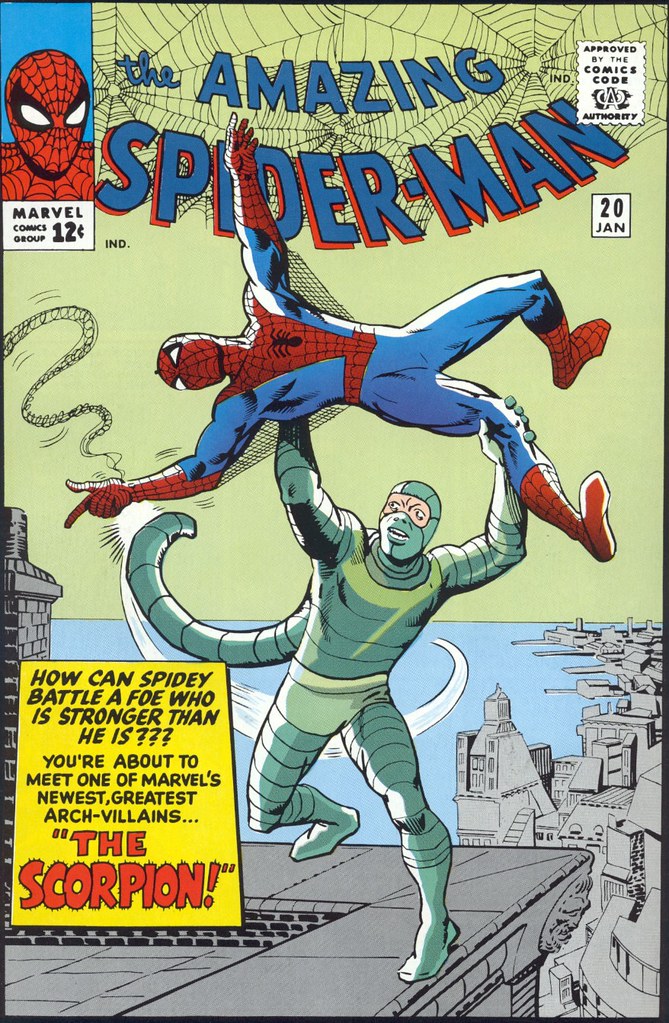
The Coming Of The Scorpion!


Amazing Spider-Man #20, January 1965.
(By Lee, Ditko, and Sam Rosen)


Thanks to the wonders of Marvel Tales reprints, this was one of the earliest Spider-Man books that I read, back when I was a nipper. And what a book it is! This book represents Stan and Steve at the height of their combined power, and is as close to perfection as you'll read in a Marvel comic. But don't take my word for it. See for yourself.

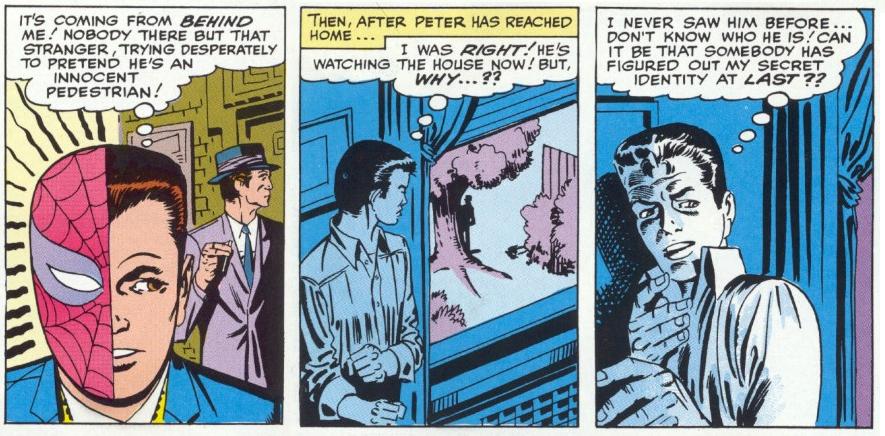
Our tale picks up with Peter Parker being stalked by a mysterious stranger, who hasn't reckoned on Pete's Spider-Sense...


I can't get enough of Kirby's "spooky" art. Look at those bags under Peter's eyes; too many late nights?

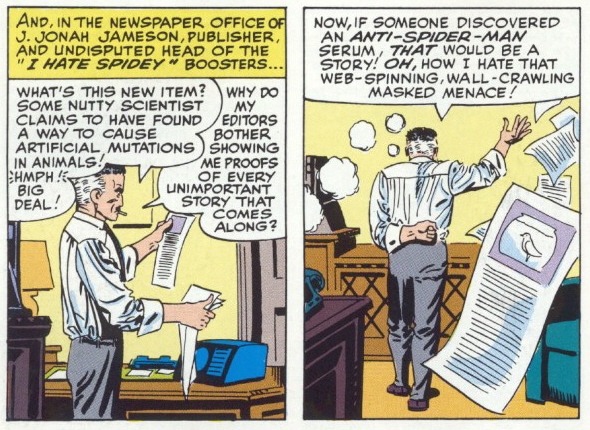
Meanwhile, whilst Peter Parker's being followed all over town, let's see what's happening at the Daily Bugle, shall we?


Say, that gives JJJ an idea, and before you can say "I have a bad feeling about this", he's got another wacky scheme to bring down Spider-Man.

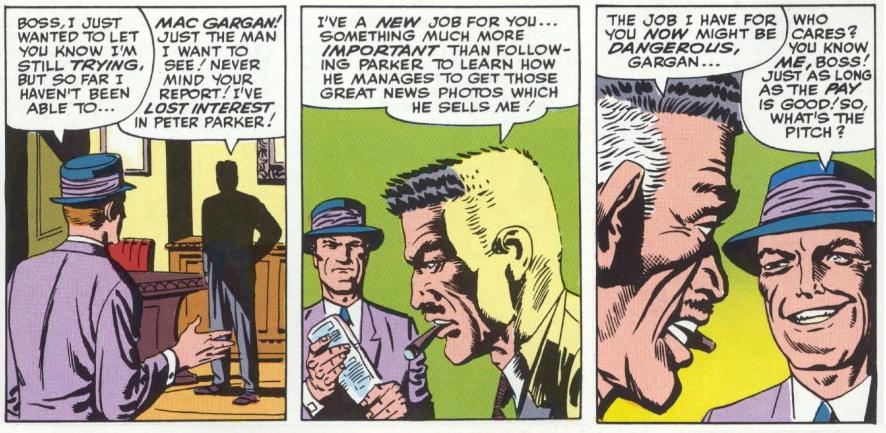
Our mystery man goes to see his equally mysterious employer, and, hey, whaddaya know?


Yeah, it's a bit of a con, but hey, as reasons for having Peter Parker go, at least it makes sense, reminds us that JJ is a piece of work, and shows us that Mac Gargan is a man who doesn't ask questions. Or an idiot. Possibly both.


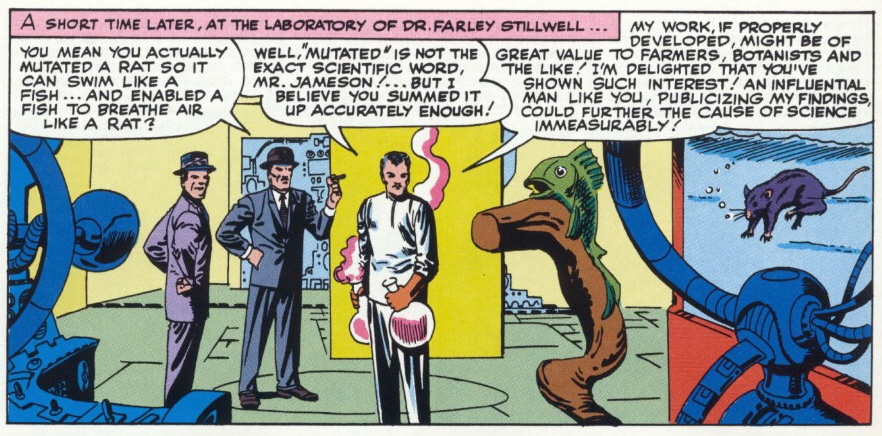
Doc Stillwell has some interesting ideas about scientific progress. I'm sure what farmers and botanists are crying out for is fish that can climb trees. Fortunately for Stillwell's bank balance, Jameson has money to burn, and a burning urge to create animal-themed super-powered vigilantes.


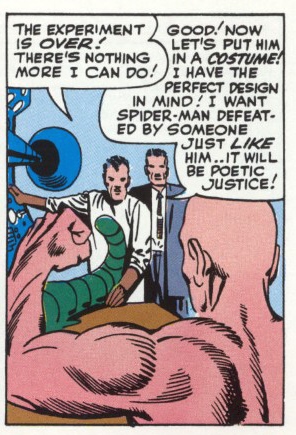
I'm not sure what's more odd, that the test subject has to have his head shaved before he can get super-powers, or that neither he nor the mad doctor give any thought at all to the "powers affecting your brain" thing. Actually, the thought that I'm not sure what's more odd, is itself more odd than either of these two things.


Yes, folks, you read that correctly. J. Jonah Jameson, the man who thinks that a brillo-pad haircut and the Hitler moustache is a sensible look, is going into costume design. Stand by...


Well, let's face it, we've seen worse. Although since JJJ intends the Scorpion to be a hero, it's a bit worrying that he's chosen to use a secondary, rather than a primary, colour.

Meantime, what's our hero up to?


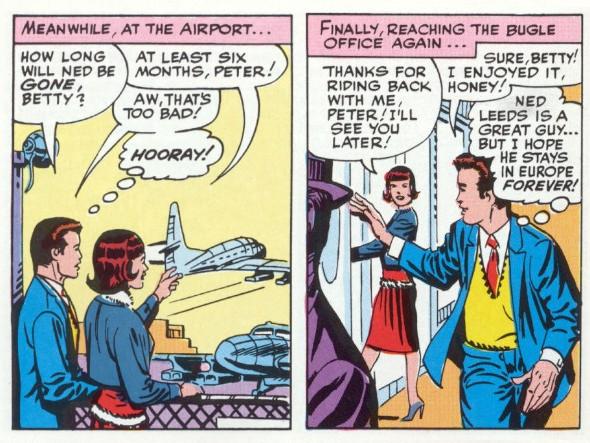
He's busy bird-dogging a potential rival for Betty Brant's affections. Ned Leeds, eh? Something tells me we'll be hearing more about that young man later.

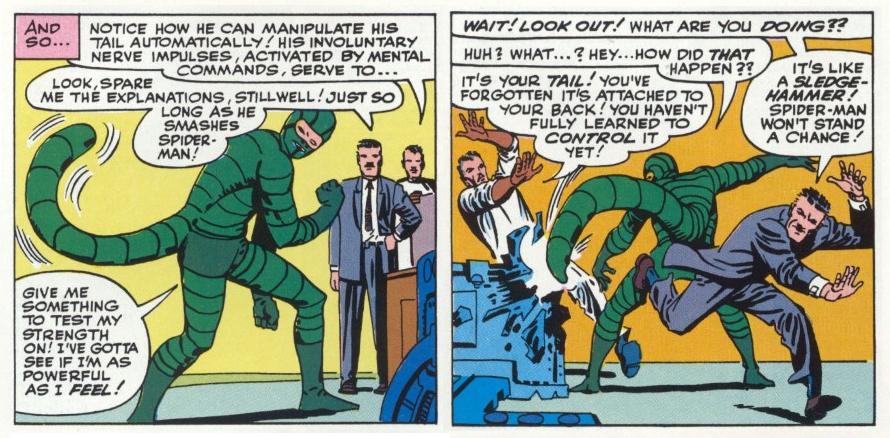
Anyway, finally getting into his Spider-suit, our hero goes to confront Jameson, and the Scorpion takes his chance. Soon, our protagonists are beating seven bells out of each other, whilst JJJ watches and gloats.


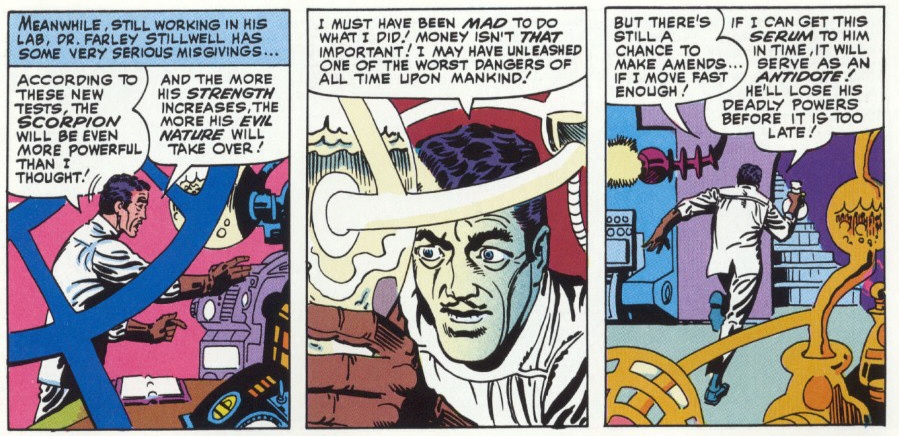
Meanwhile, in the land of mad science...


I'm oddly reminded of an episode of The simpsons where Dr Hibbert makes reference to being able to detect an "evil gene". Presumably, Dr Stillwell has access to the same evil detection device? Or all scorpions are evil? Or Stillwell's lost the plot? Or all of the above?

Anyway, while Stillwell sets off to undo his mad plan, the Scorpion has made short work of our hero. Time for the old evil gene to kick in.


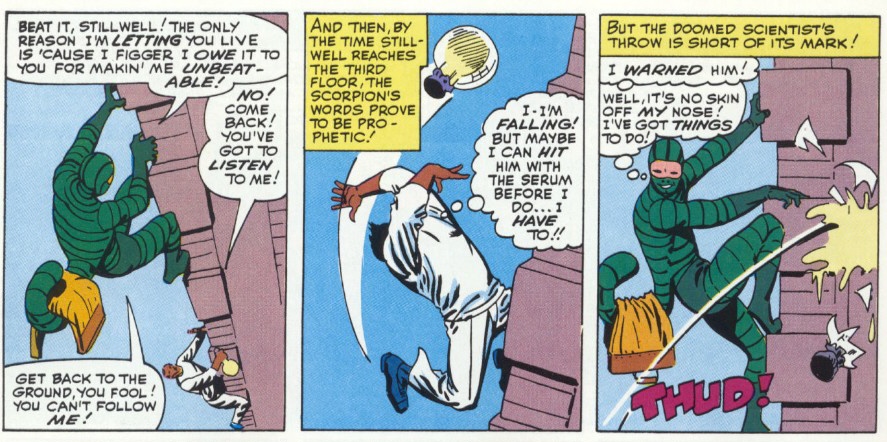
The Scorpion sets off on a one-man crime spree, whilst Jameson gnashes his teeth in impotent fury. But wait, here comes Doc Stillwell, to save the day.


RIP Dr Farley Stillwell: a surprisingly good climber, but a disappointingly bad aim.

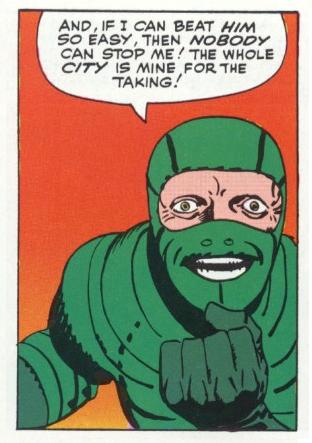
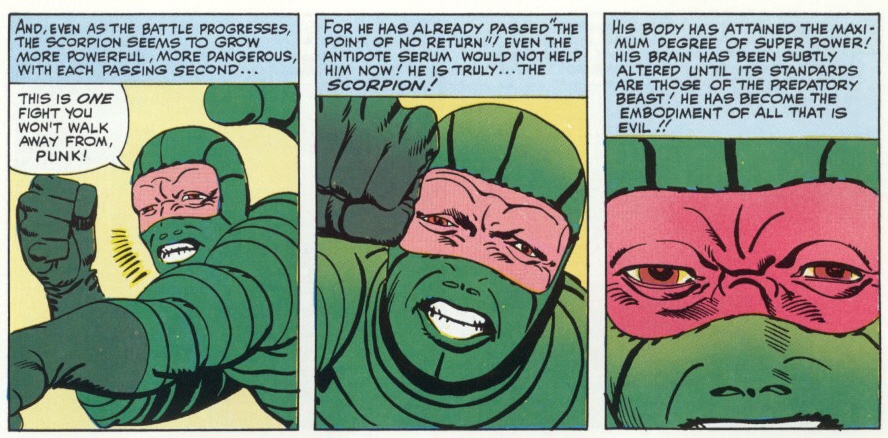
Meantime, Spidey has picked himself up off the floor, and is back for a second go at getting himself killed by the newest supervillain in town. And speaking of the Scorpion, Lee and Ditko give us a neat insight into his mind.


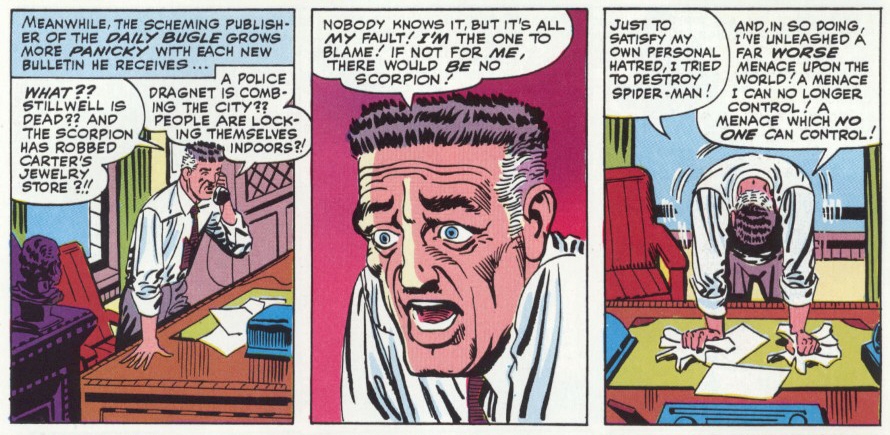
As if these three panels weren't enough to make this the best comic we've looked at so far, we follow up with the very next three panels, which take us into the mind of J. Jonah Jameson.


I mean, this isn't like 90% of the comics of the time. Lee and Ditko aren't just going through the motions here, they are really going for it. Comic creators of today should be made to study this issue, and at least some of them should be beaten to death with a rolled-up copy of it.

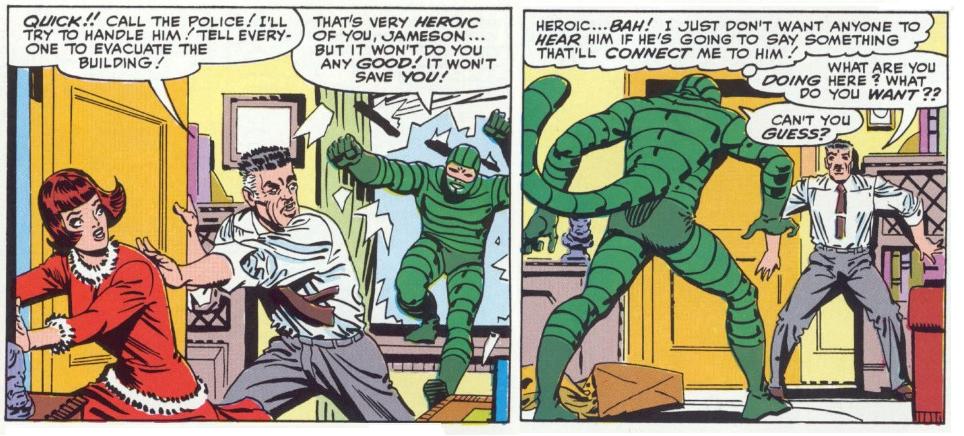
Enough of my gushing. After taking another beating from the Scorpion, Spider-Man is pretty much down and out, but his attempt to get his breath back is interrupted, as the Scorpion, realising that JJJ can tell the cops his secret identity, decides to go confront his former sponsor.

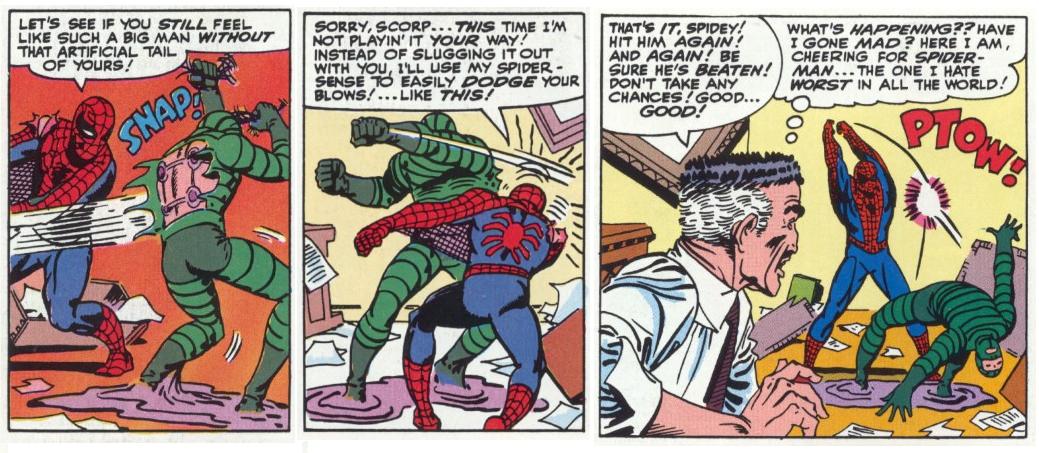
That's a boy, Jonah, do the right thing for all the wrong reasons. So, things are looking bad for JJJ - until Spider-Man shows up to save the day.

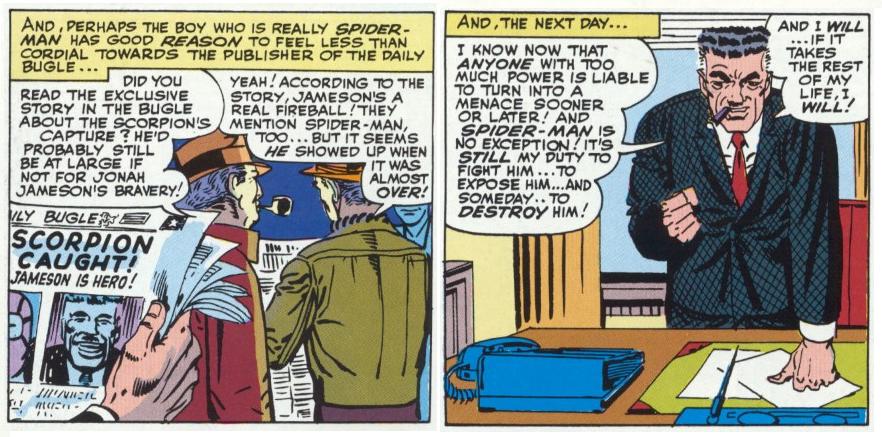
Spidey takes down the Scorpion, and leaves him for the cops, leaving Jameson to ponder on the irony of the situation. I bet JJ'll be changing his mind about Spider-Man from now on.


Oh well, maybe not. Anyway, the book ends, as all Spider-Man books should end, with our hero getting no credit for the situation, and his Aunt May fussing over his unexplained (to her anyway) bruising. Folks, if this isn't the perfect Spider-Man issue, then I'd like to know what is.