Showing posts with label Daredevil. Show all posts

Tuesday, 10 November 2009

70 Years of Marvel - 2002


2002 was the year of MAX Comics. OK, technically, that's not true. The first MAX comics were launched the previous year, but 2002 saw Marvel's 18-certificate comics line get well and truly established, to the consternation of the internet (and, if wikipedia is to believed, to the consternation of Stan Lee as well).

MAX Comics is probably most renowned for having introduced Jessica Jones to the Marvel Universe. Hard-bitten private eye / ex-superheroine, Jessica was the creation of Brian Bendis and Michael Gaydos, swore a lot, and shagged Luke Cage, before being watered down sufficiently to appear in the pages of Bendis' Avengers. MAX's other big creation has been the Hood, created by Brian K. Vaughan, but hijacked by Bendis to act as one of the main protagonists (read: most overused characters) of his recent Dark Reign storyline.

MAX also produced a fair amount of character revivals. Not just Luke Cage, reinvented as a non-costumed swearing machine, but also War Machine (now actually able to kill people), Nick Fury (rewritten by Garth Ennis as a burned-out Cold War veteran looking for one last war), Shang-Chi (reuniting 70s fan faves Doug Moench and Paul Gulacy), Howard the Duck (from original creator Steve Gerber), Blade (launched to cash in on the movie franchise), Black Widow (the blonde one, not the good one), Apache Skies (featuring some of Marvel's Western heroes). And that was just in 2002! The MAX line is still going, if not strong, than at least surviving, with a series featuring the 40s hero, Destroyer, recently out, and Howard Chaykin's revival of his Dominic Fortune character.

2002 also saw the release of the first issue of Kevin Smith's Daredevil / Bullseye miniseries. Optimistic people are still waiting for the release of issue 2.

In the real world, the Euro entered common currency, the US Government was setting up the Department of Homeland Security, and Britain, the US, and various allies were looking forward to invading Iraq.

Saturday, 7 November 2009

70 Years of Marvel - 1999


By 1999, Natasha Romanova had been around for 35 years, a beloved institution. Never big enough to support her own title for long, the Black Widow was nevertheless a big part of the Marvel Universe, either adventuring with the Avengers, superspying with Nick Fury, or snogging the face off Daredevil. So why exactly anyone thought we needed a replacement, is anyone's guess. In any case, Yelena Belova, younger and blonder than Natasha, showed up in 1999, featured in the occasional mini-series for the next few years, then got blowed up good and proper in the Avengers. There's only room for one Black Widow, luv.

1999 also saw the debut of yet another Spider-Woman. This one was Mattie Franklin, a previously-unmentioned niece of J. Jonah Jameson, with the ability to sprout extra legs and stuff. Not a big hit, Mattie's own book didn't last long, and you don't even want to know what happened to her later.

In the real world, 1999 was the year that George Lucas, against all that is decent, made a new Star Wars film, while ex-KGB man, Vladimir Putin, took over in Russia. The world was becoming a scary place, especially for Star Wars fans.

Friday, 6 November 2009

70 Years of Marvel - 1998


By 1998, Peter David had been writing the adventures of the Incredible Hulk for over a decade. In that time, the character had gradually evolved, from a character which no-one was really interested in, to one of the company's most complex books, with a main character whose motivations we could never really be sure of, and whose next move we'd rarely be able to guess. The book being a big success, Marvel editorial naturally wanted to tamper. Unfortunately, by 1998, Peter David was nearly as big a success as the Hulk, so when he was asked to alter his plans for the character, restoring the Dumb Savage Hulk who'd been so preeminent before his takeover, he walked off the book. It wouldn't be the last falling out PAD would have with Marvel Editorial, but it would be the biggest, with the Hulk wandering undirected for the next few years.

1998 also saw Marvel experiment again with outsourcing their work, this time to Event Comics, a little company run by an up-and-coming writer / artist called Joe Quesada. Rather than handing over their prime properties to Quesada and co, Marvel instead gave them free reign with some of their second-tier titles: Black Panther, Daredevil, the Inhumans, and the Punisher. The Marvel Knights books, as they were branded, were aimed at an older readership, 15 up, and, other than redefining the Punisher as a fallen angel, didn't miss a beat. In particular, Daredevil's fortunes took an upswing, transforming a character that no-one had known what to do with in years, into a grim and gritty street vigilante, under the authorship of first Kevin Smith, then Brian Michael Bendis. As with every successful idea in comics, the first idea of editorial is that more of what is successful, will automatically be more successful. Which is why pretty much every book this decade has been aimed at older readers. Comics aren't for kids, folks, not anymore.

Or maybe they are. After all, 1998 was also the year in which Spider-Girl gained her own title. Created as a one-off for an issue of What If?, May "Mayday" Parker is the daughter of Spidey and wife former bidey-in, Mary Jane (a daughter never born in the "real" Marvel Universe), and her adventures, provided by Tom DeFalco, have been ongoing ever since, despite numerous well-documented attempts to kill the title off. Let's hear it for the little book that could.

Elsewhere in 1998, Bill Clinton was denying having had relations with "that woman", whilst George Michael was admitting trying to have relations with "the man".

Wednesday, 4 November 2009

70 Years of Marvel - 1997


C'mon now, did you really think I was going to spotlight any other book?

The 90s were not a golden decade for Marvel, but there was the occasional highlight, and none more than the introduction of the Thunderbolts. With apologies for spoilering 12 year old book, Kurt Busiek's concept of having Baron Zemo and the Masters of Evil pose as superheroes in order to take over the world was pretty damn cool. But the idea that, having pulled off the initial deception, some of these long-standing bad guys (Goliath, Screaming Mimi and the Beetle) might decide that they actually quite like the respect that they're receiving, and might decide not to go through with the whole going bad and inevitably getting their heads handed to them element of the scheme, now that was genius.

In a time when there was a noticable decline in the quality of most of Marvel's product, Thunderbolts stood head and shoulders above the rest. For years, the original team trod the line between heroism, opportunism, and villainy, being at times, outlaws, acknowledged heroes and saviours of the world. Then Warren Ellis took over, and the whole concept of wannabe heroes was ditched, in favour of outright villains and psychopaths working for the government in return for a pardon. All well and good, but nothing we hadn't seen twenty years ago in Suicide Squad over at DC.

July '97 was notable for being Marvel's Flashback Month, in which Stan Lee (or a reasonable facsimile) showed up in pretty much every book, in order to introduce a tale from the past of the protagonists of the book: Daredevil's college days, Baron Zemo's childhood, Cable's first time-journey. A novel idea, but pretty much inconsequential in the long term,

1997 also saw Roger Stern and Ron Frenz return to Spider-Man, to give the definitive answer to the question: who is the Hobgoblin? The question had already been answered, a decade previously, but it had been an unsatisfactory conclusion, and Stern took advantage of the new, post-Clone Saga regime to write "his" ending to the mystery he'd started 15 years ago.

New blood was introduced to the X-Men, in the shape of Maggot, Cecelia Reyes and Marrow, all of whom were introduced during the latest X-Crossover, Operation Zero Tolerance. The first new members of the team introduced in nearly a decade, all three proved less than popular, and all three were gone from the team by the end of the millennium.

Outside of comics, New Labour swept to power on the UK in this year. A decade of national mourning was declared, following the ascension of Saint Diana, the People's Princess. And the world gasped at the majestic wonder that was Jim Cameron's Titanic. If any of this seems familiar, then I can only assume you are suffering from deja vu, and not that, for some reason, I looked up 1997 when writing the entry for 1996. Move along, move along.

Friday, 30 October 2009

70 Years of Marvel - 1993


The line had kicked off at the tail end of the previous year, but 1993 was the year that the Marvel 2099 line really kicked off. Set in a dystopian future world run by mostly evil corporations, 2099 dealt with the introduction of super-types to that world. Notably, the line featured Ravage, a character created and written by Stan The Man, in what I'm pretty sure was his most recent, and at this rate, probably last, creation for Marvel. Other books in the line featured future incarnations of Spider-Man and the Punisher, and a version of Dr Doom about whose true identity there was some mystery.


Subsequently, these initial books were followed up by X-Men, Ghost Rider, and Hulk titles, as Marvel attempted to squeeze every last buck out of their cyberpunk / dark future fans. By the time the Fantastic Four arrived in the world of tomorrow, the 2099 cash cow had pretty much been bled dry. To be fair, this was 1996, so the concept had had a good innings.


Finally killed off in 1998, with the arrival in the future of Captain America, there have been occasional attempts to revisit the 2099 line, most recently this year with the Timestorm book, and who knows, we may yet see the line spring back into life, sometime in the next 90 years.

1993 also saw the Avengers get a new member, the Shi'ar, Deathcry, and also saw the arrival of yet another Captain Marvel. This one was Genis-Vell, the son of the original Kree hero, and used the title, Legacy, before eventually taking over the mantle of his father. Genis-Vell first appeared in an annual, as did Adam-X, who for a while, was nearly someone important in the X-Books.

Finally, this was also the year in which, after keeping the same outfit for almost all of the 30 years of his existence, the Powers-What-Be decided to give Daredevil a new costume, one that only a blind man could love.


Yes, folks, it really is that hideous. Thankfully, this was kicked into touch pretty swiftly, banished to the land of Nineties Nightmare Costumes, where it belongs.

In the real world, 1993 saw Slicky Willy Clinton take over as President. On TV, the X-Files were out there, Frasier Crane was moving to Seattle, and Andy Sipowicz was becoming the best loved cop on telly.

Sunday, 25 October 2009

70 Years of Marvel - 1989


The X-Universe was getting busy by 1989, with 5 full-time books: Uncanny X-Men (under the control of Chris Claremont and Marc Silvestri); Excalibur (Claremont and Alan Davis); Wolverine (Claremont, again, and John Buscema); X-Factor (written by Louise Simonson, and drawn mostly by husband Walt); and New Mutants (Simonson, again, and mostly Bret Blevins, although the issue above was drawn by John Byrne). Of course, had we known what was ahead of us, in terms of the apparent exponential expansion of the X-universe, we'd have counted ourselves lucky to just have five books.

The New Mutants themselves were pretty busy too. They started 1989 by being embroiled in the Inferno saga, with Magik going crazy and turning into a demon. They lost the school and their headmaster, Magneto, turned back into a villain, and they finished the year stranded in Asgard, trying to save the 9 Realms from Hela. By this point, the book had abandoned any of the notion of being a story about school kids who just happened to be mutants, in favour of standard superhero stuff. We weren't quite at the annual "event" stage yet, but we were getting there.

Speaking of events, 1989 saw the "Acts of Vengeance" storyline, where some of Marvel's biggest bad guys decided the best way to beat their foes was to trade opponents. This led to such fights as Doctor Doom versus the Punisher, Daredevil versus Ultron, and the Fantastic Four versus Plantman. That storyline also saw the introduction of the New Warriors, another team of teenage superheroes, whilst, back over at the X-Books, future X-Woman, Jubilee, made her first appearance. Thor had a new secret identity, in the person of Eric Masterson, who'd later become the pseudo-Thunder God, Thunderstrike.

The real 1989 saw author Salman Rushdie get into a spot of bother, the introduction of the somewhat unpopular Poll Tax in the UK, and the decline and fall of the Berlin Wall. Yay!

Friday, 23 October 2009

70 Years of Comics - 1987


1987 saw Walt Simonson bring to a close his four-year run on Thor, a run which he'd used to reestablish Thor's godly credentials. Simonson had used ever Norse legend out there, up to and including Ragnarok. In the process, Thor had been mostly pulled out of his usual interactions with the rest of the Marvel Universe, although he would still be involved in major events like the Siege of Avengers Mansion and the Morlock Massacre. For most of the run, Simonson was both writing and drawing the book, though for the later issues the art was handled by workhorse Sal Buscema, who showed he was just as capable at handling the epic stuff as he had been the day-to-day activities of Peter Parker and Bruce Banner. Like Frank Miller's run on Daredevil, Simonson's run on Thor has never been matched; unlike Miller's run, no-one's even come close to matching Simonson.

1987 was the year that Steve Rogers was replaced in the Captain America suit by John Walker, who would later be better known as the U.S. Agent. It also saw Peter Parker and Mary Jane Watson marry move in together, setting a fine example to the youth of America.

1987 also saw Terry Waite kidnapped in Beirut, where he'd spend the next 4 years in captivity. Ronald Reagan and Oliver North were embroiled in the Iran-Contra Affair. And despite Michael Fish's assurances to the contrary, there was a hurricane coming to the south of England.

Wednesday, 21 October 2009

70 Years of Marvel - 1986


In 1986, rising comics superstar Frank Miller was just finishing up his second run on Daredevil. The "Born Again" saga, by Miller and David Muzzicchelli, began with the Kingpin discovering the secret identity of his blind foe, and ended with Daredevil teaming up with Captain America to battle a deranged supersoldier. along the way, Miller took us into the hearts of Matt Murdock and Wilson Fisk, as well as their numerous friends and associates, and set a standard that successive writers, try as they might, have never quite been able to match.

Elsewhere in 1986, Magneto was taking charge of the New Mutants. Jean Grey was back from the dead, prompting the original X-Men to reunite as the mutant-hunting X-Factor Investigations. Private investigator, Dakota North, was introduced to the Marvel Universe, as was Sharon Ventura, the new Ms. Marvel. The Scourge of the Underworld was wiping out hordes of second and third-tier villains, whilst the Marauders were wiping out hordes of Morlocks. And Baron Zemo and his Masters of Evil were doing a decent job of destroying the Avengers. But all this would pale into insignificance in the face of the coming of the New Universe titles. More on that later.

Outside of comics, 1986 was the year of the Challenger Disaster, and I don't really have anything else to say about that year.

Tuesday, 13 October 2009

70 Years of Marvel - 1981


By 1981, Rom was firmly entrenched in the Marvel Universe, taking on such heavyweights as the Mad Thinker, Jack of Hearts, and, above, the Space Phantom. Rom, here to stop an invasion by the dreadful Dire Wraiths, would himself turn up as a guest star in pretty much every title at some point before his book was wound up, presumably as part of Marvel's plan to trim its booklist in preparation for the launch of the New Universe, of which we'll hear more later.

1981 also saw the debut of Elektra, ninja assassin and agent of the Kingpin, who would go on to become Daredevil's lover, before being killed and resurrected about a hundred times over the next 30 years. It also saw the demonic Gargoyle joining the Defenders. X-Man to be and daughter of Banshee, Theresa Cassidy, made her first appearance, battling Spider-Woman, whilst future Avenger, Firebird, turned up to fight the Hulk alongside the wild-west Rangers. And in the X-Men, Caliban turned up, heralding the first appearance of the Morlocks.

In the world beyond comics, 1981 saw the inauguration of Ronald Reagan as US President. The Space Shuttle Columbia took its first trip into space. Britain was entranced by the excitement of a Royal Wedding. And the Yorkshire Ripper went to jail. For ever, one hopes.

At the pictures, Indiana Jones was raiding the lost ark, whilst over in Britain, Vangelis was scoring Chariots of Fire. On tv, Dynasty was attempting to cash in on the Dallas phenomenon, and Only Fools And Horses, the most overrated show on tv, began its 900 year run.

Thursday, 1 October 2009

70 Years of Marvel - 1970


By 1970, Roy Thomas was challenging Stan Lee as Marvel's pre-eminent writer of books. The nostalgia king was writing the Avengers, Daredevil, Hulk, and of course, Sub-Mariner. While a lesser man might have been threatened by this hot new talent, Stan was quite happy to hand over the reigns, as long as he got a mention in the credits...


Bravo. Anyway, elsewhere in 1970, Sunfire was becoming Japan's first costumed hero, the Valkyrie was becoming Asgard's second cosmic hero, and the X-Men were limping towards cancelation.

In the real world, Ted Heath was becoming British PM, Janis Joplin and Jimi Hendrix were taking too many drugs, and the Baader-Meinhoff Gang were making a name for themselves in West Germany.

At the pictures, childrens' classic, The Railway Children was out, whilst the Goodies were livening up British tv. Simon and Garfunkel were going their separate ways, and Black Sabbath were releasing their debut album. Rock on!

Friday, 25 September 2009

70 Years of Marvel - 1964


Yes, Thunderbolts fans, that is the self-same Baron Zemo who would go on to become Captain America's WW2 nemesis, who would subsequently go on to found the Masters Of Evil, and whose son would in turn found his own team of Masters, start up the Thunderbolts as the biggest con in history, and eventually become an almost-good-guy. In his first appearance, though, Doctor Zemo was merely one of many Nazi stooges who took on Sgt Fury and his Howling Commandos, and lost.

Famously, Sgt Fury was the result of a bet at the Marvel offices, in which Stan Lee wagered that he could make a war comic in the Marvel manner and make it a success. It worked, for at least the next couple of decades, thriving throughout any number of successes and failures at the House of Ideas.

Making a return to regular appearances in 1964 was Captain America, albeit only as a member of the Avengers. The Scarlet Witch and Quicksilver made their first appearance in this year, as did Daredevil, the Black Widow, Wonder Man, and Hawkeye.

1964 also saw the US Government suggest (god forbid) that smoking cigarettes might be harmful to ones health. The Beatles were conquering America. And IBM were unleashing the S360 mainframe! Meanwhile, the war was hotting up in Vietnam.

At the movies, Clint Eastwood was scowling his way through A Fistful of Dollars, while Santa Claus was Conquering the Martians. Meanwhile, on the telly, Top of the Pops was not yet tragically unhip. The Munsters and the Addams Family were both tearing up the airwaves, as was the Man From UNCLE. And a generation of kids were thrilling to the adventures of Charlie and the Chocolate Factory.

Wednesday, 26 November 2008

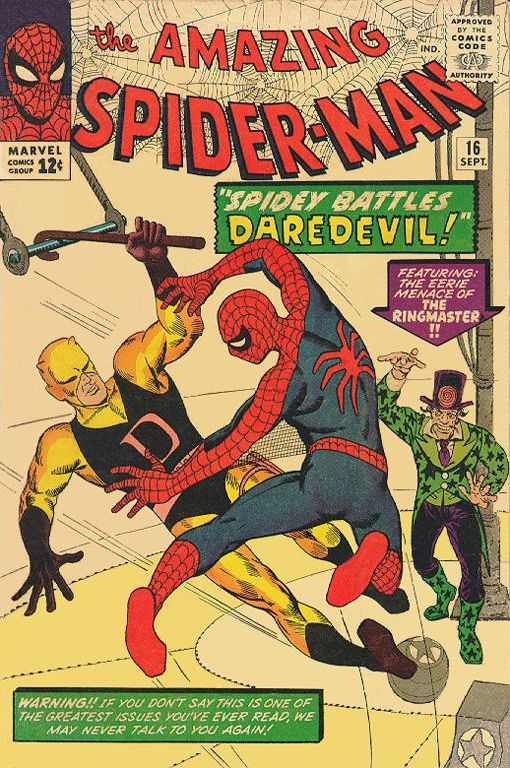
Special Cheap Reprint Edition: Spidey Battles Daredevil


Amazing Spider-Man #16, September 1964
(By Lee and Ditko)


Two years after their triumphant debut in the pages of Incredible Hulk #3, Stan Lee and Steve Ditko were scrabbling around for ideas for the next issue of Amazing Spider-Man. In the past three months, they'd brought us Mysterio! The Green Goblin! and Kraven the Goddam Hunter! How could they top that? How indeed...

Our tale begins with Peter Parker, the spectacular Spider-Man, rescuing a helpless blind man from a gang of robbers. This being the Marvel Universe, though, it's not just any blind man. Oh no.


With deductive skills like this, our blind man could work as some sort of stage mesmerist, amazing the crowds with his apparent clairvoyance. As you doubtless know, his interests lie elsewhere.


Yes, folks, it's Daredevil, in his crappy black and yellow outfit, the one which Demolition Man would one day adopt. Now, did you see there, how Stan The Man effortlessly tells his audience all they need to know about the guest star in just two panels? The art of introducing guest stars is a lost one, judging by current issues of many titles.

Anyway, at the office...


Nice of Foggy and Karen to invite him, but you have to wonder why they bothered. They have, I assume, noticed his blindness, which presumably reduces the effectiveness of visual-based entertainment.

Now, did someone say 'circus'..?


Well, lookee, lookee, that green coat looks mighty familiar...


Yep, it's him, Maynard himself, back out of the slammer and, in contravention of many parole requirements, reunited with his criminal cohorts. What's your nefarious scheme this time, Mayny?


Ah, there we go Pretend that Spider-Man's going to appear at your circus, attract a sell-out crowd, then fleece them. Ingenious! What can possibly go wrong?


Uh-oh...!

Now, then. Imagine you're the Ringmaster, you're halfway through your show, just ready to pull out the ol' hypno-hat and mesmerise your audience, when Spider-Man shows up. Do you (a) look on as Spider performs some neat acrobatic twists and turns, send in the clowns, do a few card tricks, and hot-foot it out of town, counting your lucky stars that he hasn't recognised you and hauled you back to jail, or (b) press on with your scheme anyway?

Go on, guess...


And with that, the Ringmaster does his thing, and the audience, Spidey included, are under his influence. Unbeknownst to the Ringmaster, however, one man in the audience is not under his spell. Yes, you've guessed it, Matt Murdock has changed his mind, and decided to play gooseberry on Foggy and Karen's date, and, being blind, the hypno-hat has no effect on him. Whatcha gonna do now, Maynard?


Now, this might, on the face of it, seem like a pretty good tactic on the Ringmaster's part. Hypnotise one foe into attacking the other, and escape in the confusion. However, I think the next three panels show quite eloquently why hypnotism is actually a bit shit.


When giving orders to your hypnotised slave, it's very important to consider your words carefully. The use of the phrase "Kill Daredevil!" might have been wiser than Maynard's choice of words.

From here on in, it's downhill for the Circus. Daredevil grabs the Ringmaster's hat, releases Spider-Man from his trance, and the two of them pummel the Circus into unconsciousness. In fact, such is the level to which the Circus is outmatched, that Daredevil abandons Spidey halfway through the fight, and goes back to join his friends. It was perhaps at this point that the reader should realise that the Circus may never make it into the big supervillain team league...

This, inventory post, originally presented in my other blog, back in 2005.

Thursday, 6 November 2008

The Origin Of Daredevil!


Daredevil #1, April 1964.
(By Stan Lee and Bill Everett)


Just look at that cover. What's it trying to say, exactly? "If you like our other books, you'll love this one!" Don't bother trying to sell the book on its own merits, Stan. We haven't even turned the page yet, and already, I'm tired of "fun-loving" Foggy Nelson.

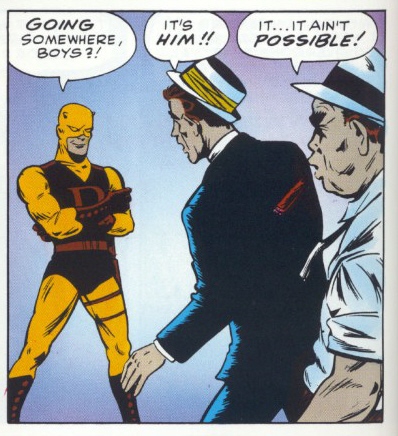
And good lord, that costume. They can't all be classics, but suffering god, that outfit looks like it was designed by a blind man.

I don't usually like to play art critic here, but I gotta say, the art here is very different to the usual Marvel style, much more gritty than we've gotten used to. Just look at these first few panels:


I don't know if the concept of retro-art was around in 1960s comics, but if not, this would be a decent example of it. To be fair, this is not so much retro, as Bill Everett drawing in the style of Bill Everett, much more realistic than Kirby's style, and less "pretty" than Ditko's.

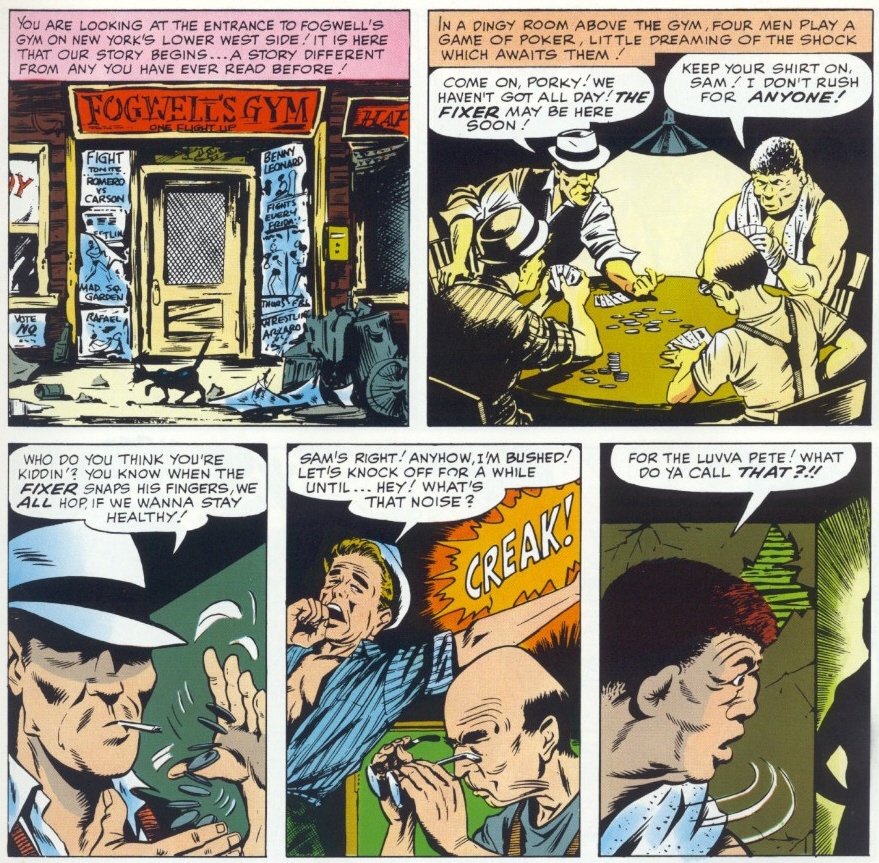
Anyway, this first issue introduces Daredevil, as he takes on the thugs pictured above, then flashes back to his origin.


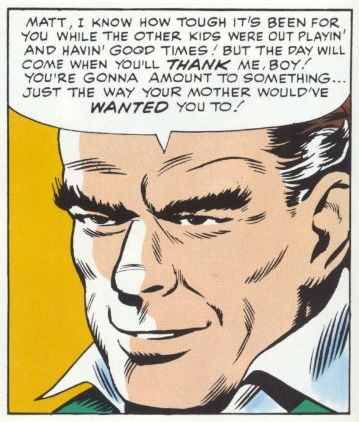
Young Matt Murdock lives with his dad, "Battling" Murdock, a washed-up boxer, determined to see his son do better for himself. Young Matt, in a sterling example to the youth of today, meekly abides by his old man's directive, regardless of the scorn and disdain his peers have for him as a consequence. But at least it makes his dad happy...


Selfish pig. Anyway, while Murdock Junior is slaving away at his stufies, Murdock Senior has signed up for a new promoter, dubbed "The Fixer". This is going to go well, don't you think?

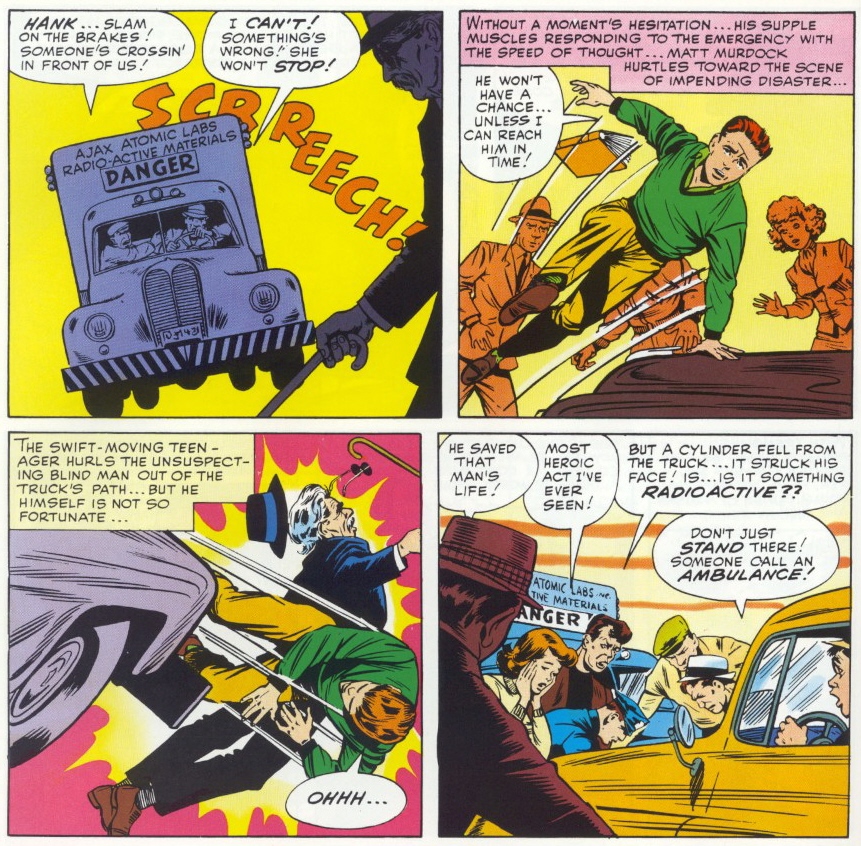
Whilst Papa Murdock is making his deal with the devil, Matt is heading for the most dramatic four panels of his young life:


Yes, folks, it's the 60s, where the good folks at Ajax Atomic Labs are still allowed to drive trucks of nuclear waste through the streets of New York City.

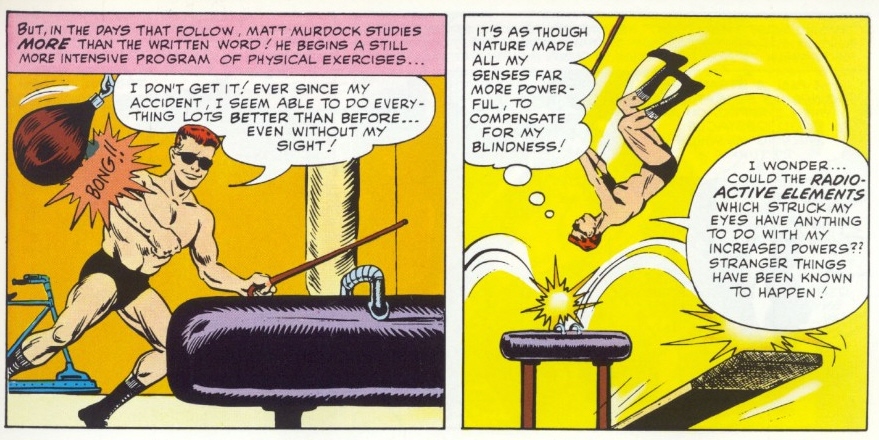
Poor old Matt ends up in the hospital, his eyesight gone, but with an unexpected consequence:


Stranger things, like turning eminent scientists into giant green monsters, perhaps. Anyway, Matt goes to college, where he quickly becomes BFF with Franklin "Foggy" Nelson. His senses, meanwhile, continue to astonish:


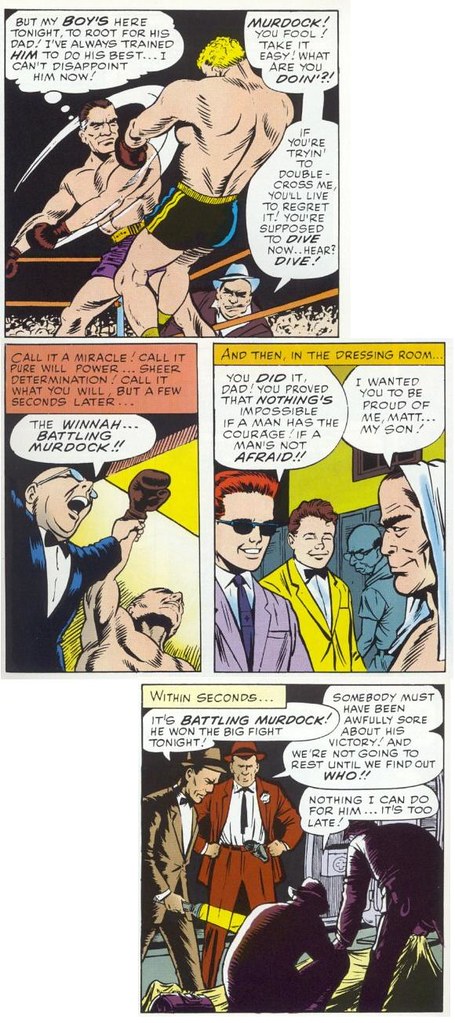
Pretty neat, daddio! Meantime, Matt's dad's career appears to be on the rise, but the Fixer has other plans. It's time for Battling Murdock to take a dive. But wait, what's this?


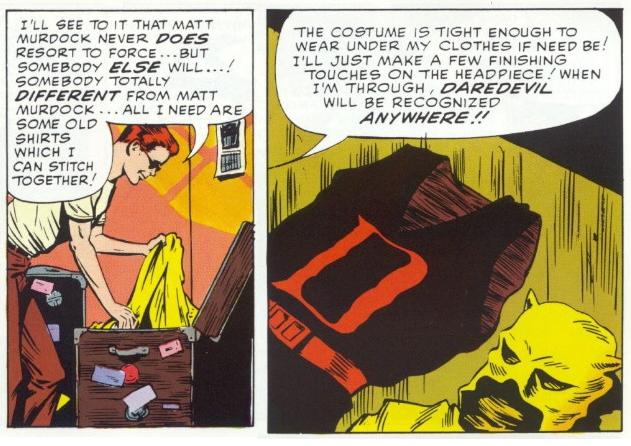
Crime may not pay, but standing up to criminals isn't always a beneficial situation either. Our Matt swears to avenge his dad's death, but remember, he promised not to fight. Thankfully, Matt's now a qualified lawyer, and thus is able to resolve this dilemma: he cheats.


By "recognised", he presumably means "pointed at", "laughed at", and "harrassed into adopting a less asthetically unpleasant uniform within, say, seven issues"...

In his new costumed identity, Matt, as Daredevil, has tracked down the Fixer to his seedy gambling joint, which is where we started.

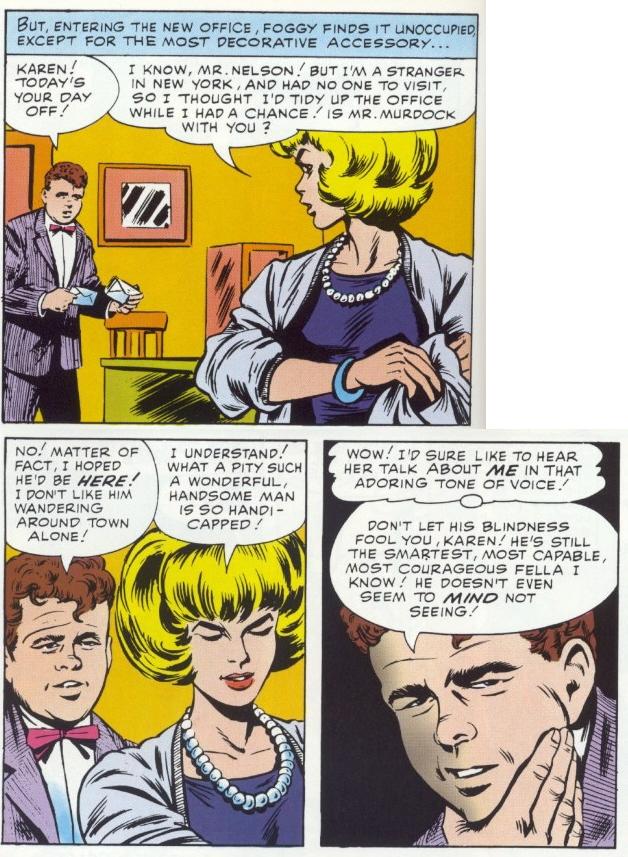
While Daredevil is taking on New York's underworld, his partner at the law firm, our pal, Foggy, is working on the romantic sub-plot which is becoming a staple of Marvel Comics. Meet legal secretary, Karen Page.


Seriously, is this how children are introduced to the idea of relationships? It's healthier than Eastenders, I suppose.

Meantime, back across town, Daredevil, having made short work of the Fixer's goons, goes after the big man himself.


How much fun does DD look like he's having here? Being a superhero, even one avenging his dad's murder, is obviously a dream come true for young Matthew. When you consider the repeated kicks in the crotch which fate, and Frank Miller, will deal him over the years, one almost wants to dive into the comic and warn the poor sap.

Anyhoo, the poor old Fixer's heart can't cope with the excitement of Daredevil's colour-scheme, and he drops dead. Still, better than being thrown in front of a moving train, eh?

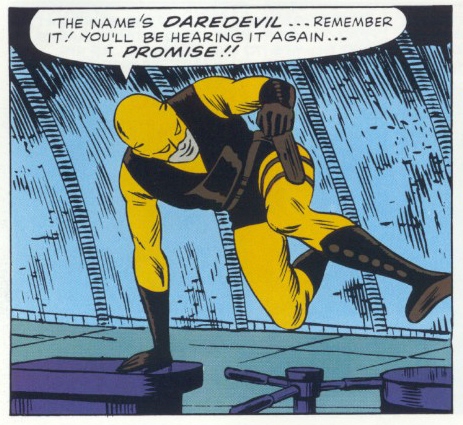
So there you have it, Daredevil makes a bold entrance, the bad guys pay for their sins, and Foggy and Karen fawn around the office. Any last words, Matt?


And off he goes, to the Superhero Costume Discount Store.