Showing posts with label Human Torch. Show all posts

Thursday, 12 November 2009

70 Years of Marvel - 2003


Another year, another new brand. 2003 was the year of Tsunami Comics, a line of books aimed at appealing to the Manga market, a source of prime dollars of which Marvel was thus far not getting a slice. The idea of the line was to produce books which would be reprinted in the digest format of Manga books, rather than the full-size trade paperbacks normally used.

We got some good books out of it. Sentinel (above) was the Iron Man / Iron Giant with a mutant-hunting robot instead of a a big friendly robot, whilst Runaways was the story of a group of teenagers who discover their parents are eeeviiiillll! Other than those sparks of originality, though, mostly it was just the same old, same old: a relaunch of New Mutants; an attempt at a solo book for bad / good mutant, Mystique; the teenage adventures of Emma Frost; and new books for Venom, Sub-Mariner, and the Human Torch. The line wasn't a great surprise: most people can presumably tell the difference between real Manga and Marvel's pseudo-Manga, and those that couldn't just weren't gripped by what they saw.

2003 also saw the legendary Neil Gaiman doing his first work for Marvel, with 1602, which had the Marvel Universe transposed to Elizabethan times. A fine tale in its own right, I'm sure the numerous non-Gaiman sequels, prequels and sidequels, haven't detracted from its impact at all.

Finally, 2003 also saw the definitive origin of Spider-Man, in the Mark Millar-penned Trouble. Or maybe it didn't. After all the hype about this book, no-one really seems sure what the point of it all was.

In the real world, 2003 saw the Columbia shuttle disaster, the downfall of Saddam Hussein, and the return of Dirty Den, all of which kept the internet chattering.

Monday, 2 November 2009

Oooh! Shiny!

The mid-90s saw the comic speculator boom reach its crescendo, as a whole bunch of stupid people decided that, because Amazing Fantasy #15 and Detective Comics #27 were worth a fortune, then all comics would eventually be worth a fortune. These stupid people went forth and bought a shedload of comics, which they then either bagged and tagged, to sell in the future once said comics had become valuable, or, hilariously, sold them to even more stupid people, who believed that because the comics were being bought in large numbers, they must be worth lots of money NOW. Before anyone could realise these spectacular profits, the bubble burst, the speculators went on to the next big thing (pogs, probably, or trading cards), and comic sales dropped like a stone, taking most of the comic shops with them. Before you laugh, bear in mind this sort of "logic" is pretty much exactly what caused the house-buying boom of the last few years, and you saw how well that turned out.

The rise and fall of the speculator market can be symbolised by looking at the use of foil covers in comic books. Bear with me.


In 1991, Silver Surfer #50 came out. This book featured a battle between Surfy and the reborn dark titan, Thanos, and was a prelude to the Infinity Gauntlet, a cosmic event which touched on most of the Marvel Universe (except the X-Books, which for some reason managed to dodge such things). Some bright spark at Marvel decided to celebrate this milestone issue, by issuing the book with a silver foil cover.

I imagine it did well, I recall friends being excited by the (really not done justice by scanners) cover. In any case, Marvel followed this up the very next month with a glow-in-the-dark cover on Ghost Rider #15.


Nice enough, I'm sure you'll agree, but, really, why the need for a gimmick cover? This issue did feature a confrontation between the 90s Ghost Rider and his 70s equivelent, but it was the concluding part of a three parter, and not even a particularly good three parter at that.

1992 saw Marvel issue a few more books promotional covers Most of them seem justifiable enough:
Amazing Spider-Man #365, Spider-Man #26 and Spectacular Spider-Man #189 all celebrated Spidey's 30th anniversary with neat little holographic panels.
Hulk #393 commemorated the Hulk's 30th anniversary and revisited his origins.
Guardians of the Galaxy #25 featured the 31st century heroes battling Galactus.
Spider-Man 2099 and Ravage 2099 introduced the world of tomorrow.
And, er, Silver Sable #1 celebrated the bounty hunting blondeshell getting her own book at last.


In 1993 , Marvel were churning out the gimmick covers, on, by my count, 44 comics. Some, such as the Avengers and the X-Men's 30th anniversary, were reasonable. Then there were such "essentials" as Namor #37, which celebrated Subby getting a new costume. Or Fantastic Four #371, in which the Human Torch accidentally set fire to Empire State University. Or Venom: Funeral Pyre, in which the world's most overrated supervillain takes on the Punisher (spoiler: nobody dies). By 1994, just about every comic had a gold, silver, platinum, 3D, die-cut, prismatic cover, or it felt like it. Every anniversary, no matter how trivial, every first issue, every "landmark" issue, had a pretty cover, and an inflated cover price to match. Sales were spiking all over the place, based not on how good the books were, but on the relative "buzz" generated by Excalibur #75 or Nova #1.


By 1995, the speculators were getting tired, and by 1996, most of them had vanished off in search of the nearest shop selling Magic: The Gathering cards. Other than a couple of Marvel 2099 books, the foil cover phenomenon vanished without trace virtually overnight.


It would be a good long while before Marvel would try another attempt at getting those speculator dollars, through the use of variant covers on books. A glance at the shelves of your nearest comic shop will show that Marvel doesn't really seemed to have learned any lessons from the 90s speculator boom, as just about every comic out at the moment is available with at least two covers. Disaster lies ahead...

Tuesday, 20 October 2009

"Slay Your Enemies, And All You Desire Shall Be Yours!"

As mentioned yesterday, in 1985 (and indeed 1984) comic fans were getting all excited over Secret Wars. It was, while by no means the first mini-series published by Marvel, certainly the first one to have line-wide consequences. These days Marvel would call it an "event", publish a line of related titles, and you'd be sick of the thing before it was halfway finished. In the mid-80s though, Marvel just had many of their top heroes whisked away via a mysterious portal to another world, where they were forced to battle villains, with the promise of the ultimate prize for the winners. Jim Shooter took a year to tell the story of what had happened, but whilst these days, we'd face 12 months of comics featuring stand-in heroes in the missing characters' books, in those days, they simply showed the heroes returning the next month, and the radical changes which the as yet untold Secret Wars had wrought.

Spider-Man appeared with a new, black and white costume, which changed between civilian and super-duds depending on what was needed, and which never ran out of webbing. Later he'd discover that the costume was actually an alien symbiote, trying to take him over. Later still, the symbiote would be reborn as the villainous Venom, and later still, we'd all be sick of the sight of the black costume. But at the time, for all that it was just a change of look, we were quite excited by it.


The Incredible Hulk came back from Battleworld with a broken leg and a bad attitude. The broken leg was courtesy of a fight against Ultron, whilst the bad attitude came, at least in part, from the manipulations of old Dr Strange foe, Nightmare, out to get at the Sorcerer Supreme via one of his fellow former Defenders. Of course, a week of fighting the Absorbing Man and having mountains dropped on him probably didn't help the Hulk's disposition either.


The Vision, newly recovered from a near-death experience, took advantage of the disappearance of most of the Avengers to launch a bloodless coup. Naming himself chairman, he cosied up to the government and got them to approve setting up a new West Coast branch of the team. Had anyone realised that he was suffering from the android equivalent of brain damage after his time spent in a coma, he'd probably have encountered slightly more resistance.


Ben Grimm, in contrast to most of the heroes, quite enjoyed his time away from Earth. He discovered that he was able to turn back into his human form at will, and decided that, on the whole, he'd sooner spend his future riding around on pteradons than go home and be a monster again. So he chose to stay on Battleworld, leaving the Fantastic Four a man short.


The FF didn't waste time replacing the Thing, offering his place in the team to the first superstrong person they saw. In this case, the She-Hulk, who, although a member of the Avengers, was happy to cross the street to the Baxter Building. Later, the Human Torch would take advantage of the Thing's absence to shag his girlfriend. Classy. Secret Wars would also tease the readers of the FF with the mystery of how Doctor Doom, killed the previous year, could be alive on Battleworld. A somewhat convoluted explanation would eventually be given, accompanied by a somewhat gratuitous appearance by the Beyonder.


And the X-Men? Well, they stood around a hill in Japan talking a lot. Well, it was the 80s, and it was Chris Claremont, so perhaps we shouldn't have expected anything too revolutionary. In Claremont's defence, he did use Secret Wars to promote his agenda of Magneto as an extreme activist, rather than as an out-and-out supervillain, to break up Kitty Pryde and Colossus as a couple, and to justify Professor X deciding to take a more active role in leading the X-Men, but what we really remember is the constant talking...

Thursday, 24 September 2009

70 Years of Marvel - 1963


By 1963, Marvel was promoting the Human Torch as its breakout character, giving him his own spotlight title, Strange Tales, a holdover from the pre-superhero horror days, in which Johnny Storm fought such terrors as the Plantman - who would be lame in one form or another for the next. Eventually, Stan would work out that all the cool kids wanted to be the Thing, but for now, the Torch was the most over-exposed character in Marvel's books.

1963 would also see the first appearance of Iron Man, Nick Fury (in both his WW2 and 60s incarnations!), the Wasp, the Avengers, Dr Strange, and the Uncanny X-Men. Yowza!

1963, of course, also saw the death of JFK, and the first episode of Doctor Who, two events which would shape the remainder of the 20th century. Liz Taylor and Richard Burton were playing Anthony and Cleopatra, whilst Steve McQueen was practicing bike skills in the Great Escape. Meanwhile, Peter Sellers was stealing the show in the Pink Panther.

Thursday, 20 November 2008

"We Have To Fight - The X-Men!"


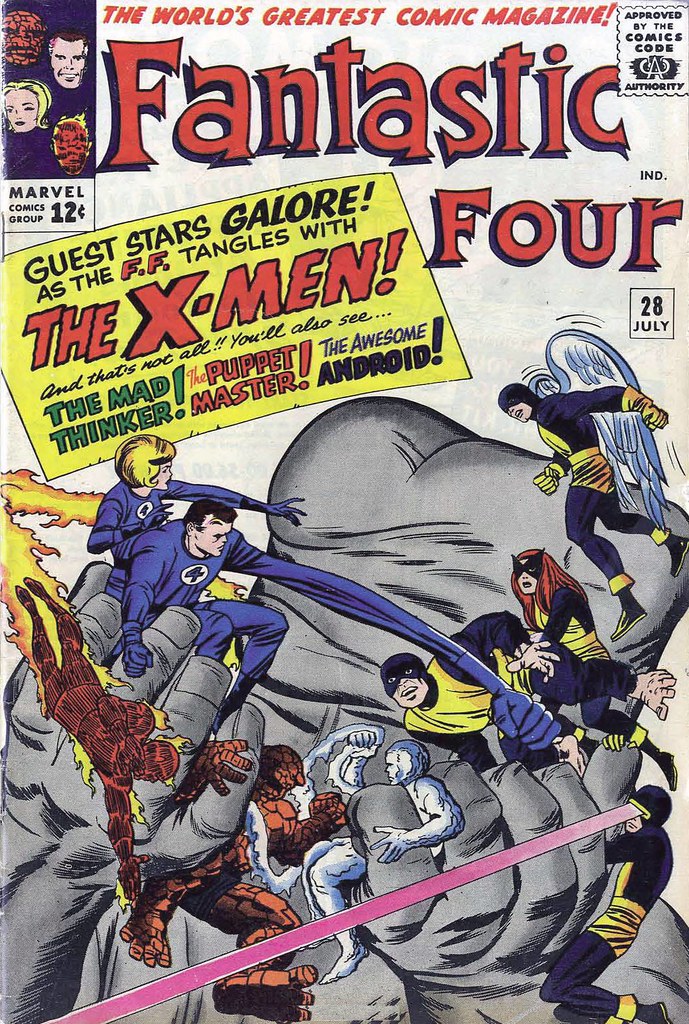
Fantastic Four #28, July 1964
(By Lee, Kirby, & Chic Stone)

Well, here we are. Stan has gotten the hang of the whole shared universe thing, and in the past three months, he's had:

The Hulk show up in the pages of Fantastic Four #25 & 26.

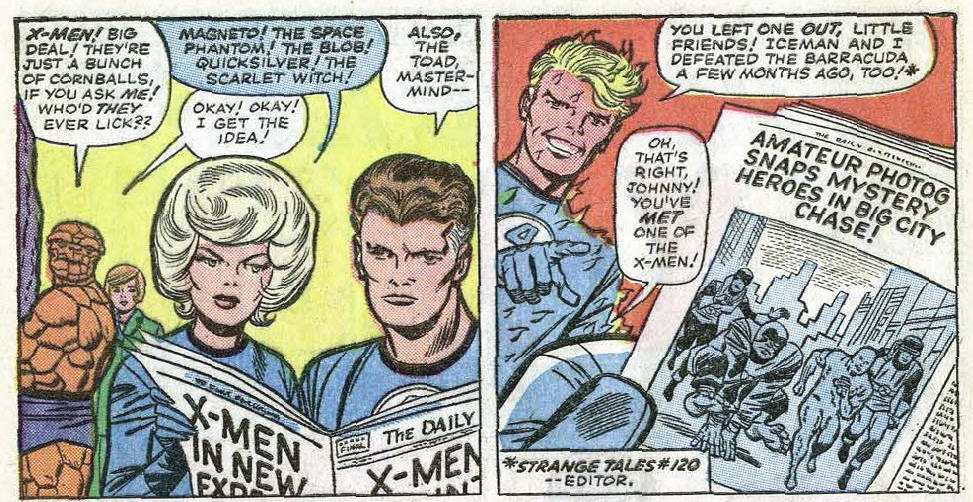
Iceman teaming up with the Human Torch in Strange Tales #120.

The FF try to hire the services of Nelson & Murdock in Daredevil #2.

Dr Strange help the FF take on the Sub-Mariner in FF#27.

Spider-Man and the Green Goblin running into the Hulk in Amazing Spider-Man #14.

Spider-Man and Giant-Man tricked into fighting each other, in Tales To Astonish #57.

Whilst I'm sure that these appearances weren't purely designed to flog more copies of the guest stars' own books, I have my doubts at times...


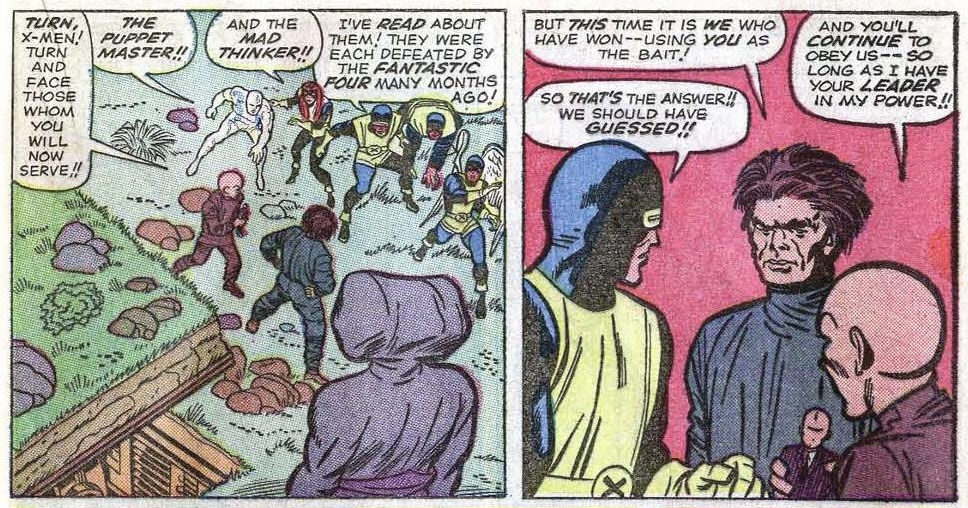
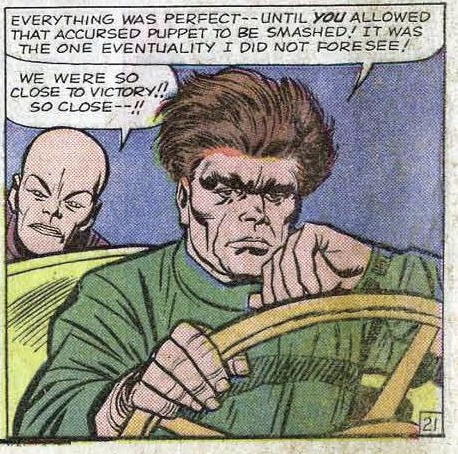
With the gratuitous plugs out of the way, we'd best track down the villains of the piece. Here they are, folks!


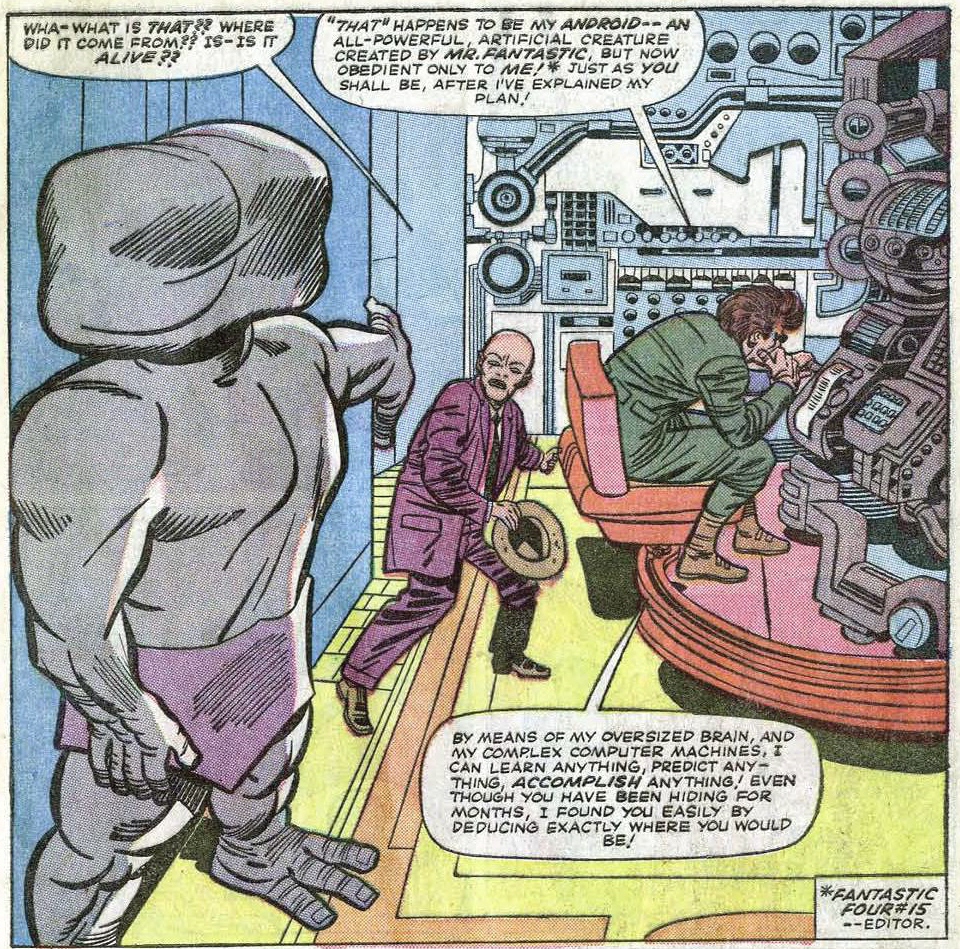
That there baldy fella is the Puppet Master. He can sculpt clay into little voodoo dolls. His daughter is also the Thing's girlfriend. The bloke with the big hair is the Mad Thinker. He's a genius, dontcha know?

Both the Thinker and the Puppet Master have had their heads handed to them by the FF in the past, and they want revenge. What's the plan? Glad you asked.


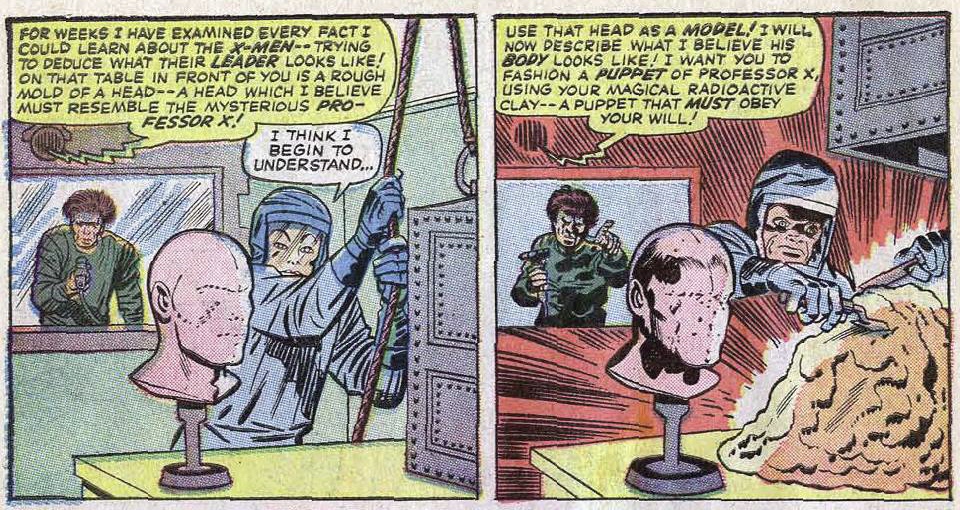
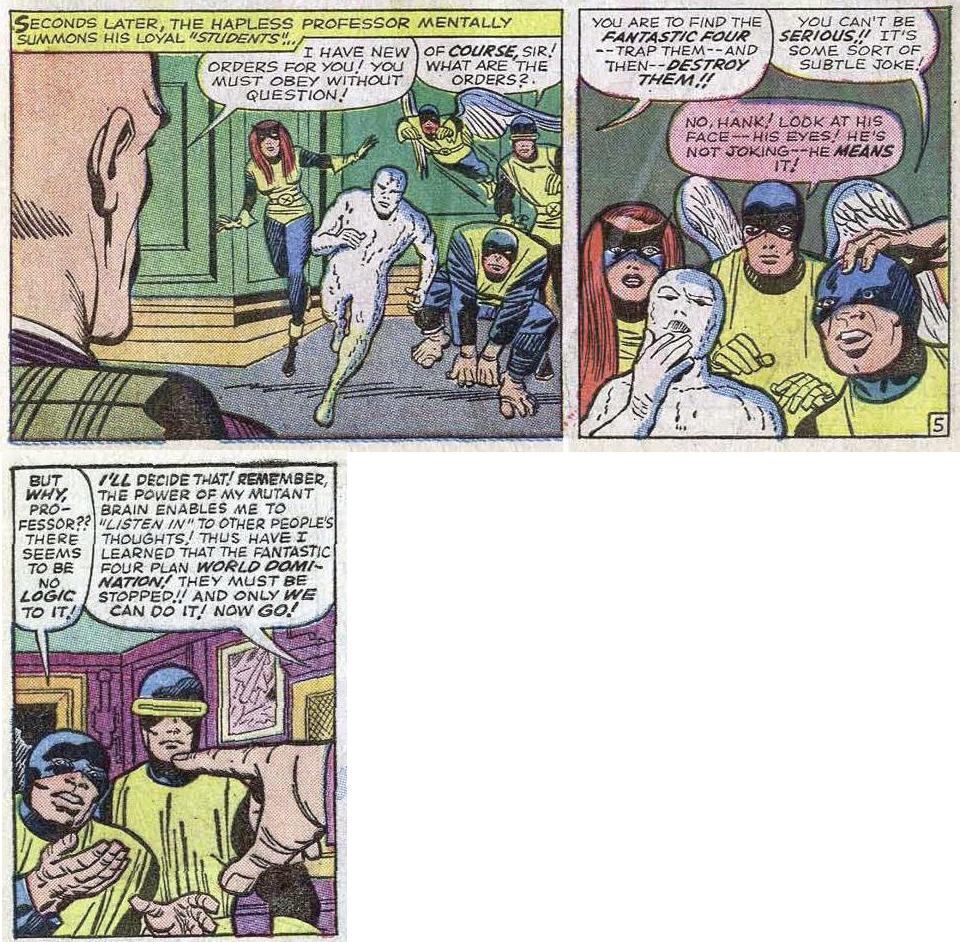
Either the Mad Thinker is incredibly smart, or Prof X needs to spend less time accompanying the team on missions. The Puppet Master does his thing, and before we know it, Professor X is under his mental thrall.


And here we see the benefits of Xavier's policy of training his students to obey orders without question: even when those orders are clearly bonkers, his students rush to obey them. The X-Men hop in their helicopter and head over to the Baxter Building, where they lure the FF out of the city, by dint of (that already clichéd strategem) kidnapping the Invisible Girl.

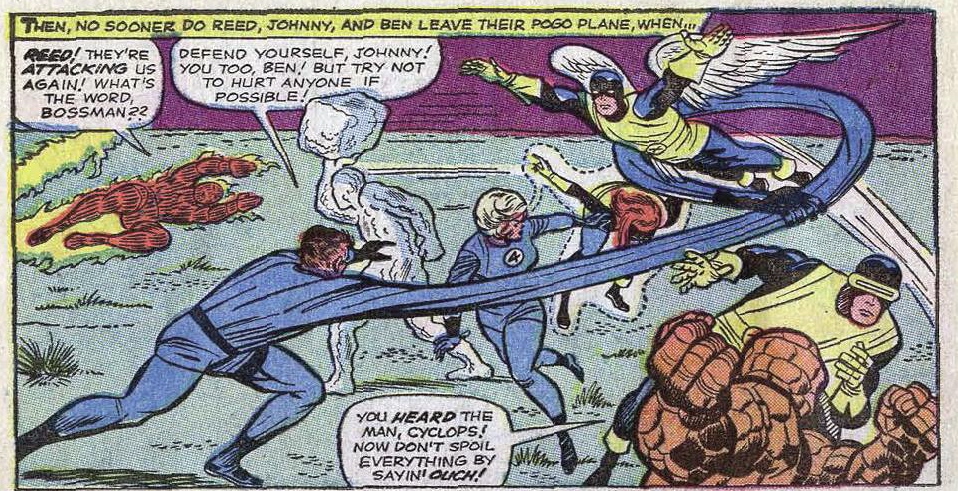
The FF are soon in hot pursuit, but the X-Men are waiting for them...


You tell 'er, Cyclops, you fascist drone.

Anyway, Professor X's plan, it appears, is for the X-Men to beat up the Fantastic Four. Naturally, violence ensues.


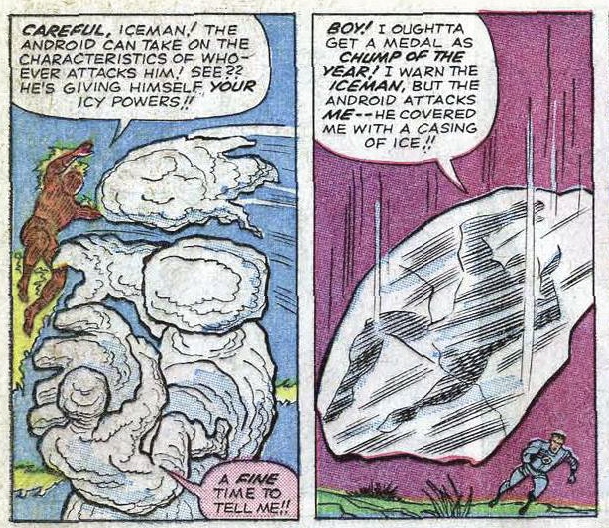
Ok, so, Human Torch versus Iceman, fair enough, could be a long fight, but it makes sense, I guess. Personally, I'd get the Invisible Girl to catch Angel in a force-field, given how hopeless Reed is at achieving that goal. And, really, Cyclops versus the Thing? Poor Cyclops. I'm assuming Beast is off-camera reading a biology book or some such, rather than joining in the bruhaha?

To liven up the battle, the Mad Thinker has set various booby-traps on the field of battle, which succcessfully capture the FF, who are too distracted by the fight to avoid said traps. Not a bad plan, as far as it goes, but naturally, the Thinker can't help but gloat.


Crivvens, what a scunner! Puppet Master orders the Professor to knock out his merry mob, but reckons without the super-brain of Hank McCoy, who can resist mental domination just be dint of being really smart. The Beast crushes the Prof X voodoo doll and rescues his team, whilst the FF free themselves, just in time for the big fight!


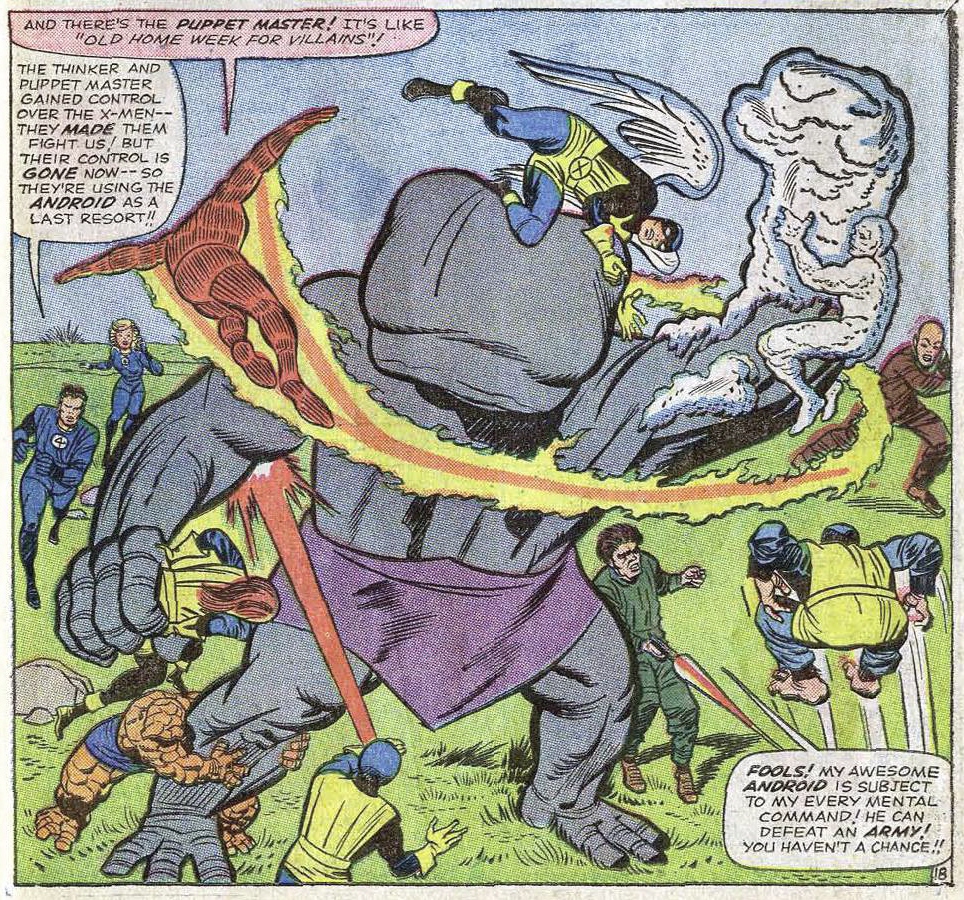
The Awesome Android, you may not know, can copy superpowers, which, when he's fighting nine superheroes, gives him a bit of room to get his groove on.


Unfortunately, no amount of superpowercopying mojo can overcome our heroes, particularly when Professor X gets in on the act.


And what of our villains? They're escaping in the Thinker's escape plane. Ready to work together again, boys?


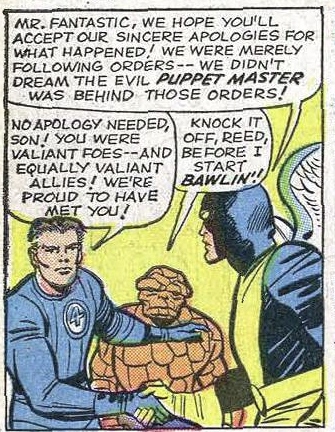
Hmm, guess not. Anyway, just time for some weasil words from Cyclops...


That's right, boys, kiss and make up, until your next fight...

Saturday, 27 September 2008

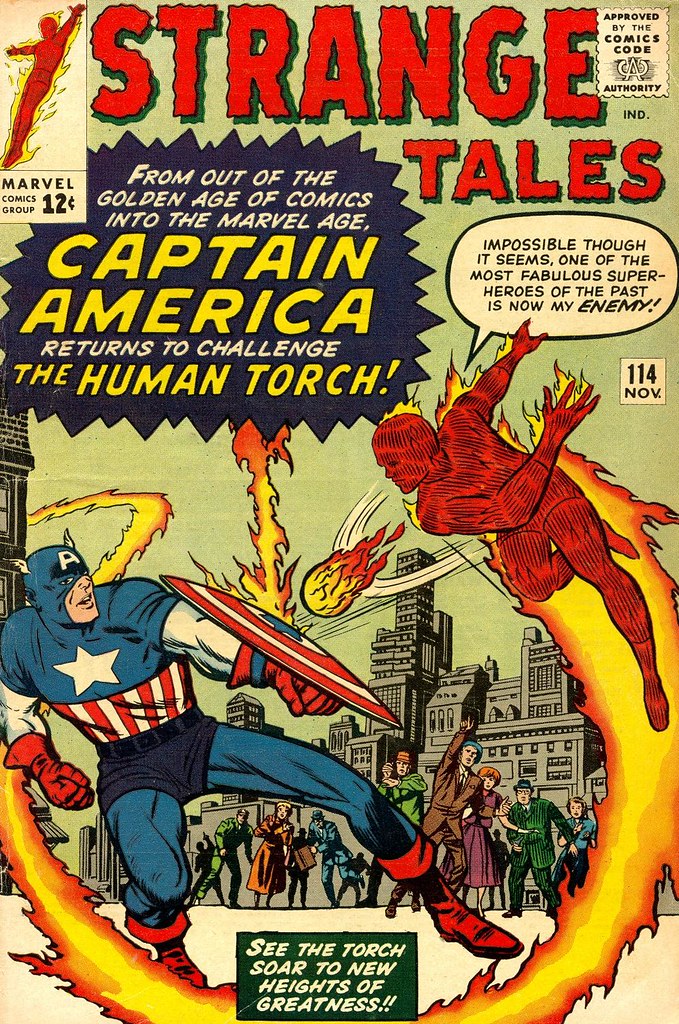
The Human Torch Meets ... Captain America

Strange Tales #114, November 1963.
(By Lee, Kirby, and Ayers)


So, I know what you're thinking: "Wasn't Captain America defrosted by the Avengers in Avengers #4, a few months after this issue was released? So who's this joker?" Who indeed...
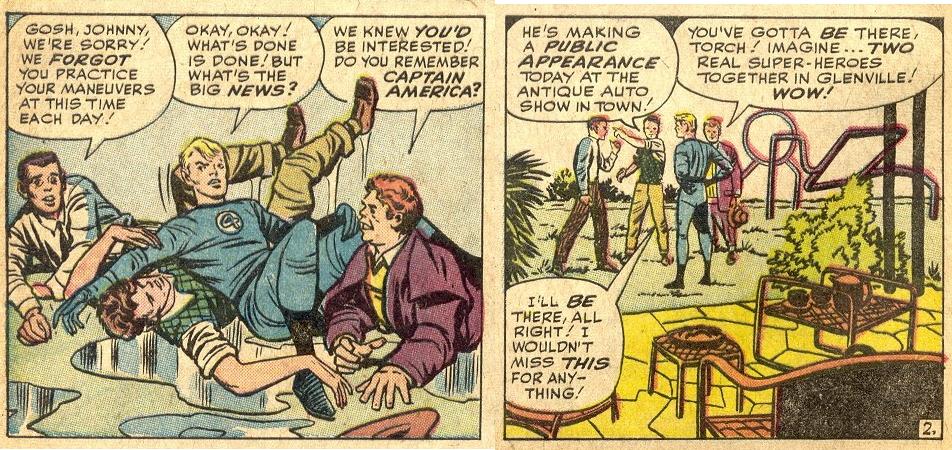
Our tale begins as the Human Torch's daily workout is interrupted by some of his college pals. No, I don't know what happened to his secret identity from a couple of issues back either.


Naturally, Johnny Storm is a big fan of Captain America, having read comic books about his adventures when he was a kid. Thankfully, this was in the days before we had a rolling timeline. These days, I guess Johnny would have been read antique comics by his great-great grandfather or something.

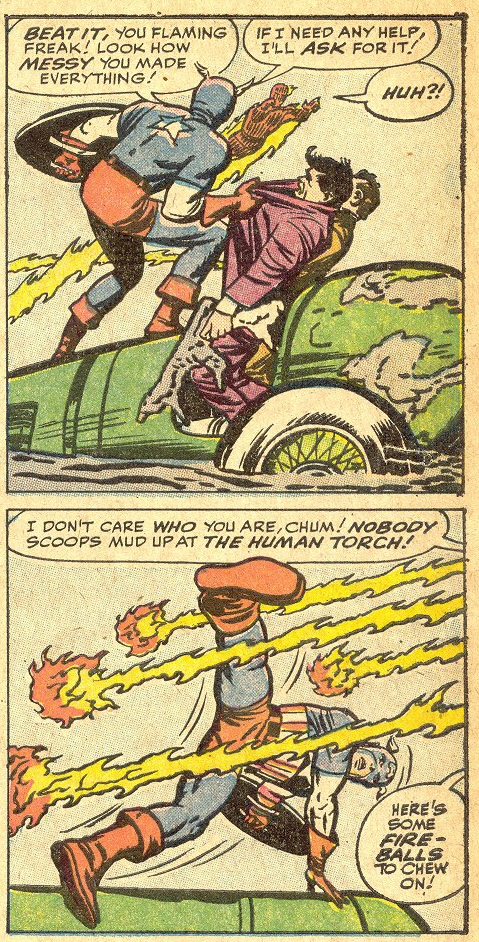
Anyway, at the antique car fair, trouble erupts in the form of a couple of ne'er-do-wells who pinch a racing car and race off. The Torch sets off after them, but he's not alone.


The two heroes stop the crooks' getaway, but fall to arguing amongst themselves.


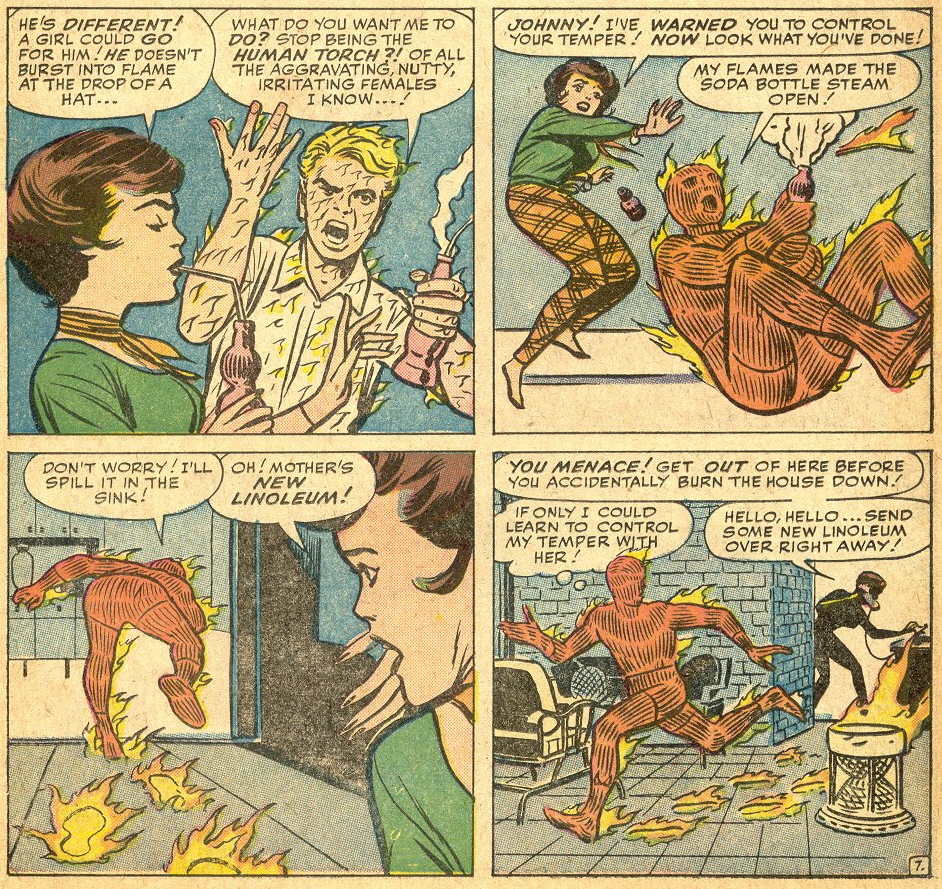
Fortunately, the cops show up to catch the villains. The Torch goes off in a sulk, whilst Captain America takes the credit, the cad! Heading home to meet his girlfriend, the two argue over the merit of the returned hero, with "hilarious" results:


Meanwhile, Captain America is back, and it looks like he's a bad 'un...


While the escaped cons draw the attention of the police, the villainous Cap is robbing the local bank. How very... mundane.


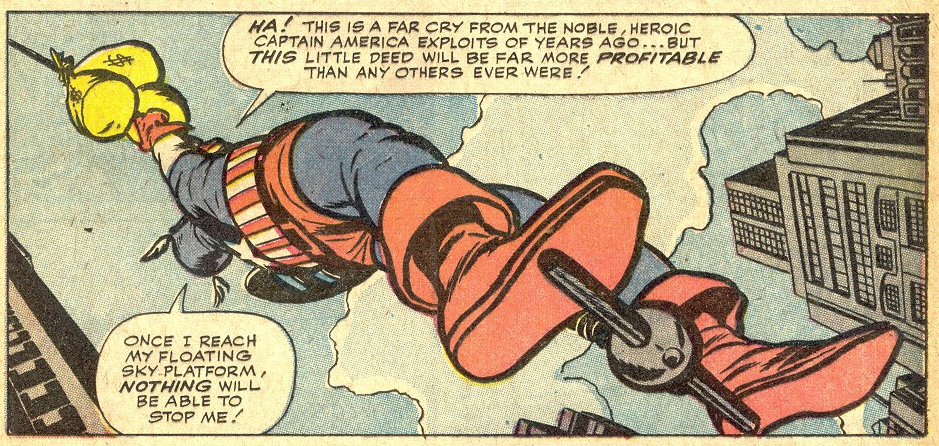
Wait a minute, did he just say "sky-platform"?


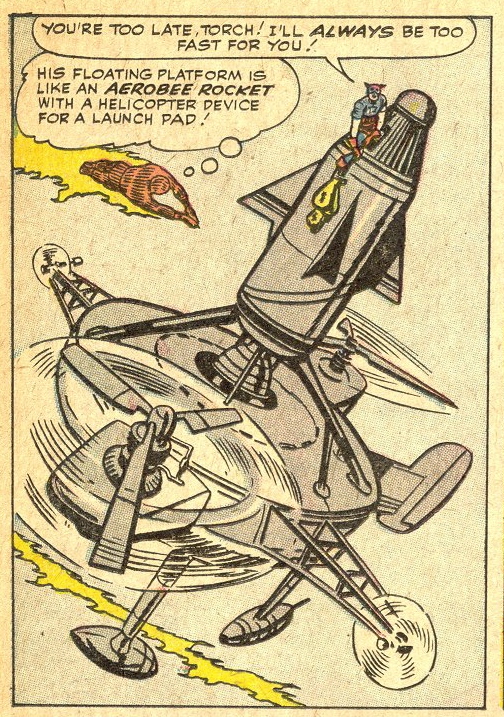
Holy crap, he did! This costumed criminal has built or bought some sort of Kirbytech helicopter thing, in order to steal a sack of swag from a crappy little town in upstate New York? Does Lee's plot just get really vague at this point, leaving Kirby to fill in the blanks, or was Kirby making it up as he went along, leaving Lee to try and make some sense of it all?

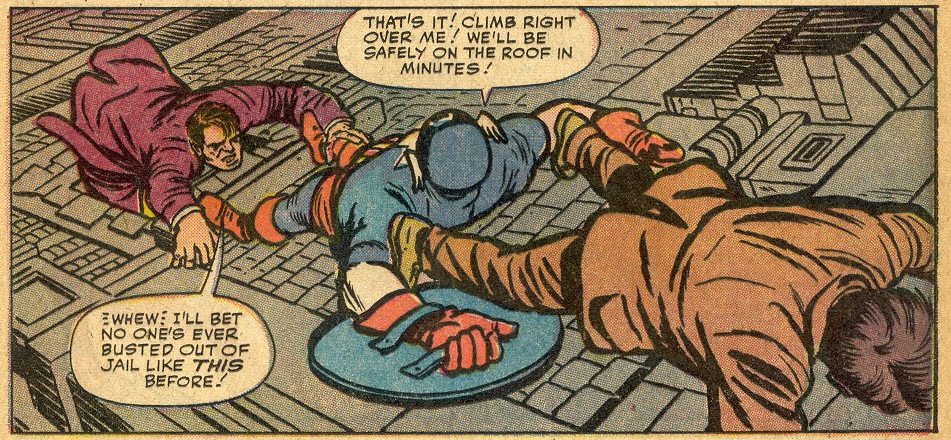
Anyway, let's plough on, shall we? After parachuting to safety from his Kirbycopter, "Cap" escapes in a truck, pursued by the Torch, who's in for a surprise...


I mean, seriously, what? How organised is this guy? Were asbestos-lined trucks just lying around New York back in the 60s? Or was there a supplier of superhero-inconveniencing traps, based on 5th Avenue, back in those days?

Naturally, the Torch escapes his fate, and captures the Cap impersonator, who turns out to be an old foe of the Torch's, the Acrobat, an incredibly minor villain making, justifiably, his last appearance. Presumably he was kneecapped by whomoever was dumb enough to lend him the Kirbycopter. And the point of this story?


I guess we all know what response that appeal met with. "Hey, assholes! Captain America wears BLUE shorts!"

Saturday, 13 September 2008

A Skrull Walks Among Us!


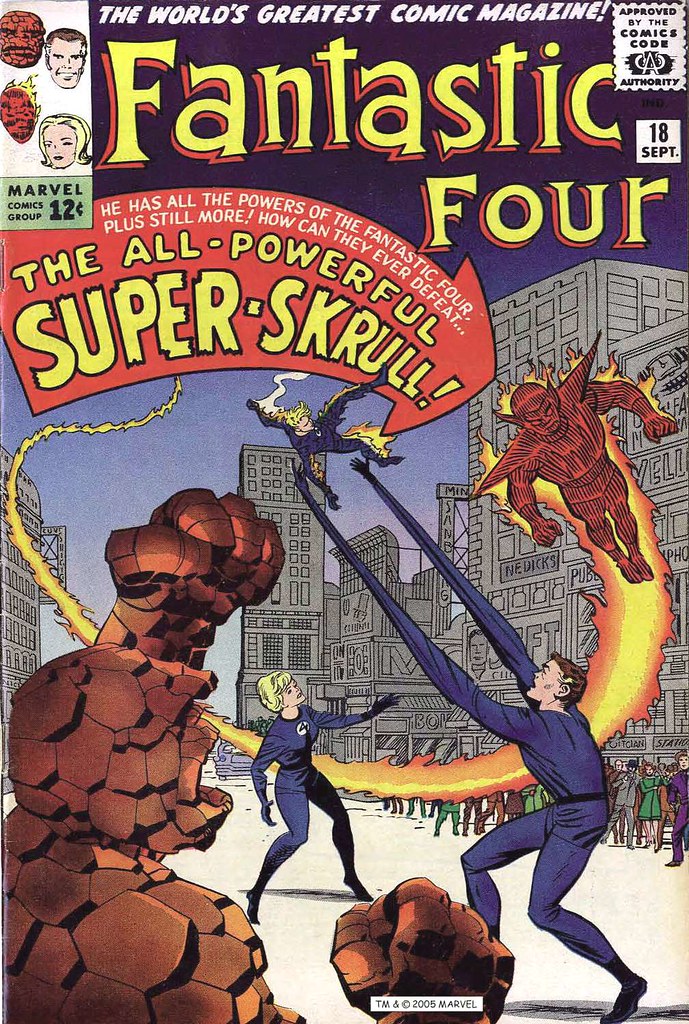
Fantastic Four #18, September 1963. Again.
(By Lee, Kirby, and Ayers)

As I may have mentioned in the past, I used to run a Marvel Superheroes RPG, back in the days when I still had the time, energy, and enthusiasm to try to run a decent game. In the course of the campaign, I learned many hard lessons about super-powered combat. So, with the aid of this issue of FF, let me bring you

Dr Sordid's 10 Tips For Truly Effective Super-Villains!

1. Good Planning Is Half The Battle.


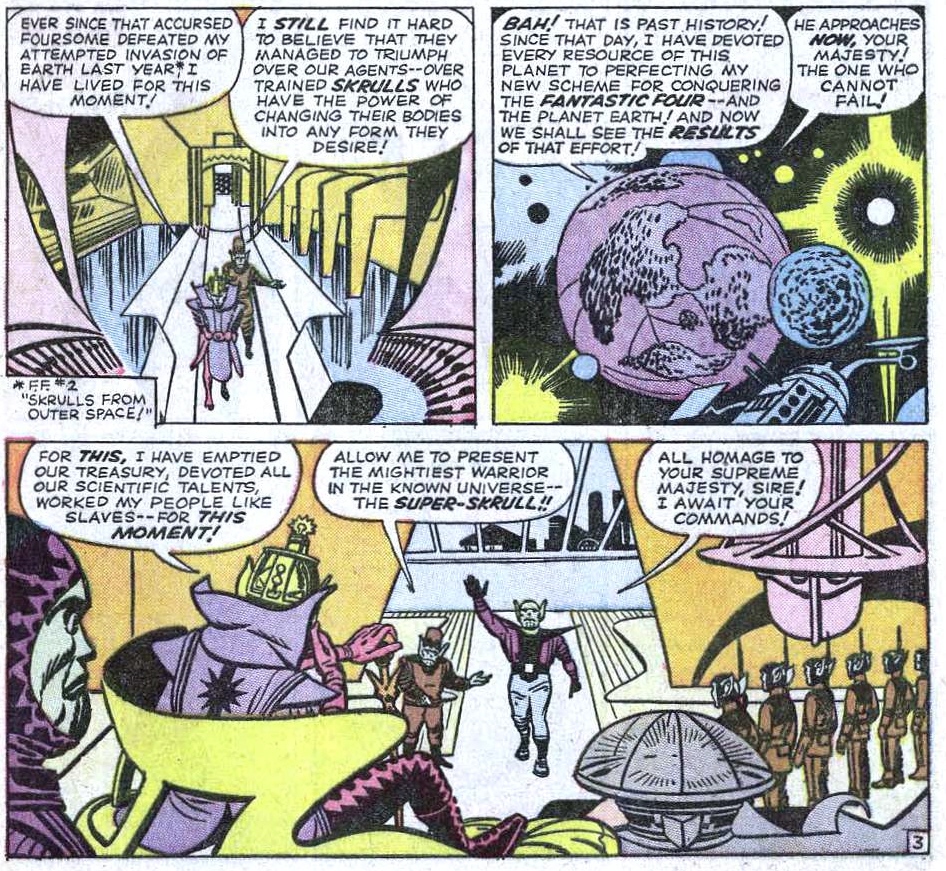
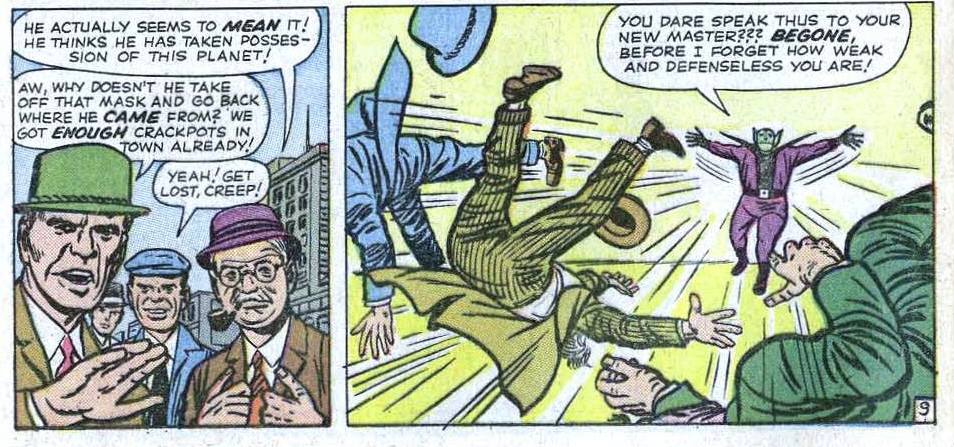
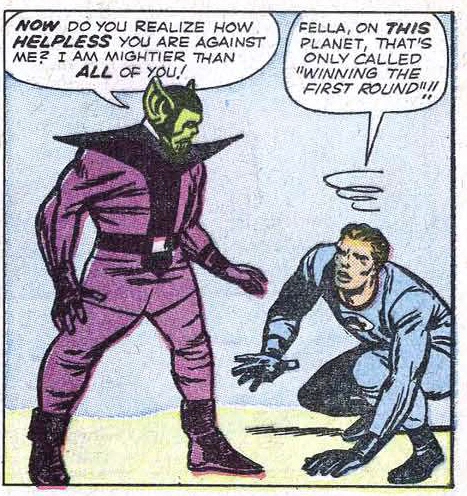
As the Emperor of the Skrulls demonstrates here, it's vitally important to put the appropriate time and money into developing your super-villain. That can make the difference between reducing your enemy's homeplanet to rubble, and being left with andromedan egg on your face.


2. Imitation Is The Sincerest Form Of Flattery.


Surprisingly few superheroes consider how to counter their own powers. Which is odd, when you consider just how often a superhero meets his evil twin, or has his powers stolen by a villainous scientist.


3. Always Go One Better, Just In Case.


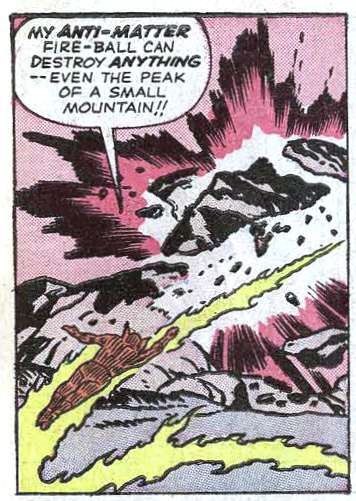
If you're going to make copying your enemies abilities your schtick, it's wise to make sure that the R&D department provide you with a bit of extra oomph, on the off chance that you encounter a hero who's smart enough to consider the previous point.


4. Put On A Good Show.


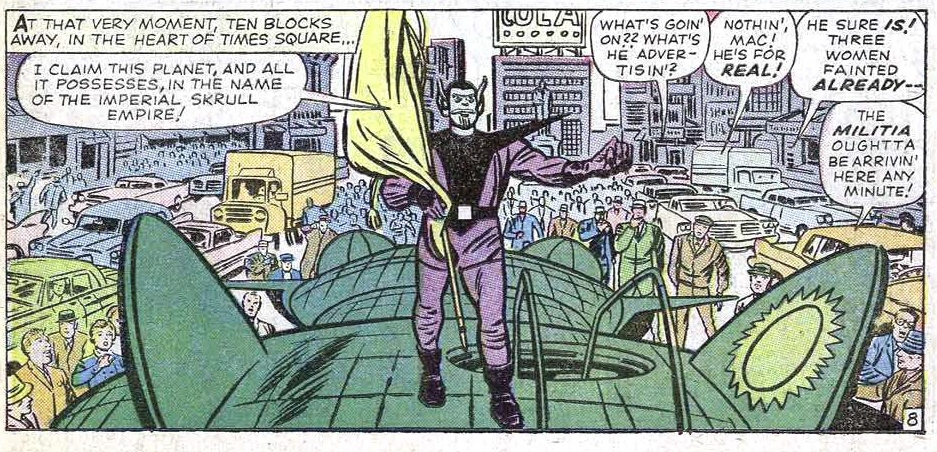
When presenting to a potentially hostile, audience, you can't go wrong with a good strong introduction. If enough people believe you're capable of single-handedly conquering New York, then their faith in the heroes who show up to take you on can be dented, which never harms your chances, when it comes to the inevitable fight sequence.


5. Don't Take Any Crap From Civilians.


Residents of the Big Apple are notoriously reluctant to welcome visitations from alien invaders. It's best to beat the crap out of any pipe-smoking, fedora-wearing New Yorkers who give you any back-talk. (Oddly, a variation on this advise, replacing "alien invaders" with "tourists", appears in the most recent edition of the Rough Guide To New York. Who'da thought it?


6. Resist The Urge To Gloat.


Should your first encounter with the heroes go well, then it's best not to rub your opponent's nose in it. Heroes have an annoying tendency to bounce back, and you can bet anything you say now will come back to haunt you later. Remember: pride cometh before a fall, so a slight smile should be your only outward expression of satisfaction.


7. Goats Are Not Scary. Not Even A Little Bit.


This one should be self-explanatory, but just in case: before you invade an alien planet, check which animals are regarded as fearsome, and which are thought of as cute or ineffectual.


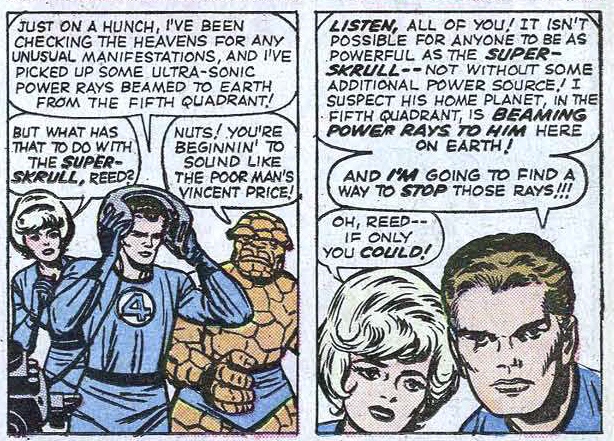
8. Never, Ever, Let Super-Smart Heroes Get Access To A Laboratory.


If you have a weakness which can be exploited, you can bet your bottom Altarian Dollar that the heroes will find it, if you give them an opportunity. So, either don't give them that opportunity, or better yet, don't have any such weakness in the first place.


9. If All Else Fails, Cheat!


If things are starting to not go your way, then it's time to pull something out of your back pocket. And, speaking from personal experience, let me tell you that hypnotism is a seriously underrated superpower! Why fight your foes, when you can mesmerise them into beating the crap out of each other instead?


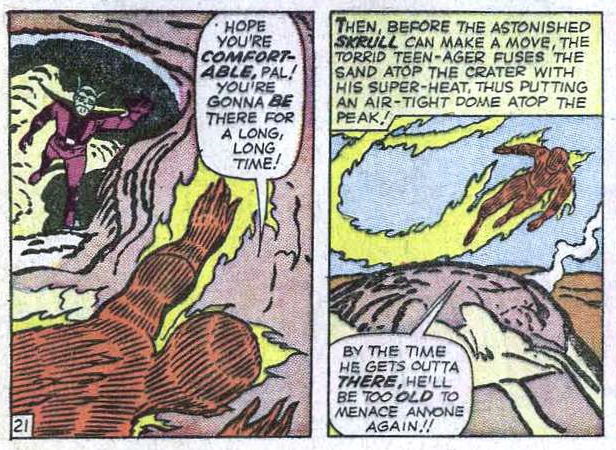
10. Always Have An Escape Plan.


If you've had your arse handed to you by the superheroes, then I recommend you have a means of avoiding being sealed up in a volcano for ever. A teleporter, perhaps, or a rescue ship from your home planet. If not, it may not be the end of the world, as the odds are you'll be back anyway before too long....

Friday, 29 August 2008

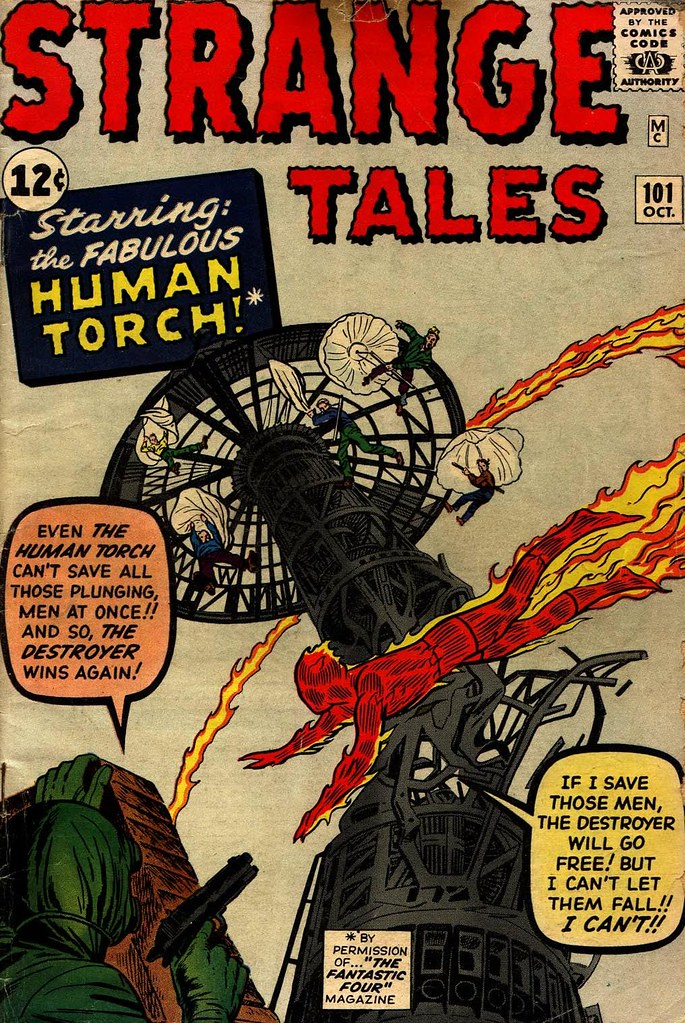
The Human Torch!


Strange Tales #101, October 1962
(Stan Lee, Larry Lieber and Jack Kirby)

(Yes, folks, Jack Kirby handles the artistic chores here, which, with him also illustrating Fantastic Four, Journey Into Mystery, Hulk, and the ongoing adventures of Ant-Man in Tales to Astonish, takes him up to 5 titles a month. Phew.)

Back in the earliest days of the FF, before the Thing built up his cult of personality, the Human Torch was regarded as the most popular member of the team. As a teenager, he was most likely to appeal to the young readership, so he was awarded his own title (or at least a share of his own title, as he had to share with various anthology strips).

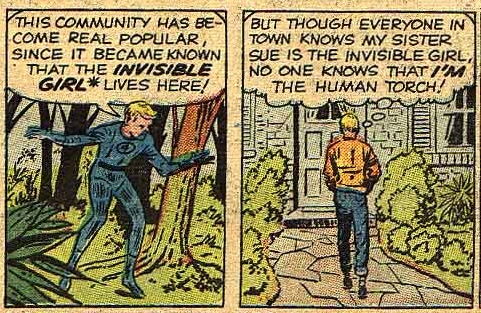
For the purposes of this series, the Human Torch has taken up residence in Glenville, somewhere in New York State. Bizarelly, despite being a member of the most famous super-hero team in the world, he has a secret identity.


Apparently, the good people of Glenville aren't all that smart, then. Anyway, whilst he gets to battle the Sub-Mariner and Doctor Doom on a regualar basis in FF, here he has to make do with villains like the Destroyer, who may sound like a serious threat, but, well, you'll see.


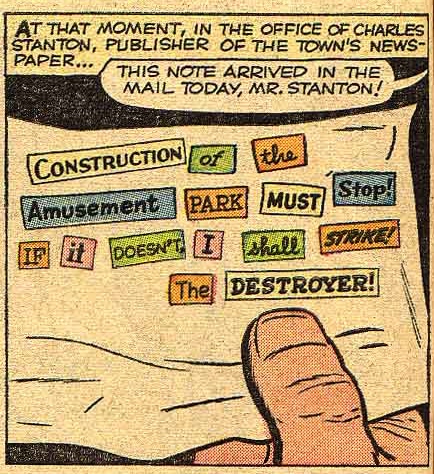
Yes, the Destroyer is a serious threat. To theme parks. Scary stuff. The Destroyer stages a serious of incidents at the new amusement fayre, which the Torch must stop, without compromising his secret identity.


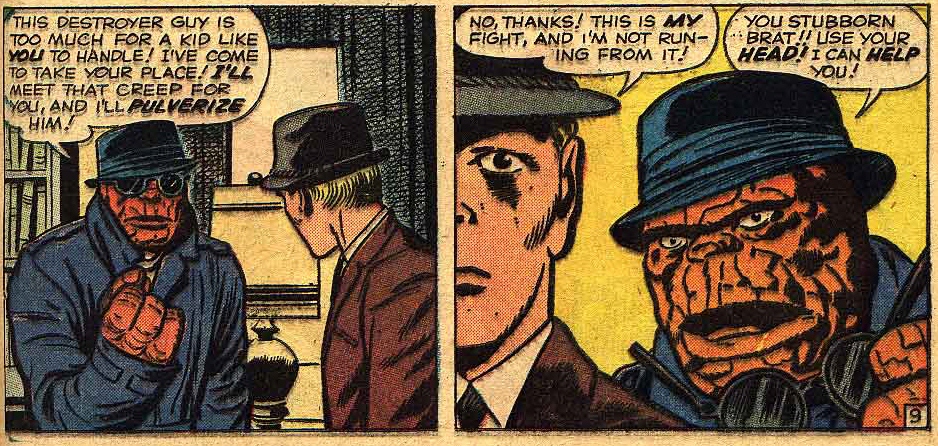
After his first couple of attempts are thwarted by the Torch, the Destroyer gets mad, and challenges the Torch to battle. This catches the attention of the Torch's team-mate, the Thing, who shows up to help. So much for protecting his secret identity.


Johnny Storm's no chicken, though, and he tells the Thing to sling his hook, so that he can take on the Destroyer himself. In a rare example of intelligence, the Torch decides to investigate why the fayre is being targeted, and discovers...


Yes, the red menace has come to upstate New York. Kids in the 60s must have been convinced there was a communist hiding behind every corner, if these comics had any influence on them. Of course, there was generally an evil alien hiding behind every other corner...

Anyway, the Torch makes short work of the Soviet submarine, and quickly tracks down the Destroyer, who turns out to be -


It's all a bit Scooby-Doo, isn't it?