Showing posts with label Sub-Mariner. Show all posts

Friday, 20 November 2009

70 Years of Marvel - 2009


So, the Secret Invasion's over, and the Skrulls have had their backsides kicked back to Skrullos. Good news for our heroes, right? Wrong. For whatever plot-serving reason, Norman Osborn, formerly the Green Goblin, formerly dead, and formerly a world-renowned supervillain, is now the hero of the world, and has been placed in charge of SHIELD (or HAMMER, as it's now known), and, as you can see from the picture above, he's brought along a few of his pals.

Osborn's "Cabal" is made up of Loki, the Hood, Emma Frost, Sub-Mariner and Doctor Doom. Apparently, Norman is the only person alive who doesn't know how well it goes when supervillains team up: Acts of Vengeance, anyone?

Whilst we wait for the inevitable decline and fall of Osborn and his friends, comic readers in 2009 can choose to look away from the mainstream Marvel universe, and look out to the stars, where the Kree, conquered by the Inhumans, are at war with the Shi'ar. The War of Kings, as it's dubbed, has drawn in any number of Marvel's cosmic characters, from Nova to the Guardians of the Galaxy, and, like most Marvel successes, shows signs of being over-exploited. Still, it's more fun that the grimness of most Marvel books these days, so enjoy it while it lasts.

Thursday, 12 November 2009

70 Years of Marvel - 2003


Another year, another new brand. 2003 was the year of Tsunami Comics, a line of books aimed at appealing to the Manga market, a source of prime dollars of which Marvel was thus far not getting a slice. The idea of the line was to produce books which would be reprinted in the digest format of Manga books, rather than the full-size trade paperbacks normally used.

We got some good books out of it. Sentinel (above) was the Iron Man / Iron Giant with a mutant-hunting robot instead of a a big friendly robot, whilst Runaways was the story of a group of teenagers who discover their parents are eeeviiiillll! Other than those sparks of originality, though, mostly it was just the same old, same old: a relaunch of New Mutants; an attempt at a solo book for bad / good mutant, Mystique; the teenage adventures of Emma Frost; and new books for Venom, Sub-Mariner, and the Human Torch. The line wasn't a great surprise: most people can presumably tell the difference between real Manga and Marvel's pseudo-Manga, and those that couldn't just weren't gripped by what they saw.

2003 also saw the legendary Neil Gaiman doing his first work for Marvel, with 1602, which had the Marvel Universe transposed to Elizabethan times. A fine tale in its own right, I'm sure the numerous non-Gaiman sequels, prequels and sidequels, haven't detracted from its impact at all.

Finally, 2003 also saw the definitive origin of Spider-Man, in the Mark Millar-penned Trouble. Or maybe it didn't. After all the hype about this book, no-one really seems sure what the point of it all was.

In the real world, 2003 saw the Columbia shuttle disaster, the downfall of Saddam Hussein, and the return of Dirty Den, all of which kept the internet chattering.

Monday, 2 November 2009

Oooh! Shiny!

The mid-90s saw the comic speculator boom reach its crescendo, as a whole bunch of stupid people decided that, because Amazing Fantasy #15 and Detective Comics #27 were worth a fortune, then all comics would eventually be worth a fortune. These stupid people went forth and bought a shedload of comics, which they then either bagged and tagged, to sell in the future once said comics had become valuable, or, hilariously, sold them to even more stupid people, who believed that because the comics were being bought in large numbers, they must be worth lots of money NOW. Before anyone could realise these spectacular profits, the bubble burst, the speculators went on to the next big thing (pogs, probably, or trading cards), and comic sales dropped like a stone, taking most of the comic shops with them. Before you laugh, bear in mind this sort of "logic" is pretty much exactly what caused the house-buying boom of the last few years, and you saw how well that turned out.

The rise and fall of the speculator market can be symbolised by looking at the use of foil covers in comic books. Bear with me.


In 1991, Silver Surfer #50 came out. This book featured a battle between Surfy and the reborn dark titan, Thanos, and was a prelude to the Infinity Gauntlet, a cosmic event which touched on most of the Marvel Universe (except the X-Books, which for some reason managed to dodge such things). Some bright spark at Marvel decided to celebrate this milestone issue, by issuing the book with a silver foil cover.

I imagine it did well, I recall friends being excited by the (really not done justice by scanners) cover. In any case, Marvel followed this up the very next month with a glow-in-the-dark cover on Ghost Rider #15.


Nice enough, I'm sure you'll agree, but, really, why the need for a gimmick cover? This issue did feature a confrontation between the 90s Ghost Rider and his 70s equivelent, but it was the concluding part of a three parter, and not even a particularly good three parter at that.

1992 saw Marvel issue a few more books promotional covers Most of them seem justifiable enough:
Amazing Spider-Man #365, Spider-Man #26 and Spectacular Spider-Man #189 all celebrated Spidey's 30th anniversary with neat little holographic panels.
Hulk #393 commemorated the Hulk's 30th anniversary and revisited his origins.
Guardians of the Galaxy #25 featured the 31st century heroes battling Galactus.
Spider-Man 2099 and Ravage 2099 introduced the world of tomorrow.
And, er, Silver Sable #1 celebrated the bounty hunting blondeshell getting her own book at last.


In 1993 , Marvel were churning out the gimmick covers, on, by my count, 44 comics. Some, such as the Avengers and the X-Men's 30th anniversary, were reasonable. Then there were such "essentials" as Namor #37, which celebrated Subby getting a new costume. Or Fantastic Four #371, in which the Human Torch accidentally set fire to Empire State University. Or Venom: Funeral Pyre, in which the world's most overrated supervillain takes on the Punisher (spoiler: nobody dies). By 1994, just about every comic had a gold, silver, platinum, 3D, die-cut, prismatic cover, or it felt like it. Every anniversary, no matter how trivial, every first issue, every "landmark" issue, had a pretty cover, and an inflated cover price to match. Sales were spiking all over the place, based not on how good the books were, but on the relative "buzz" generated by Excalibur #75 or Nova #1.


By 1995, the speculators were getting tired, and by 1996, most of them had vanished off in search of the nearest shop selling Magic: The Gathering cards. Other than a couple of Marvel 2099 books, the foil cover phenomenon vanished without trace virtually overnight.


It would be a good long while before Marvel would try another attempt at getting those speculator dollars, through the use of variant covers on books. A glance at the shelves of your nearest comic shop will show that Marvel doesn't really seemed to have learned any lessons from the 90s speculator boom, as just about every comic out at the moment is available with at least two covers. Disaster lies ahead...

Monday, 26 October 2009

70 Years of Marvel - 1990


In 1990, Jim Starlin was back with a vengeance. Starlin had been out of the superhero game for most of the 80s, concentrating on his science-fiction work, but his killing off of Robin over in the BatBooks had brought him back to the attention of Marvel Editorial, who hired him to take over the Silver Surfer book. Within a couple of issues, Starlin had brought his most famous creation, Thanos, back from the dead, along with Thanos' nemesis, Drax the Destroyer. For the next couple of years, Starlin would take Marvel Comics in a more cosmic direction, with the Infinity Trilogy, the return of Adam Warlock, and the formation of the Infinity Watch. The cosmic revival didn't last long after Starlin lefr Marvel for other shores, and it would be a long time before we'd see Marvel do "cosmic" again.

In other comics, 1990 saw the introduction of Gambit, terrible accented cajun thief, and Cable, the mutant with the most complicated secret origin ever. I'd explain what was so confusing, but Quarter Bin, a much-missed comics website from ages past, did so much more consisely.


In the Avengers, Spider-Man nearly joined the team, whilst Sersi the Eternal and Rage the street vigilante did so. Danny Ketch became a new Ghost Rider, and Sub-Mariner, Nomad, and the Guardians of the Galaxy all got a new series.

Meanwhile in 1990, Nelson Mandela was out of jail, the USSR was coming apart at the seams, and Mrs Thatcher was being turfed out of her seat. On tv, we were being baffled by Twin Peaks, and Paul Merton and Ian Hislop began taking shots at those making the news, while at the pictures, Macaulay Culkin was becoming a child star.

Saturday, 17 October 2009

My First Comics

I may never know which Borders comics fan's mum decided to turf out his November and December-dated Marvel comics, but it was my good fortune that, rather than binning them, she instead donated them to one of the stalls at the Liberal Party's pre-Christmas Bazaar. At the event, where I was dragged by my mum and dad, not only did I get to meet the impressively-statured Cyril Smith, I was confronted with a selection of comics of which, until then, I was sadly unaware.


Alpha Flight #4 & #5 (both by John Byrne)
Alpha Flight #4 featured the tail end of a multi-parter in which the so-called Master of the World attempted to conquer the world, using Marrina the Fish-Girl. It also featured the Invisible Girl and Sub-Mariner, and introduced the idea of Aurora's multiple personality disorder. Issue #5 featured the dwarf, Puck, investigating a drug-smuggling ring based out of a hospital. For a comic featuring only one character I'd even heard of, Alpha Flight had me hooked from the start.


Fantastic Four #260 & #261 (both also by John Byrne)
FF #260 introduced me to the FF's nemesis, Doctor Doom (I may have been aware of him from things like the Spider-Man cartoons, but it would be a very vague awareness), and, before the end of the issue, had killed him off, in a battle between the Silver Surfer and Tyros. This was also the end of a multi-parter, but was also reasonably straightforward to fathom. Alpha Flight #4 was set immediately between #260 and #261, introducing me to the idea of crossovers between titles. #261 had the FF off in space, bumping into the Watcher, and had the team trying to justify not having let Galactus die in an earlier issue. This was a bit of a mystery, but by the end of the book, I pretty much understood what it was all about. The issue also featured a recap of the FF's origin, which was handy for newbies like me.


Amazing Spider-Man #246 & #247 (by Roger Stern and John Romita Jr)
ASM #246 was, essentially, an imaginary story, in which J. Jonah Jameson, Mary Jane Watson, the Black Cat, and Spidey himself daydreamed about their perfect day. Oddly, whilst Jameson and the Cat's dreams ended well, neither Mary Jane or Peter Parker were able to sustain their delusion, suggesting that both have some psychological issues to deal with. #247 featured Spidey teaming up with the fabulous Frog Man, a hunt for the Hobgoblin, and a mystery villain, Thunderball (of the Wrecking Crew). It would be years before I would find out who Thunderball is, and I have no idea to this day about Frog Man. The Hobgoblin was another story, of course.


Spectacular Spider-Man #84 (by Bill Manto and Dave Simons) and #85 (by Mantlo and Al Milgrom)
PPTSSM #84 featured Spidey hunting down a gang of child abductors, and was a purely self-contained story. #85, on the other hand, had the Hobgoblin show up to take on Spidey and the Black Cat. It also, handily, showed the story so far of the Hobgoblin, and featured Peter Parker having a get together with his old college friends, including Harry Osborn, which in turn introduced me to the history of the Green Goblin, which made Spider-Man's obsession with the Hobgoblin a lot more explicable.


Avengers #237 & #238 (both by Roger Stern and Al Milgrom)
Avengers #237 featured Spider-Man trying out for the team, an event alluded to in Spidey's own book, and had the Avengers fighting a whole load of supervillains in Project Pegasus. Looking back, I'm not sure why I accepted supervillains being imprisoned with their costumes on, but it's not something that gave me cause for concern at the time. Issue #238 had the Vision, in a coma due to an earlier battle, recover unexpectedly, showed the She-Hulk househunting, and featured a last-page appearance by Tigra and the ghost of Spider-Woman, the last of which confused the heck out of me.


Captain America #288 (by JM DeMatteis and Mike Zeck)
Set in the future world of 1993, this featured Cap teaming up with the cyborg, Deathlok, to take on the ruler of a destroyed New York. This was pretty much double-dutch to me at the time, and since I didn't have the next issue, it would be a long time before I'd find out how Cap stopped the imminent destruction of the world.

Daredevil #202 (by Dennis O'Neil and William Johnson)
This book had Matt Murdock's firm hired by an African tribe do do PR for their boss, Micah Synn. Micah turns out to be a nutjob, prone to dangling policemen out of windows. As a one-shot, it does a fine job of introducing DD and his significant others, and as an introduction to Micah Synn, it made me want to read more about him, which handily was what Denny O'Neil intended.


Defenders #125 (by JM DeMatteis and Don Perlin)
My first issue of Defenders featured the departure of the original team, the wedding of Patsy Walker and Daimon Hellstrom, and a new team being formed. it also featured an Elf. Much of this made little sense, but thankfully, there was a handy letters page which clarified some of what was going on.

The Thing #5 (by John Byrne and Ron Wilson)
This book had Ben Grimm getting beaten up, for no readily apparent reason, by Wonder Man, She-Hulk, and Spider-Man, before being possessed by his old foe, the Puppet Master. I didn't know at the time who the Puppet Master was, nor why he was out to get the Thing, so this was a less successful introduction to the book, but since the book was essentially an FF spin-off, it wasn't too much of a problem.


Incredible Hulk #289 (by Bill Mantlo and Sal Buscema)
The Hulk was intelligent at this point in his history, which seemed odd at the time, less so now. It had MODOK setting the Abomination to attack Bruce Banner, who was working for the government on gamma ray research - which with hindsight seems less logical than the Hulk's intelligence. Mostly the issue involved Hulk beating up the Abomination, which for a Hulk book is pretty much what you'd expect.

Marvel Team-Up #135 (by Bill Mantlo, again, and Ron Frenz)
This issue featured Kitty Pryde (note the lack of codename) rescuing some kidnapped children from the Morlock tunnels, with the help of Spider-Man. I didn't know who the Morlocks were at the time, and I'm not sure why they were kidnapping people, but it was a decent enough tale, at the time.


The Mighty Thor #337 (by Walt Simonson)
This was a flummoxer. Thor lost his powers, whilst an alien invader gets them. Nick Fury turns up, with little explanation of who he is and why he has a flying car and a helicarrier. And out in space, someone is forging something big. Now, having read the succeeding two years worth of issues, I know this is a classic, but at the time, it was not a good first issue. Not at all.

Uncanny X-Men #175 (by Chris Claremont, Paul Smith and John Romita Jr)
Speaking of confusing first issues, this issue features the wedding of Cyclops and Madelyne Pryor, the return of Dark Phoenix, and Mastermind looking for revenge against the team for what Phoenix had done to him. Confusing stuff, but with enough exposition (this was a Claremont book) to make it explicable.

So there you have it. My first 18 Marvel books. Some classics, and some, less than classic, but enough to get an 11 year-old me hooked on the things, if not for life, then at least for the forseeable future. To my bank manager's horror.

Tuesday, 6 October 2009

10 Second-Stringers

Following up on yesterday's post, I thought it'd be nice to take a closer look at these guys, a posse of criminally underexposed characters introduced in 1974, who, if not for the cult of Wolverine, might well be far more respected in comics circles. Or they might not. You judge...


Nuklo was the son of a couple of golden age heroes, and briefly, the brother of Quicksilver and the Scarlet Witch. Created by Roy Thomas in the pages of Giant-Size Avengers, Nuklo, unfortunately, possessed the power of being highly radioactive, which probably scuppered his chances of joining any of the big-name teams. So naturally, he ended up appearing in the pages of Thunderbolts later on.


Created by Jim Starlin and Steve Englehart, Nitro's proved one of the more successful of the class of 1974. Not only was he indirectly responsible for the death of Captain Marvel, who died as a result of an illness contracted during this very issue, but, depending on your viewpoint, he was either indirectly or directly to blame for the disaster which led to Marvel's Civil War a couple of years back.

No, your eyes are not deceiving you, unfortunately. That really is a man dressed up as a giant chicken. To be fair, he is a voodoo priest, so a chicken costume is not entirely inappropriate, but I'm not sure most comics readers are discerning enough to take that look seriously. Time remains to tell whether Black Talon ( a creation of Len Wein and Gene Colan) will once again show up as a foe of Brother Voodoo, now that he's the Sorcerer Supreme.


Oh, my... Mid-70s Marvel was many things, but subtle it wasn't. Mahkizmo, the Nuclear Man, came from an alternative future world where men enslaved women, a world at war with another alternative world, this one the female-dominated world of Thundra. Created by Gerry Conway and Rich Buckler, Mahkizmo disappeared after his first appearance, only resurfacing when She-Hulk author John Byrne was looking for some bottom of the barrel villain to make fun of.


OK, so they can't all be winners. Marv Wolfman and George Tuska brought the Piranha into the pages of Sub-Mariner, as they were beginning to seriously run out of good ideas. Originally, a real piranha fish, this chap was mutated by radiation during one of Subby's many battles, and, rather than count his blessings, Piranha decided to hunt down Namor. Other than a couple of guest shots in the Defenders, alongside other fish-based foes, he's never been seen since. Good.

And talking of the Defenders, here's Nebulon. Introduced by Len Wein and Sal Buscema, Nebulon made a couple of half-hearted efforts to conquer the Earth, before vanishing into the mists of time.

Luke Cage had some wacky bad guys in the early days of his title. Created by Len Wein (him again) and George Tuska (and him again), Cottonmouth was a drug-dealer with ambition, a taste for snake skin shoes, and, when the occasion demanded, a bazooka. Like so many other animal-themed characters, he seems to have been a one-shot character, with his name being pinched later by a member of the Serpent Society.


From the mailbox: "It had to happen. Marvel was first among comics publishers to feature black superheroes - and villains. Marvel was first to recognise the women's movement in comics with characters like the Black Widow. And now, in this issue of STRANGE TALES, we're proud to introduce the comics' first Jewish monster-hero. Needless to say, we're looking forward to your reactions[]. So ... grab a sheet of paper or a post card or last week's leftover bagel and WRITE!!" I think you can guess how filled-to-the-brim the Mighty Marvel Mailbag was that week. Brought to the world by Len Wein (it's that man again) and John Buscema, the Golem lasted all of three months, before vanishing for the rest of the century.


Jeez, Len Wein gets about, doesn't he? Equinox, a curious blend of the power of fire and ice, turned up a few times in the pages of Marvel Team-Up, and even showed up a couple of years ago during the Secret Invasion, but despite having one of the more interesting visual looks of the era, never really seems to have found his groove.


Brought to us courtesy of Gerry Conway and Ross Andru, Grizzly must be the character who must resents the ol' Canucklehead. I mean, look at the guy. With that surly attitude, coupled with the ridiculous costume, he must have reckoned he had at least as good a chance as Wolverine of making the big time. If not for a quirk of fate, Grizzly could have found himself on the cover of Giant-Sized X-Men #1, and we might now be reading three or four monthly books about the exploits of the world's favourite ex-wrestler. There's no justice.
So there you have. Ten of the, er, best creations of 1974 who didn't go on to become superstars. I like to think that in some parallel universe, these guys are world-famous, with legions of fans. Well, except for Piranha. That guy sucks.

Friday, 2 October 2009

70 Years of Marvel - 1971


1971 saw the start of one of Marvel's most famous sagas, the cosmos-spanning Kree-Skrull War, in which the Avengers - aided by the Kree exile, Captain Marvel, learned of a centuries-long conflict between the two most prominent alien races in the Marvel Universe, and, in their efforts to avoid Earth being devastated by the war, found themselves being drawn deeply into it. On the way, Roy Thomas got to bring back (albeit briefly) a number of golden age heroes:


Clockwise, from Captain America, we have the Fin, the Human Torch, the Angel, the Blazing Skull, perpetual sidekick Rick Jones, the Patriot, the original Vision, and of course the Sub-Mariner, all serving as a reminder of the glorious (by this time 32 year) history of the Marvel Universe.

Elsewhere in comics, 1971 saw the introduction of super-psychiatriast, Doc Samson, who would spend the next few years hunting the Hulk. It would also see Spider-Man briefly transformed into a literal man-spider, and the debut of the not-quite-a-vampire, Morbius and the not-quite-Swamp-Thing, Man-Thing, as Marvel chanced their arm to see what the Comics Code Authority would allow. But possibly most earth-shattering of all, 1971 saw the arrival of the world's greatest non-team, the Defenders, as the Hulk teamed up with the Sub-Mariner and Dr Strange to face Yandroth's greatest challenge: the Omegatron! Ooh, scary!

In the real 1971, Britain dropped the old pounds-shilling-pence system, in favour of something which people could actually understand. The World Trade Center, then the tallest building in the world, was completed. The UK government launched Operation Demetrius, interring people suspected of being members of the IRA. And DB Cooper became a legend.

Entertainment-wise, one could pick from buying Led Zeppelin IV, reading The Day of the Jackal, watching The Two Ronnies on the telly, or, if one was quick, catch A Clockwork Orange at the pictures.

Thursday, 1 October 2009

70 Years of Marvel - 1970


By 1970, Roy Thomas was challenging Stan Lee as Marvel's pre-eminent writer of books. The nostalgia king was writing the Avengers, Daredevil, Hulk, and of course, Sub-Mariner. While a lesser man might have been threatened by this hot new talent, Stan was quite happy to hand over the reigns, as long as he got a mention in the credits...


Bravo. Anyway, elsewhere in 1970, Sunfire was becoming Japan's first costumed hero, the Valkyrie was becoming Asgard's second cosmic hero, and the X-Men were limping towards cancelation.

In the real world, Ted Heath was becoming British PM, Janis Joplin and Jimi Hendrix were taking too many drugs, and the Baader-Meinhoff Gang were making a name for themselves in West Germany.

At the pictures, childrens' classic, The Railway Children was out, whilst the Goodies were livening up British tv. Simon and Garfunkel were going their separate ways, and Black Sabbath were releasing their debut album. Rock on!

Sunday, 27 September 2009

70 Years of Marvel - 1966


By 1966, everyone who was everyone in the Marvel Universe had their own title. Even headliners of previously-cancelled books, like the Hulk, or remnants of the golden age, like Namor, were being given the chance to co-pilot a book - in this case, Tales to Astonish, which had starred Ant-Man, until Stan saw sense and put a couple of remotely ineresting characters into the book instead.

1966 would also see the first appearance of the Silver Surfer, herald to Galactus, and of the Mimic, another sometime hero / occasional villain. The Black Panther battled the Fantastic Four in his hidden kingdom of Wakanda.

Outside of comics, Rhodesia was becoming independent of British rule, after a fashion. Nigeria was in the midst of civil war. Oh, and England won the World Cup. Guess which one of these three events is constantly harped on about by the British press, and which ones have been quietly forgotten.

On the small screek, American geekdom was born with the birth of Star Trek, while superhero fans could watch the not-yet-a-cult-classic Batman show. Meanwhile, the world of children's movies was impoverished, with the death of Walt Disney; the Disney empire would, however, continue to grow.

Monday, 31 August 2009

70 Years Of Marvel - 1939

So, apparently, Marvel Comics is 70. Which is odd, because in 1986, it was 25. Mind you, Marvel's idea of the passage of time has always been fluid, whether it be the sliding 10-15 year timescale of the Marvel Universe, or confusion over what came first, 1954 or 1961 (just ask Alan Moore). Anyway, in tribute to this alleged anniversary, and in order to fill up some space on the internet, here's the first in a hopefully daily look at Marvel through the years, beginning with...


Where it all began - Marvel Comics #1 - which saw the first appearances of, among others, Namor the Sub-Mariner and the Human Torch, as well as the creative talents of such luminaries as Paul Gustavson, Carl Burgos, and of course, Bill Everett. It may not look like much now, but it blazed a trail which successive generations of writers and artists have been following ever since.

Saturday, 18 October 2008

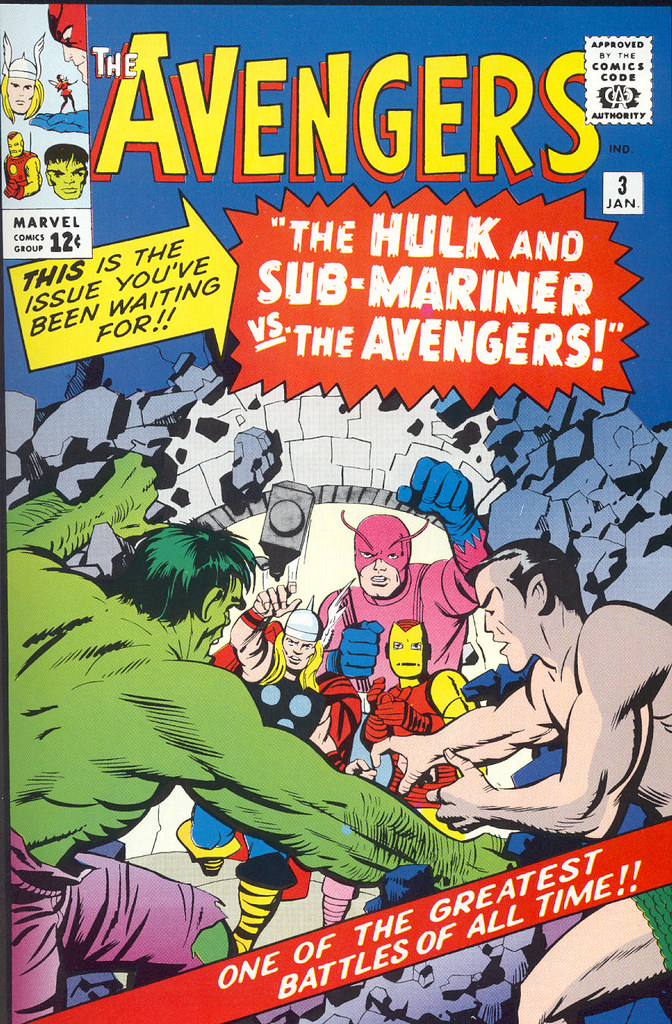
The Avengers Meet ... Sub-Mariner!


Avengers #3, January 1964.
(By Lee, Kirby, and Reinman)


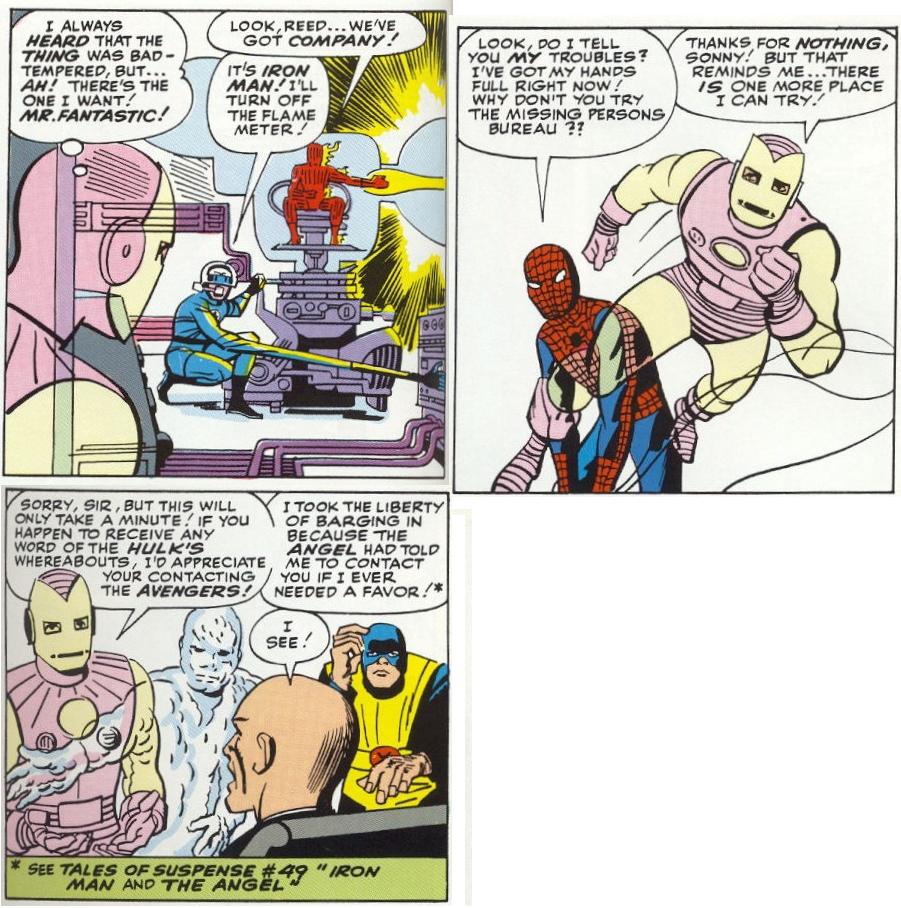
So, where were we? Ah yes, the Avengers, a team consisting of Iron Man, Thor, Ant-Man (now Giant Man), the Wasp, and the Hulk. Only, the Hulk's not much of a team player, so he's quit the team. Needless to say, the Avengers don't want to leave him wandering the deserts of the United States, so they're on his tracks. Cue a few gratuitous cameos:


Yes, the Marvel Universe has quickly become a unified body, in a way that DC rarely managed at that time. We've had cameos, guest appearances, but not yet a full-blown crossover. Watch this space.

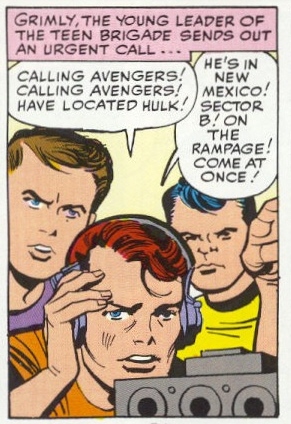
Anyhoo, fortunately, the Hulk's old pal, Rick Jones, has managed to track down the Green Goliath, and he can always be relied on to do the right thing.


Even if the right thing, in this case, is to nark out the guy who saved his life a few months ago. Cheers, Rick..!

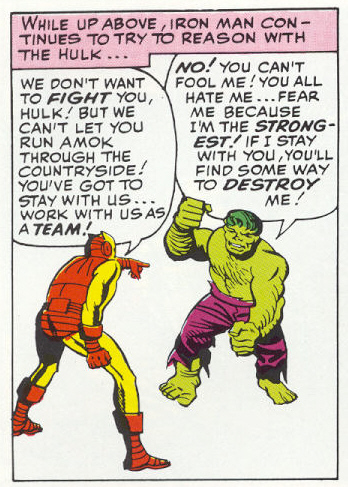
So, the Avengers show up to take down the Hulk, who's not so keen on a reunion with his former co-workers.


He's a shrewd one, that Hulk. He knows better than to trust Tony Stark as far as he can throw him, and history will vindicate that opinion. Naturally, conflict ensues, including an almighty broohaha aboard a speeding train.


Lucky for the Hulk, his cunning flour bomb catches pretty much the only Avenger who doesn't have any way of avoiding being blinded by the smoke screen - if only he had super-lungs or some other get-out.

And in case you were wondering, yes, the Hulk has not yet arrived at his "Hulk smash puny fish man!" persona.

And speaking of puny fish men...


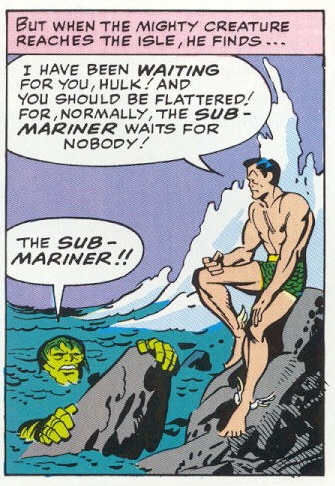
Namor has just (in Fantastic Four Annual #2) been thwarted in his plan to invade the surface world, and has been abandoned by his own people, to boot. And, like the Hulk, he's got a serious grudge against humanity.


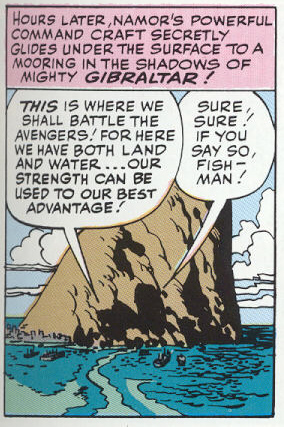
Yes, it's time for a Super-Villain Team-Up! Agreeing to work together to defeat the Avengers, the two rogues start out on stage one of their plan: the invasion of Gibraltar!

You heard me.


You see, Gibraltar has a network of caves under it, filled with military ordinance left over from WW2. Useful if a gang of superheroes turns up to arrest you, I suppose, although I'm surprised that Subby doesn't have any weapons lying around in that underwater kingdom of his.

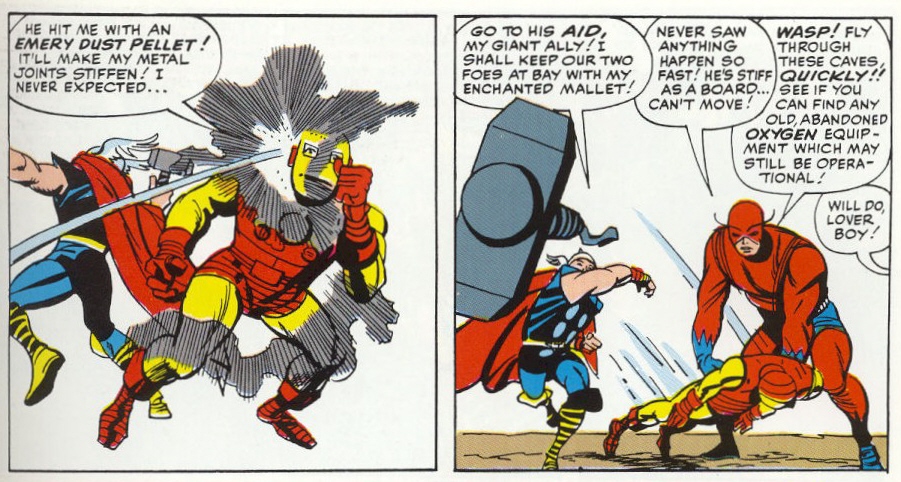
The Avengers waste no time in setting out to confront their foes, but the Sub-Mariner is well-prepped.


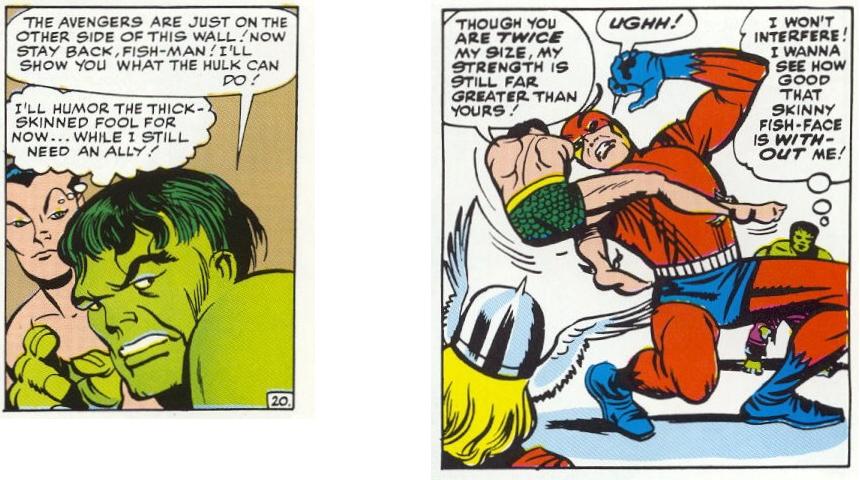
However, no amount of preparation can take the place of team-work, and that, tragically, is what Subby and the Hulk are missing:


Yes, apparently, the Hulk and the Sub-Mariner have been watching too much tag-team wrestling, and are unaware of the benefits of, say, both fighting at the same time.

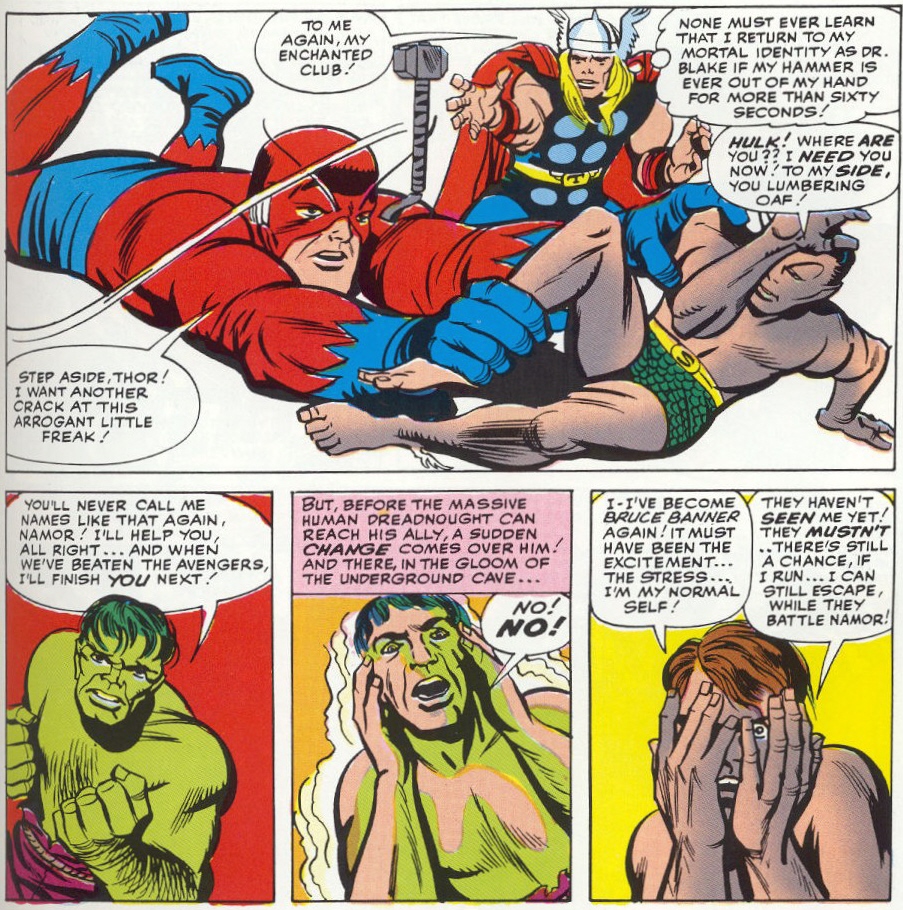
The result is fairly inevitable:


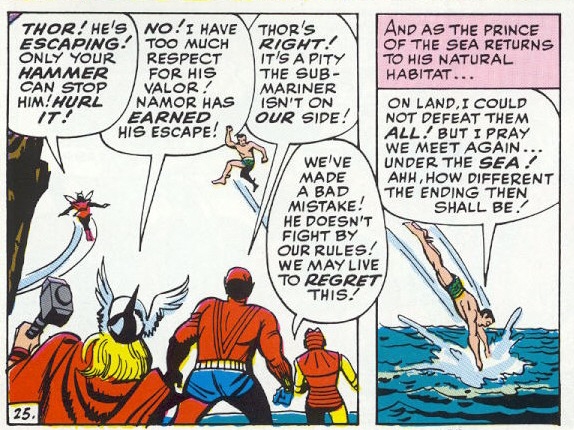
Bruce "Must shout out my secret identity!" Banner flees the scene, whilst Sub-Mariner decides that discretion is the better part of valour.


So, if you fight well, Thor will let you go free? That doesn't seem to be a very sensible attitude for the forces of law and order. I'm with Iron Man on this one.