Showing posts with label Hulk. Show all posts

Thursday, 19 November 2009

70 Years of Marvel - 2008


The department of the UK government which deals with supernatural and metahuman affairs, had been around since 1996, under one name or another, but in 2008, Paul Cornell used MI13 as the setting for the latest attempt at giving Captain Britain his own book again. Cornell had Cap heading up a team of superhumans, including the Black Knight, vampire-hunter Blade, and golden age heroine, Spitfire. One of the few books not to be directly tied to any of the major franchises, the title lasted just over a year, after which the good Captain and friends slipped back into limbo. We look forward to the next revival attempt, in a year or so.

Captain Britain & MI13 spun out of the events of Marvel's big event of 2008: Secret Invasion. This jolly romp showed the Skrulls, wiped out almost to a man a couple of years back by the Annihilation Event, still more than capable of infiltrating human society , kidnapping and replacing vital figures such as Hank Pym, Spider-Woman and Elektra, before launching a mass attack on New York, and presumably, London. Another classic from Bendis, this just seems to have been intended to tidy up the mess left after Civil War, whilst leaving things in more of a mess than before. But we'll get to that tomorrow.

Other new comics of 2008? Well, there were some. After being around for, depending on your opinion, 43 years 3000 years, Hercules finally got his own ongoing title, inheriting his book from the Hulk, who, turfed out of his book, immediately got a new one, restarting from issue #1. If you think that was confusing, you're right, and it'll take a finer man than me to explain it. Sorry.

Wednesday, 18 November 2009

70 Years of Marvel - 2007


One of the highlights of 2007 was this little gem, MODOK's 11, in which the Big Giant Head recruits a couple of fistfuls of followers, including second-stringers like Mentallo, the Armadillo, and the Chameleon, to commit the ultimate robbery. With the rest of the Marvel Universe getting increasingly grim and gritty, this was a nice lighthearted little romp, and got Fred Van Lente his first start in the Marvel Universe proper.

Other than this, most books in 2007 revolved around either the fallout from Civil War, the consequences of the Annihilation Event, or the Hulk's invasion of New York. The Spider-Books were being culled left, right, and centre, whilst Spidey himself was making a deal with the devil to save his Aunt May. Elsewhere, JMS was being recruited to revamp Thor, Captain America was getting shot, and Iron Man was being appointed Director of SHIELD. The world was getting weirder, that was for sure.

Monday, 16 November 2009

70 Years of Marvel - 2006


By 2006, "event comics were rampant at Marvel. We had, in no particular order:

X-Men: Deadly Genesis - in which Ed Brubaker finally answered the question of who Cyclops and Havok's mystery brother was, about a decade after anyone had last expressed an interest in finding this out. The third brother, Vulcan, believed dead, and erased from the memories of everyone who met him (by that good guy, Professor X), came back from the dead, kidnapped the X-Men, killed Banshee, then went off into space to conquer the Shi'ar Empire.

Civil War - in which Mark Millar spins a yarn in which the New Warriors accidentally blow up a school, and the superhero community is torn in half, with factions arguing for and against superhero registration led by Iron Man and Captain America respectively, Spider-Man reveals his secret identity to the world, and Hank Pym builds a clone of Thor.

Planet Hulk - in which Mr Fantastic, Iron Man, Black Bolt and Dr Strange decide to exile the Hulk into space, accidentally sending him to a planet of enslaving insects, whom he proceeds to conquer. Planet Hulk's writer, Greg Pak, would subsequently return the Hulk to Earth to kick some arse, but this was a far superior tale.

Annihilation - in which Annihilus and his Negative Zone pals try to conquer the "Positive" Universe. Used by Keith Giffen and others as a means to jumpstart Marvel's "cosmic" characters, who had been somewhat underused in recent years.

Additionally, 2006 saw the Black Panther marry the X-Men's Storm, Warren Ellis launch Nextwave, comedy misadventures of some b-list heroes, and Neil Gaiman relaunch the Eternals. In all, a busy year for Marvel's marketing department.

Friday, 6 November 2009

70 Years of Marvel - 1998


By 1998, Peter David had been writing the adventures of the Incredible Hulk for over a decade. In that time, the character had gradually evolved, from a character which no-one was really interested in, to one of the company's most complex books, with a main character whose motivations we could never really be sure of, and whose next move we'd rarely be able to guess. The book being a big success, Marvel editorial naturally wanted to tamper. Unfortunately, by 1998, Peter David was nearly as big a success as the Hulk, so when he was asked to alter his plans for the character, restoring the Dumb Savage Hulk who'd been so preeminent before his takeover, he walked off the book. It wouldn't be the last falling out PAD would have with Marvel Editorial, but it would be the biggest, with the Hulk wandering undirected for the next few years.

1998 also saw Marvel experiment again with outsourcing their work, this time to Event Comics, a little company run by an up-and-coming writer / artist called Joe Quesada. Rather than handing over their prime properties to Quesada and co, Marvel instead gave them free reign with some of their second-tier titles: Black Panther, Daredevil, the Inhumans, and the Punisher. The Marvel Knights books, as they were branded, were aimed at an older readership, 15 up, and, other than redefining the Punisher as a fallen angel, didn't miss a beat. In particular, Daredevil's fortunes took an upswing, transforming a character that no-one had known what to do with in years, into a grim and gritty street vigilante, under the authorship of first Kevin Smith, then Brian Michael Bendis. As with every successful idea in comics, the first idea of editorial is that more of what is successful, will automatically be more successful. Which is why pretty much every book this decade has been aimed at older readers. Comics aren't for kids, folks, not anymore.

Or maybe they are. After all, 1998 was also the year in which Spider-Girl gained her own title. Created as a one-off for an issue of What If?, May "Mayday" Parker is the daughter of Spidey and wife former bidey-in, Mary Jane (a daughter never born in the "real" Marvel Universe), and her adventures, provided by Tom DeFalco, have been ongoing ever since, despite numerous well-documented attempts to kill the title off. Let's hear it for the little book that could.

Elsewhere in 1998, Bill Clinton was denying having had relations with "that woman", whilst George Michael was admitting trying to have relations with "the man".

Monday, 2 November 2009

Oooh! Shiny!

The mid-90s saw the comic speculator boom reach its crescendo, as a whole bunch of stupid people decided that, because Amazing Fantasy #15 and Detective Comics #27 were worth a fortune, then all comics would eventually be worth a fortune. These stupid people went forth and bought a shedload of comics, which they then either bagged and tagged, to sell in the future once said comics had become valuable, or, hilariously, sold them to even more stupid people, who believed that because the comics were being bought in large numbers, they must be worth lots of money NOW. Before anyone could realise these spectacular profits, the bubble burst, the speculators went on to the next big thing (pogs, probably, or trading cards), and comic sales dropped like a stone, taking most of the comic shops with them. Before you laugh, bear in mind this sort of "logic" is pretty much exactly what caused the house-buying boom of the last few years, and you saw how well that turned out.

The rise and fall of the speculator market can be symbolised by looking at the use of foil covers in comic books. Bear with me.


In 1991, Silver Surfer #50 came out. This book featured a battle between Surfy and the reborn dark titan, Thanos, and was a prelude to the Infinity Gauntlet, a cosmic event which touched on most of the Marvel Universe (except the X-Books, which for some reason managed to dodge such things). Some bright spark at Marvel decided to celebrate this milestone issue, by issuing the book with a silver foil cover.

I imagine it did well, I recall friends being excited by the (really not done justice by scanners) cover. In any case, Marvel followed this up the very next month with a glow-in-the-dark cover on Ghost Rider #15.


Nice enough, I'm sure you'll agree, but, really, why the need for a gimmick cover? This issue did feature a confrontation between the 90s Ghost Rider and his 70s equivelent, but it was the concluding part of a three parter, and not even a particularly good three parter at that.

1992 saw Marvel issue a few more books promotional covers Most of them seem justifiable enough:
Amazing Spider-Man #365, Spider-Man #26 and Spectacular Spider-Man #189 all celebrated Spidey's 30th anniversary with neat little holographic panels.
Hulk #393 commemorated the Hulk's 30th anniversary and revisited his origins.
Guardians of the Galaxy #25 featured the 31st century heroes battling Galactus.
Spider-Man 2099 and Ravage 2099 introduced the world of tomorrow.
And, er, Silver Sable #1 celebrated the bounty hunting blondeshell getting her own book at last.


In 1993 , Marvel were churning out the gimmick covers, on, by my count, 44 comics. Some, such as the Avengers and the X-Men's 30th anniversary, were reasonable. Then there were such "essentials" as Namor #37, which celebrated Subby getting a new costume. Or Fantastic Four #371, in which the Human Torch accidentally set fire to Empire State University. Or Venom: Funeral Pyre, in which the world's most overrated supervillain takes on the Punisher (spoiler: nobody dies). By 1994, just about every comic had a gold, silver, platinum, 3D, die-cut, prismatic cover, or it felt like it. Every anniversary, no matter how trivial, every first issue, every "landmark" issue, had a pretty cover, and an inflated cover price to match. Sales were spiking all over the place, based not on how good the books were, but on the relative "buzz" generated by Excalibur #75 or Nova #1.


By 1995, the speculators were getting tired, and by 1996, most of them had vanished off in search of the nearest shop selling Magic: The Gathering cards. Other than a couple of Marvel 2099 books, the foil cover phenomenon vanished without trace virtually overnight.


It would be a good long while before Marvel would try another attempt at getting those speculator dollars, through the use of variant covers on books. A glance at the shelves of your nearest comic shop will show that Marvel doesn't really seemed to have learned any lessons from the 90s speculator boom, as just about every comic out at the moment is available with at least two covers. Disaster lies ahead...

Tuesday, 27 October 2009

11 of the Best: Cosmic Sagas

Since we're talking about cosmic comics, here's what I regard as the most unmissably unmissable space tales. Long-term readers of comics may find little to surprise them here...


The Coming Of Galactus, Fantastic Four, 1966 (Lee & Kirby)
Jack and Stan had already introduced us to the world beyond, with the introduction of the Skrull Empire in the early issues of FF, but this was the biggie. A god-like being turns up, heralded by a cosmic-powered sentinel, the Silver Surfer, and the Fantastic Four know this is bad news, because the sworn-never-to-interfere Watcher shows up to warn them. Marvel's first truly epic storyline.


The Kree-Skrull War, Avengers, 1971-72 (Roy Thomas, Sal Buscema, and Neil Adams)
Also introduced in the pages of the FF, the Kree were the great space power of the galaxy, with the Earth considered too remote to interest them. That changed when the Kree's centuries-old conflict with the Skrull Empire spread to the Earth's solar system. The Avengers were drawn, via their ally, Captain Mar-Vell, into the war, and fought to prevent the Earth itself being an innocent bystander of the battle.


The Thanos War, Strange Tales, Avengers and Marvel Two-In-One, 1977 (Jim Starlin)
The mad god, Thanos, had been lurking on the fringes of the Marvel Universe for a few years, and had even gotten hold of a Cosmic Cube once, but this was his big play for universal domination. Obsessed with death, Thanos had obtained the Infinity Gems, which he intended to use to destroy the universe. The Avengers, Captain Marvel, and Adam Warlock would stand against him, and one of them would not be walking away from this battle.


The Phoenix Saga, X-Men, 1977 (Chris Claremont, Dave Cockrum, and John Byrne)
This was the X-Men's first big space adventure, in which Professor X's latest floozy, Princess Lilandra, was kidnapped by her insane brother, the Shi'ar Emperor, D'ken, and the team went to rescue her. Notable for the first appearance of the Starjammers, and the first time Jean Grey was allowed to unleash the power of the Phoenix, this also saw the introduction of the Shi'ar as the other great star empire, one powerful enough to give even the Kree pause in their expansionism.


The Trial Of Galactus, Fantastic Four, 1983-84 (John Byrne)
After being saved from certain death by Mr Fantastic, Galactus finds the Skrull homeworld, and eats it. As well as incurring Reed Richards the displeasure of pretty much every sentient being in the universe, this throws out the balance of power in the galaxy, crippling the Skrull Empire, and setting the stage for...


Operation: Galactic Storm, various Avengers books, 1992 (Bob Harras, Steve Epting, Roy and Dann Thomas, Dave Ross, Mark Gruenwald, Rik Levins, Greg Capullo, Gerard Jones and Jeff Johnson)
In which the Kree and Shi'ar Empires go to war, with the Avengers stuck in the middle. Condemned at the time as a cheap attempt to cash in on Operation: Desert Storm (why, and how, anyone would "cash in" on a war is a bit of a puzzler, I have to say), O:GS is notable for the uncompromising attitude of some of the Avengers, an attitude for which the editorial staff have to be commended: no bottling the tough issues here. Of course, this uncompromising attitude is probably where the current "dickish" Iron Man comes from, so it's not all good...


The Troyjan War, Incredible Hulk, 1994 (Peter David and Gary Frank)
Maybe Peter David was hoping to create the next big alien race, or maybe he was just looking for a villain who could give the Hulk a run for his money. Either way, this wasn't the most successful launch, since the Troyjans haven't (to the best of my knowledge) showed up anywhere since the Hulk led his then-allies, the Pantheon, against the Troyjans and their warlord, Arm’chedon (Armageddon, get it?). However, there's a lot going on in this serial, with appearances by both the Silver Surfer and the Starjammers, not to mention a battle royal between the Hulk and the Troyjan's champion, Trauma. Great stuff.


Maximum Security, various titles, 2001 (Kurt Busiek and Jerry Ordway)
One of the wackier storylines of recent years, Maximum Security saw various alien governments, led by the Shi'ar, turn Earth into an impromtuo penal colony and exile their worst criminals there. The prisoners, regretably, include Ego, the Living Planet, who proceeds to try to take over the world. Bizarre, but great fun, which is all you can ask for in a comic, particularly a 21st century comic...


Fall And Rise Of The Shi'ar Empire, Uncanny X-Men, 2006-07 (Ed Brubaker, Billy Tan, and Clayton Henry)
In which Havok pursues his long-lost brother, Vulcan, into deep space, to try to stop him from taking his revenge on the Shi'ar for killing their mother. Another run which disrupts the balance of power in the galaxy, with Vulcan declaring himself Shi'ar emperor and threatening to cause chaos. Mind you, perhaps the Shi'ar can count themselves lucky; after all, they at least managed to avoid...


Annihilation, 2006-07 (Keith Giffen and Andrea Divito)
A dark power strikes in the galaxy, sparking an interstellar war, which sees the Skrull Empire crushed, the Kree severely weakened, and the Silver Surfer once again swearing loyalty to Galactus. Just about every one of Marvel's cosmic powers showed up in this maxi-series, a title which has done more to open up the expanded Marvel Universe than pretty much anything else in the past forty years.


War of Kings, 2009 (Dan Abnett, Andy Lanning, and Paul Pelletier)
Abnett and Lanning have been building on Annihilation for some time now. They used that title as an opportunity to bring Nova back in his own title. They wrote the sequel, Conquest, in which the Phalanx, a long-forgotten X-Men foe, conquer the Kree, and they used that story to launch their own version of the Guardians of the Galaxy, a book which has made a star of a talking raccoon. Finally, they had the Kree, now led by Black Bolt and the Inhumans, go to war with the Vulcan-led Shi'ar, bringing together pretty much all the cosmic events of the past few years. Since Marvel seem to have worked out that there's money to be made out of these cosmic events, expect Abnett and Lanning, and others, to continue mining this seam for some time to come.

(This post mostly recycled from an earlier post on my other blog.)

Tuesday, 20 October 2009

"Slay Your Enemies, And All You Desire Shall Be Yours!"

As mentioned yesterday, in 1985 (and indeed 1984) comic fans were getting all excited over Secret Wars. It was, while by no means the first mini-series published by Marvel, certainly the first one to have line-wide consequences. These days Marvel would call it an "event", publish a line of related titles, and you'd be sick of the thing before it was halfway finished. In the mid-80s though, Marvel just had many of their top heroes whisked away via a mysterious portal to another world, where they were forced to battle villains, with the promise of the ultimate prize for the winners. Jim Shooter took a year to tell the story of what had happened, but whilst these days, we'd face 12 months of comics featuring stand-in heroes in the missing characters' books, in those days, they simply showed the heroes returning the next month, and the radical changes which the as yet untold Secret Wars had wrought.

Spider-Man appeared with a new, black and white costume, which changed between civilian and super-duds depending on what was needed, and which never ran out of webbing. Later he'd discover that the costume was actually an alien symbiote, trying to take him over. Later still, the symbiote would be reborn as the villainous Venom, and later still, we'd all be sick of the sight of the black costume. But at the time, for all that it was just a change of look, we were quite excited by it.


The Incredible Hulk came back from Battleworld with a broken leg and a bad attitude. The broken leg was courtesy of a fight against Ultron, whilst the bad attitude came, at least in part, from the manipulations of old Dr Strange foe, Nightmare, out to get at the Sorcerer Supreme via one of his fellow former Defenders. Of course, a week of fighting the Absorbing Man and having mountains dropped on him probably didn't help the Hulk's disposition either.


The Vision, newly recovered from a near-death experience, took advantage of the disappearance of most of the Avengers to launch a bloodless coup. Naming himself chairman, he cosied up to the government and got them to approve setting up a new West Coast branch of the team. Had anyone realised that he was suffering from the android equivalent of brain damage after his time spent in a coma, he'd probably have encountered slightly more resistance.


Ben Grimm, in contrast to most of the heroes, quite enjoyed his time away from Earth. He discovered that he was able to turn back into his human form at will, and decided that, on the whole, he'd sooner spend his future riding around on pteradons than go home and be a monster again. So he chose to stay on Battleworld, leaving the Fantastic Four a man short.


The FF didn't waste time replacing the Thing, offering his place in the team to the first superstrong person they saw. In this case, the She-Hulk, who, although a member of the Avengers, was happy to cross the street to the Baxter Building. Later, the Human Torch would take advantage of the Thing's absence to shag his girlfriend. Classy. Secret Wars would also tease the readers of the FF with the mystery of how Doctor Doom, killed the previous year, could be alive on Battleworld. A somewhat convoluted explanation would eventually be given, accompanied by a somewhat gratuitous appearance by the Beyonder.


And the X-Men? Well, they stood around a hill in Japan talking a lot. Well, it was the 80s, and it was Chris Claremont, so perhaps we shouldn't have expected anything too revolutionary. In Claremont's defence, he did use Secret Wars to promote his agenda of Magneto as an extreme activist, rather than as an out-and-out supervillain, to break up Kitty Pryde and Colossus as a couple, and to justify Professor X deciding to take a more active role in leading the X-Men, but what we really remember is the constant talking...

Saturday, 17 October 2009

My First Comics

I may never know which Borders comics fan's mum decided to turf out his November and December-dated Marvel comics, but it was my good fortune that, rather than binning them, she instead donated them to one of the stalls at the Liberal Party's pre-Christmas Bazaar. At the event, where I was dragged by my mum and dad, not only did I get to meet the impressively-statured Cyril Smith, I was confronted with a selection of comics of which, until then, I was sadly unaware.


Alpha Flight #4 & #5 (both by John Byrne)
Alpha Flight #4 featured the tail end of a multi-parter in which the so-called Master of the World attempted to conquer the world, using Marrina the Fish-Girl. It also featured the Invisible Girl and Sub-Mariner, and introduced the idea of Aurora's multiple personality disorder. Issue #5 featured the dwarf, Puck, investigating a drug-smuggling ring based out of a hospital. For a comic featuring only one character I'd even heard of, Alpha Flight had me hooked from the start.


Fantastic Four #260 & #261 (both also by John Byrne)
FF #260 introduced me to the FF's nemesis, Doctor Doom (I may have been aware of him from things like the Spider-Man cartoons, but it would be a very vague awareness), and, before the end of the issue, had killed him off, in a battle between the Silver Surfer and Tyros. This was also the end of a multi-parter, but was also reasonably straightforward to fathom. Alpha Flight #4 was set immediately between #260 and #261, introducing me to the idea of crossovers between titles. #261 had the FF off in space, bumping into the Watcher, and had the team trying to justify not having let Galactus die in an earlier issue. This was a bit of a mystery, but by the end of the book, I pretty much understood what it was all about. The issue also featured a recap of the FF's origin, which was handy for newbies like me.


Amazing Spider-Man #246 & #247 (by Roger Stern and John Romita Jr)
ASM #246 was, essentially, an imaginary story, in which J. Jonah Jameson, Mary Jane Watson, the Black Cat, and Spidey himself daydreamed about their perfect day. Oddly, whilst Jameson and the Cat's dreams ended well, neither Mary Jane or Peter Parker were able to sustain their delusion, suggesting that both have some psychological issues to deal with. #247 featured Spidey teaming up with the fabulous Frog Man, a hunt for the Hobgoblin, and a mystery villain, Thunderball (of the Wrecking Crew). It would be years before I would find out who Thunderball is, and I have no idea to this day about Frog Man. The Hobgoblin was another story, of course.


Spectacular Spider-Man #84 (by Bill Manto and Dave Simons) and #85 (by Mantlo and Al Milgrom)
PPTSSM #84 featured Spidey hunting down a gang of child abductors, and was a purely self-contained story. #85, on the other hand, had the Hobgoblin show up to take on Spidey and the Black Cat. It also, handily, showed the story so far of the Hobgoblin, and featured Peter Parker having a get together with his old college friends, including Harry Osborn, which in turn introduced me to the history of the Green Goblin, which made Spider-Man's obsession with the Hobgoblin a lot more explicable.


Avengers #237 & #238 (both by Roger Stern and Al Milgrom)
Avengers #237 featured Spider-Man trying out for the team, an event alluded to in Spidey's own book, and had the Avengers fighting a whole load of supervillains in Project Pegasus. Looking back, I'm not sure why I accepted supervillains being imprisoned with their costumes on, but it's not something that gave me cause for concern at the time. Issue #238 had the Vision, in a coma due to an earlier battle, recover unexpectedly, showed the She-Hulk househunting, and featured a last-page appearance by Tigra and the ghost of Spider-Woman, the last of which confused the heck out of me.


Captain America #288 (by JM DeMatteis and Mike Zeck)
Set in the future world of 1993, this featured Cap teaming up with the cyborg, Deathlok, to take on the ruler of a destroyed New York. This was pretty much double-dutch to me at the time, and since I didn't have the next issue, it would be a long time before I'd find out how Cap stopped the imminent destruction of the world.

Daredevil #202 (by Dennis O'Neil and William Johnson)
This book had Matt Murdock's firm hired by an African tribe do do PR for their boss, Micah Synn. Micah turns out to be a nutjob, prone to dangling policemen out of windows. As a one-shot, it does a fine job of introducing DD and his significant others, and as an introduction to Micah Synn, it made me want to read more about him, which handily was what Denny O'Neil intended.


Defenders #125 (by JM DeMatteis and Don Perlin)
My first issue of Defenders featured the departure of the original team, the wedding of Patsy Walker and Daimon Hellstrom, and a new team being formed. it also featured an Elf. Much of this made little sense, but thankfully, there was a handy letters page which clarified some of what was going on.

The Thing #5 (by John Byrne and Ron Wilson)
This book had Ben Grimm getting beaten up, for no readily apparent reason, by Wonder Man, She-Hulk, and Spider-Man, before being possessed by his old foe, the Puppet Master. I didn't know at the time who the Puppet Master was, nor why he was out to get the Thing, so this was a less successful introduction to the book, but since the book was essentially an FF spin-off, it wasn't too much of a problem.


Incredible Hulk #289 (by Bill Mantlo and Sal Buscema)
The Hulk was intelligent at this point in his history, which seemed odd at the time, less so now. It had MODOK setting the Abomination to attack Bruce Banner, who was working for the government on gamma ray research - which with hindsight seems less logical than the Hulk's intelligence. Mostly the issue involved Hulk beating up the Abomination, which for a Hulk book is pretty much what you'd expect.

Marvel Team-Up #135 (by Bill Mantlo, again, and Ron Frenz)
This issue featured Kitty Pryde (note the lack of codename) rescuing some kidnapped children from the Morlock tunnels, with the help of Spider-Man. I didn't know who the Morlocks were at the time, and I'm not sure why they were kidnapping people, but it was a decent enough tale, at the time.


The Mighty Thor #337 (by Walt Simonson)
This was a flummoxer. Thor lost his powers, whilst an alien invader gets them. Nick Fury turns up, with little explanation of who he is and why he has a flying car and a helicarrier. And out in space, someone is forging something big. Now, having read the succeeding two years worth of issues, I know this is a classic, but at the time, it was not a good first issue. Not at all.

Uncanny X-Men #175 (by Chris Claremont, Paul Smith and John Romita Jr)
Speaking of confusing first issues, this issue features the wedding of Cyclops and Madelyne Pryor, the return of Dark Phoenix, and Mastermind looking for revenge against the team for what Phoenix had done to him. Confusing stuff, but with enough exposition (this was a Claremont book) to make it explicable.

So there you have it. My first 18 Marvel books. Some classics, and some, less than classic, but enough to get an 11 year-old me hooked on the things, if not for life, then at least for the forseeable future. To my bank manager's horror.

Tuesday, 13 October 2009

70 Years of Marvel - 1981


By 1981, Rom was firmly entrenched in the Marvel Universe, taking on such heavyweights as the Mad Thinker, Jack of Hearts, and, above, the Space Phantom. Rom, here to stop an invasion by the dreadful Dire Wraiths, would himself turn up as a guest star in pretty much every title at some point before his book was wound up, presumably as part of Marvel's plan to trim its booklist in preparation for the launch of the New Universe, of which we'll hear more later.

1981 also saw the debut of Elektra, ninja assassin and agent of the Kingpin, who would go on to become Daredevil's lover, before being killed and resurrected about a hundred times over the next 30 years. It also saw the demonic Gargoyle joining the Defenders. X-Man to be and daughter of Banshee, Theresa Cassidy, made her first appearance, battling Spider-Woman, whilst future Avenger, Firebird, turned up to fight the Hulk alongside the wild-west Rangers. And in the X-Men, Caliban turned up, heralding the first appearance of the Morlocks.

In the world beyond comics, 1981 saw the inauguration of Ronald Reagan as US President. The Space Shuttle Columbia took its first trip into space. Britain was entranced by the excitement of a Royal Wedding. And the Yorkshire Ripper went to jail. For ever, one hopes.

At the pictures, Indiana Jones was raiding the lost ark, whilst over in Britain, Vangelis was scoring Chariots of Fire. On tv, Dynasty was attempting to cash in on the Dallas phenomenon, and Only Fools And Horses, the most overrated show on tv, began its 900 year run.

Thursday, 8 October 2009

70 Years of Marvel - 1976


In 1976, the Defenders were the antidote to superhero comics. Steve Gerber had taken over the book a year or so back, and what had been just another team book rapidly became something else, with bodyswaps, self-help gurus, possessed deer, and the Hulk dressed as a clown. And all that , just in the issue above! These weren't your dad's comic books.

In the same year, Captain Britain was making his debut, in the pages of his own Marvel UK title. Richard Ryder was gaining the power of Nova. The Shroud was turning up for the first time, in the pages of Super-Villain Team-Up. In the X-Men, Jean Grey was transforming into the Phoenix. Third-string super hero, Jack of Hearts, was appearing in the pages of Deadly Hands of Kung Fu. And, with Kirby back at Marvel, he was taking over the reigns at Captain America, adapting the 2001: A Space Odyssey movie, as well as launching a new team of god-like beings, the Eternals.

In the real world, 1976 saw Jim Callaghan become British PM, Jimmy Carter become American President, and Chairman Mao dead.

On television, children were watching Rentaghost and Multi-Coloured Swap Shop, whilst the grown-ups were watching Reginald Perrin and I, Claudius. Sylvester Stallone was making a name for himself as Rocky Balboa. And vampire literature got a boost, with the publication of Interview With The Vampire, introducing the "vampire rock star" subgenre of horror fiction.

Monday, 5 October 2009

70 Years of Marvel - 1974


1974 saw Jim Starlin at the height of his cosmic powers, as writer of the Captain Marvel comic books, in which Mar-Vell was taking on the evil titan, Thanos, who would haunt most of Starlin's Marvel work for the rest of the century.

Other comics-related events included the first appearance of The Punisher, Gerry Conway's assassin to the stars, hired to kill Spider-Man, and at this point, lacking any sort of defined origin. We also so the debut of Iron Fist, Marvel's attempt to combine the superhero and martial artist genres, as well as Doug Moench and Rich Buckler's cyborg sensation, Deathlok. 1974 also saw the Marvel Universe being brought a little bit closer, as ex-Avenger, Quicksilver, married ex-Fantastic Four member and full-time Inhuman, Crystal. Oh, and I suppose it would be a sin not to mention that Incredible Hulk #180 and #181 saw the debut of everyone's favourite shortarse Canadian.

In the real world in 1974, Tricky Dicky finally gave in and resigned. Fortunately, his immediate successor pardoned him for any crimes which he may have committed. It's a good life, eh?

Friday, 2 October 2009

70 Years of Marvel - 1971


1971 saw the start of one of Marvel's most famous sagas, the cosmos-spanning Kree-Skrull War, in which the Avengers - aided by the Kree exile, Captain Marvel, learned of a centuries-long conflict between the two most prominent alien races in the Marvel Universe, and, in their efforts to avoid Earth being devastated by the war, found themselves being drawn deeply into it. On the way, Roy Thomas got to bring back (albeit briefly) a number of golden age heroes:


Clockwise, from Captain America, we have the Fin, the Human Torch, the Angel, the Blazing Skull, perpetual sidekick Rick Jones, the Patriot, the original Vision, and of course the Sub-Mariner, all serving as a reminder of the glorious (by this time 32 year) history of the Marvel Universe.

Elsewhere in comics, 1971 saw the introduction of super-psychiatriast, Doc Samson, who would spend the next few years hunting the Hulk. It would also see Spider-Man briefly transformed into a literal man-spider, and the debut of the not-quite-a-vampire, Morbius and the not-quite-Swamp-Thing, Man-Thing, as Marvel chanced their arm to see what the Comics Code Authority would allow. But possibly most earth-shattering of all, 1971 saw the arrival of the world's greatest non-team, the Defenders, as the Hulk teamed up with the Sub-Mariner and Dr Strange to face Yandroth's greatest challenge: the Omegatron! Ooh, scary!

In the real 1971, Britain dropped the old pounds-shilling-pence system, in favour of something which people could actually understand. The World Trade Center, then the tallest building in the world, was completed. The UK government launched Operation Demetrius, interring people suspected of being members of the IRA. And DB Cooper became a legend.

Entertainment-wise, one could pick from buying Led Zeppelin IV, reading The Day of the Jackal, watching The Two Ronnies on the telly, or, if one was quick, catch A Clockwork Orange at the pictures.

Thursday, 1 October 2009

70 Years of Marvel - 1970


By 1970, Roy Thomas was challenging Stan Lee as Marvel's pre-eminent writer of books. The nostalgia king was writing the Avengers, Daredevil, Hulk, and of course, Sub-Mariner. While a lesser man might have been threatened by this hot new talent, Stan was quite happy to hand over the reigns, as long as he got a mention in the credits...


Bravo. Anyway, elsewhere in 1970, Sunfire was becoming Japan's first costumed hero, the Valkyrie was becoming Asgard's second cosmic hero, and the X-Men were limping towards cancelation.

In the real world, Ted Heath was becoming British PM, Janis Joplin and Jimi Hendrix were taking too many drugs, and the Baader-Meinhoff Gang were making a name for themselves in West Germany.

At the pictures, childrens' classic, The Railway Children was out, whilst the Goodies were livening up British tv. Simon and Garfunkel were going their separate ways, and Black Sabbath were releasing their debut album. Rock on!

Sunday, 27 September 2009

70 Years of Marvel - 1966


By 1966, everyone who was everyone in the Marvel Universe had their own title. Even headliners of previously-cancelled books, like the Hulk, or remnants of the golden age, like Namor, were being given the chance to co-pilot a book - in this case, Tales to Astonish, which had starred Ant-Man, until Stan saw sense and put a couple of remotely ineresting characters into the book instead.

1966 would also see the first appearance of the Silver Surfer, herald to Galactus, and of the Mimic, another sometime hero / occasional villain. The Black Panther battled the Fantastic Four in his hidden kingdom of Wakanda.

Outside of comics, Rhodesia was becoming independent of British rule, after a fashion. Nigeria was in the midst of civil war. Oh, and England won the World Cup. Guess which one of these three events is constantly harped on about by the British press, and which ones have been quietly forgotten.

On the small screek, American geekdom was born with the birth of Star Trek, while superhero fans could watch the not-yet-a-cult-classic Batman show. Meanwhile, the world of children's movies was impoverished, with the death of Walt Disney; the Disney empire would, however, continue to grow.

Thursday, 1 January 2009

The Trail Of The Hulk


So, as of October 1964, the Hulk was back headlining a book, albeit as a jobshare with Giant Man. But where has he been, in the 19 months since his own title was cancelled?

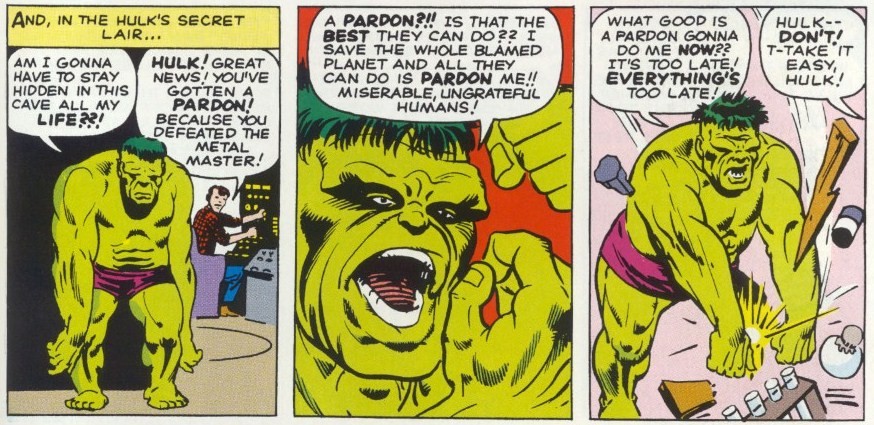
Pretty much everwhere, that's where. Don't believe me? Well, let's see. Having defeated the Metal Master (in Incredible Hulk #6), the Hulk had some good news:


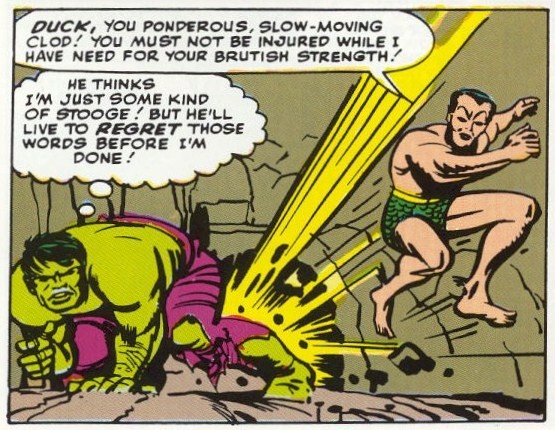
The great green ungrateful sod promptly vanished for a while, before Loki decided to use him in his latest scheme to destroy Thor (a story we've covered already), a scheme which results in the Hulk teaming up with the heroes he was supposed to be fighting.


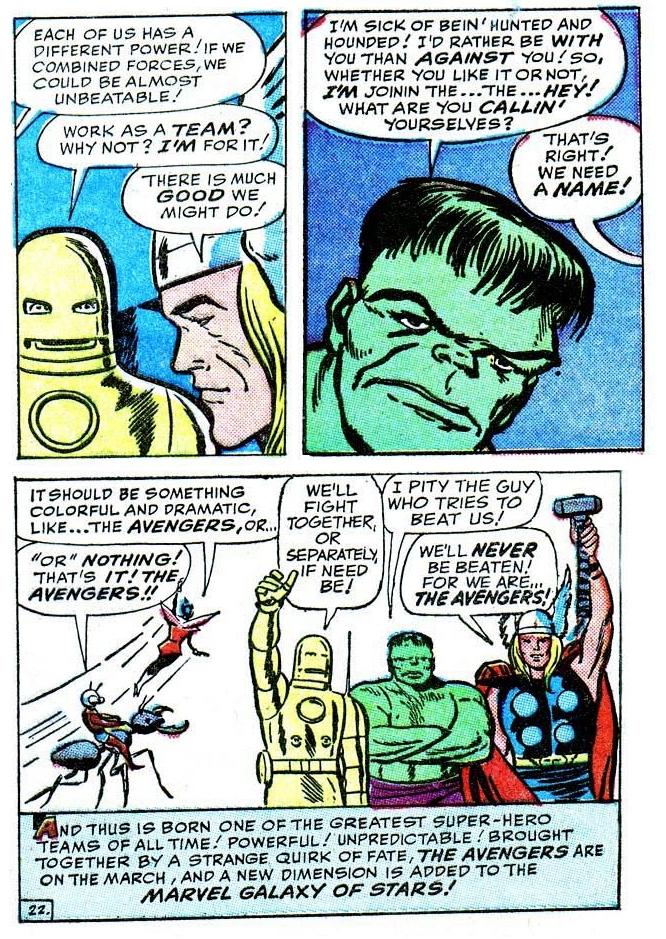
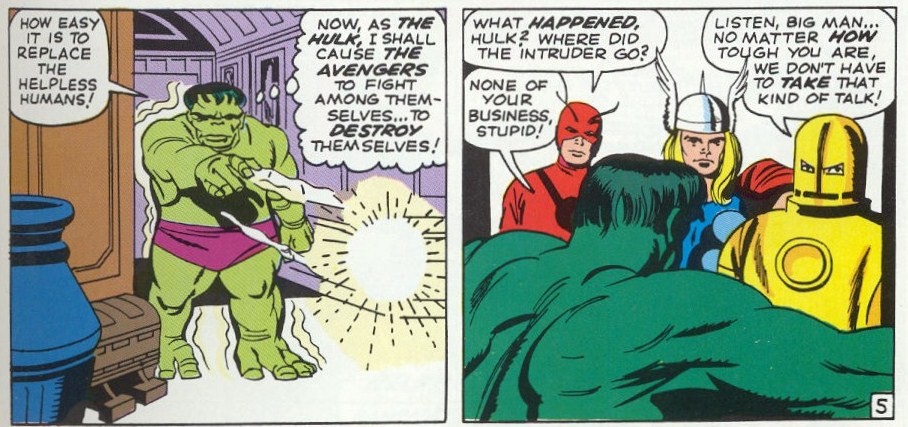
He doesn't hang round long, though, as the Space Phantom sets the Avengers against each other.


Having stomped off, the Hulk, or at least his alter-ego, shows up long enough to make a non-appearance in Tales of Suspense #49:


Hunted by his ex-pals, the Hulk continues to hang around New Mexico, where, as already detailed, he fights the Avengers, teams up with the Sub-Mariner, and invades Gibraltar.


Hopping back to New Mexico, and his trusty underground cave, he Hulk takes a snit because the Avengers have replaced him with Captain America, and promptly (in FF #25) starts trashing New York. This brings him to the attention of the Fantastic Four, particularly the Thing:


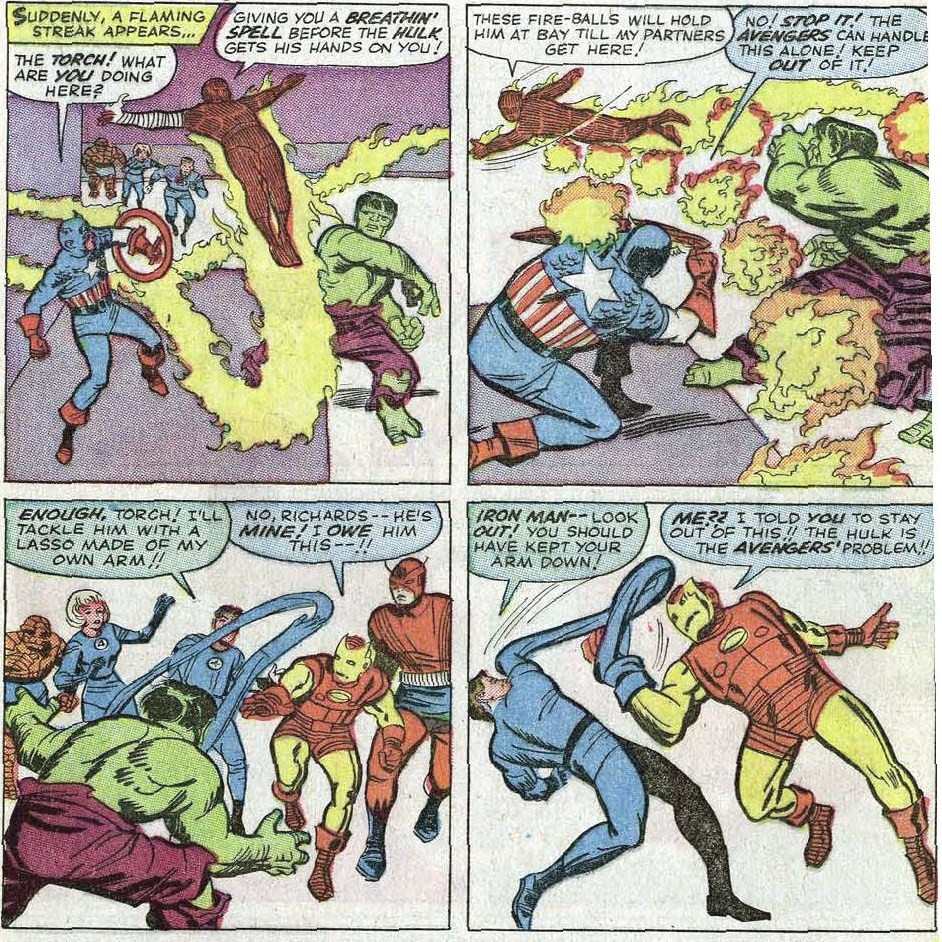
And then the Avengers show up to take down the Hulk. Cue one of the less successful super-team team-ups:


After an epic battle (which takes two issues to resolve, compared to the seven issue mini-series and seven or eight tie-ins it would take these days), the Hulk escapes from his foes, and heads back to New Mexico, back to the welcoming arms of his significant others:


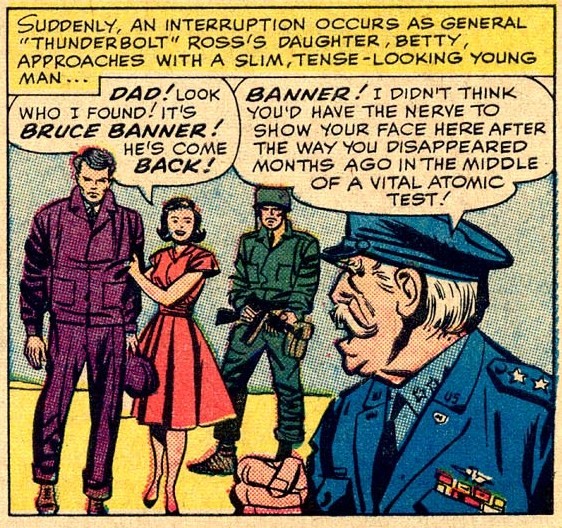
Banner and the Rosses put in a guest appearance in Avengers #5, in which the Hulk fights his old pals once again, and inadvertantly helps them defeat the invasion of the Lava Men.


The Hulk next shows up in the pages of Amazing Spider-Man #14, as an surprise guest star - well, it's a surprise to Spidey anyway, even if the appearance is showcased on the cover.


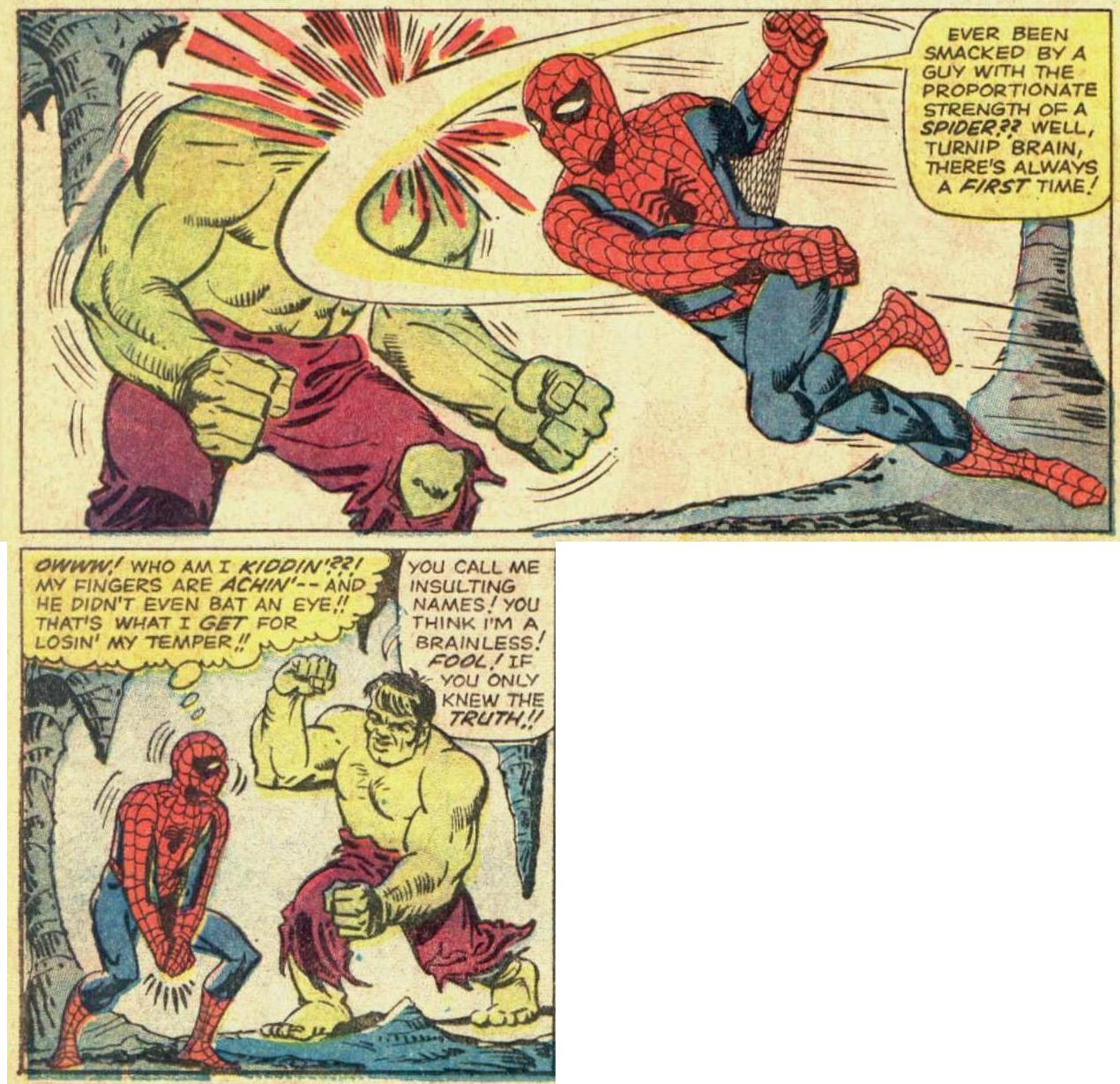
Spidey soon shows him who's boss.


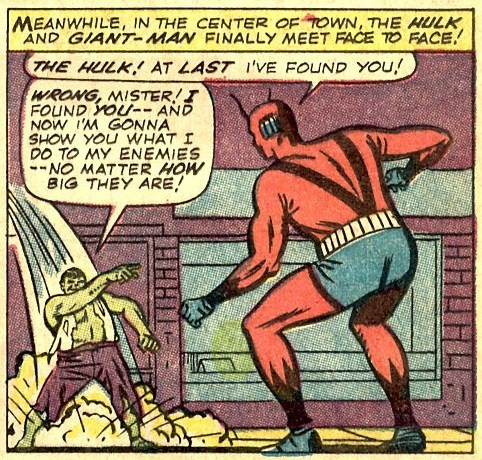
Or not. Somehow the Hulk manages to avoid killing Spider-Man and vanishes again. But his fight makes the papers, which draws the attention of his old team-mate, Giant Man, who decides to track him down, in Tales to Astonish #59:


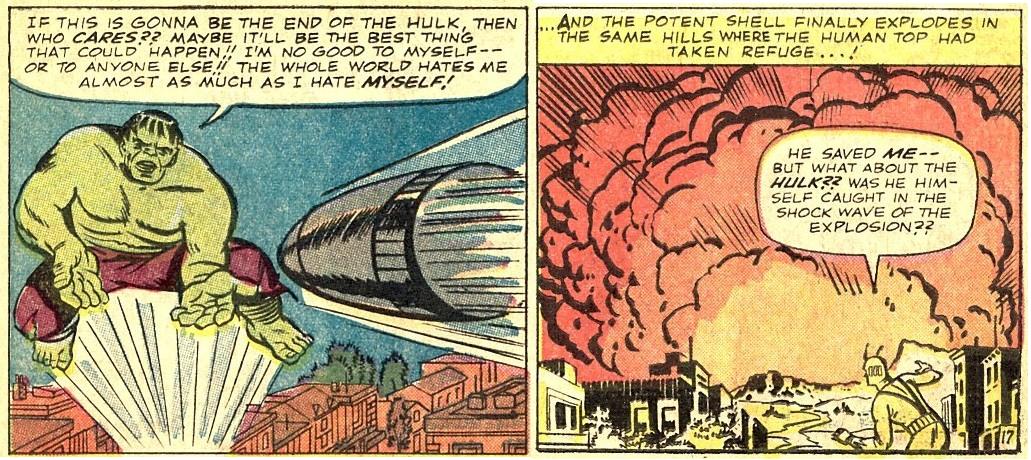
Taking advantage of the battle, General Ross decides to polish off the Hulk once and for all - with an atomic missile. No, really.


No surprises, he survives, and as a reward, he gets his own comic, courtesy (for the moment, anyway) of Lee and Ditko. And we were poised for purple-trousered action..!